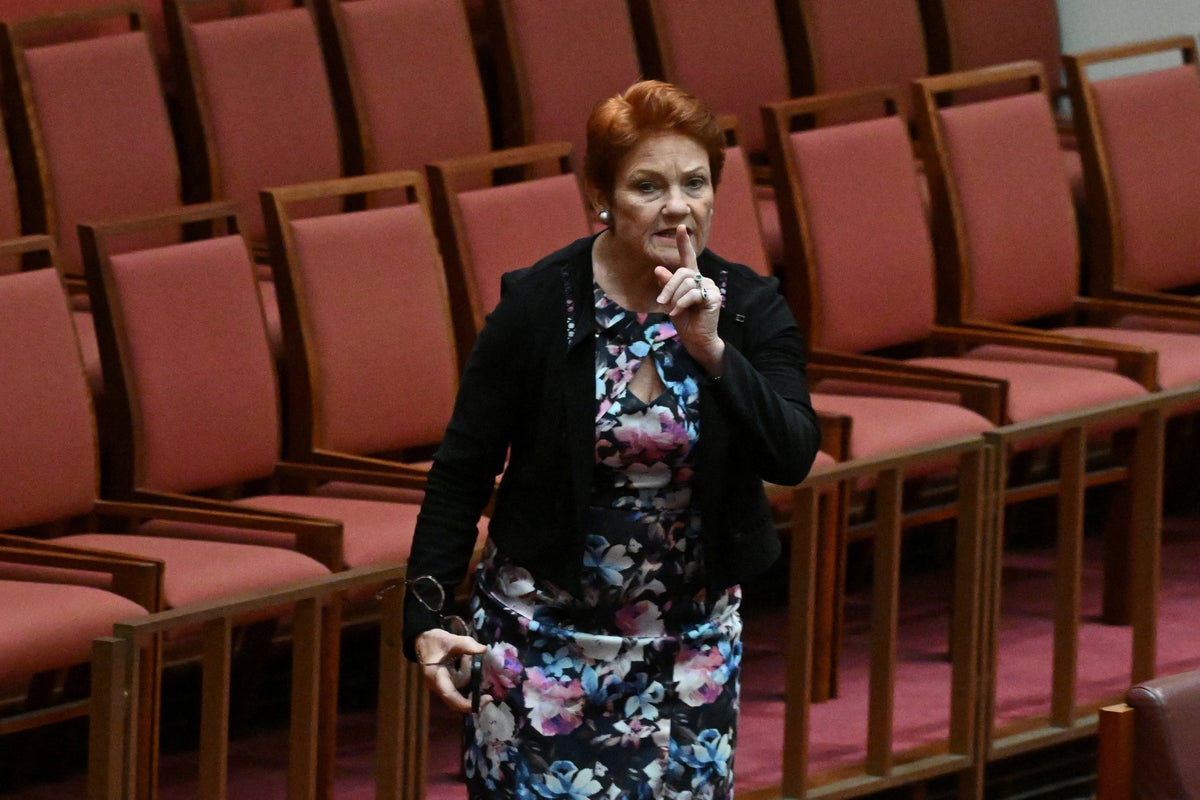
The Australian Senate has long prided itself on being a "house of review," a place where the hot-headed impulses of the lower house go to be tempered by sober deliberation. That veneer of Victorian-era civility shattered completely when Senator Fraser Anning walked out of the chamber, fleeing a formal censure motion triggered by his response to the Christchurch mosque massacre. While the headlines focused on the spectacle of the walkout, the real story lies in the deliberate erosion of parliamentary norms as a political survival strategy. Anning did not leave because he was offended; he left because the theater of victimhood is the only currency left for a politician with no party, no base, and no path to re-election.
The censure motion, a rare and stinging formal rebuke, passed with near-unanimous support from both the government and the opposition. It was a direct response to Anning’s public assertion that the slaughter of 51 worshippers in New Zealand was the result of "the immigration program which allowed Muslim fanatics to migrate to New Zealand in the first place." By shifting the blame from the gunman to the victims, Anning crossed a line that even the most hardened Canberra veterans found impossible to ignore. But to view this as a simple case of a politician losing his filter is to misunderstand the mechanics of modern populism.
The Mechanics of the Strategic Outcast
Fraser Anning’s presence in the Senate was a mathematical fluke. He entered the chamber on the back of just 19 primary votes, a beneficiary of the complex "above-the-line" voting system and the disqualification of One Nation’s Malcolm Roberts during the dual-citizenship crisis. He was a man without a mandate, representing a constituency that largely didn't know he existed until he started talking about "the final solution" to immigration in his maiden speech.
For a politician in this position, traditional lawmaking is a dead end. He cannot pass bills. He cannot negotiate in committees. His only path to relevance is through the deliberate provocation of the "political class." The censure motion provided him with the perfect stage. By walking out, he signaled to his digital followers that he was the only man brave enough to speak "truths" that the "elites" were too scared to hear.
This is the insurgent’s playbook. When the institution tries to enforce its rules, the insurgent frames those rules as a form of censorship. The walkout wasn't a retreat; it was a content-generation exercise for social media.
The Christchurch Catalyst and the Death of Nuance
The Christchurch attacks changed the gravity of political speech in Australia. Before March 2019, the Australian Senate had a relatively high tolerance for "tough on borders" rhetoric. Border protection is a staple of Australian elections, often used as a wedge issue by both major parties. However, Anning’s attempt to link the tragedy to the very presence of the victims in a Western country stripped away the plausible deniability that usually coats such rhetoric.
The Senate’s reaction was an attempt to cauterize a wound. The censure motion stated that Anning’s comments were "inflammatory and divisive" and "sought to attribute blame to victims of a horrific crime."
The Censure as a Blunt Instrument
In the Australian parliamentary system, a censure motion carries no legal weight. It does not remove a senator from office, nor does it strip them of their salary or voting rights. It is a reputational black mark, a formal statement of "we do not stand with you."
- Symbolic Weight: It serves as a historical record of the chamber's collective disgust.
- Political Isolation: It signals to donors and potential coalition partners that the individual is toxic.
- Voter Guidance: It provides a clear signal to the electorate ahead of the next polling cycle.
The irony is that for Anning, this isolation was the goal. The more the Senate condemned him, the more he could claim to be the victim of a "witch hunt." He leaned into the role of the pariah because, in the ecosystem of the far-right, a pariah is a hero.
The Financial and Legal Quagmire
Behind the scenes of the political firestorm, Anning was facing a much more grounded reality: bankruptcy proceedings and legal challenges. Investigative looks into his finances showed a man under immense pressure from creditors, specifically relating to a failed agribusiness venture.
This is a recurring theme in the lives of many fringe political figures. When the walls of reality—debts, court dates, and administrative failures—start closing in, the rhetoric usually gets louder. Ideological warfare serves as a convenient distraction from mundane incompetence. If you are being sued by a bank, it is much more heroic to tell your followers you are being persecuted for your "patriotism."
The walkout also served to obscure the fact that Anning had become a nomad within the building. After defecting from One Nation to Katter’s Australian Party, he was eventually kicked out of the latter for his views being "too extreme" even for Bob Katter. He was a party of one, sitting on the furthest fringes of the crossbench, literally and figuratively distanced from the levers of power.
The Egg Boy Incident and the Viral Loop
No analysis of this period is complete without mentioning the "Egg Boy" incident in Melbourne. When teenager Will Connolly cracked an egg on the back of Anning’s head during a media doorstop, the resulting footage went global. Anning’s immediate physical retaliation—swinging punches at a minor—further cemented his image as a man governed by impulse rather than intellect.
However, the incident also highlighted the dangerous feedback loop between fringe politics and digital fame. For every person who cheered the egg-throwing, Anning’s base saw a physical assault on a democratically elected representative. It hardened the battle lines. The middle ground in Australian politics, usually a vast and quiet space, was suddenly a no-man’s land.
The Limits of Parliamentary Privilege
Anning frequently used parliamentary privilege to say things that would otherwise lead to civil litigation. This legal protection allows members of Parliament to speak freely in the chamber without fear of being sued for defamation.
But privilege is a double-edged sword. While it protected his "final solution" speech, it did nothing to protect his reputation among his peers. The Senate has a long memory. By using the chamber as a soapbox for rhetoric that many felt incited violence, Anning effectively ended any chance of being taken seriously on policy matters like tax or infrastructure. He became a ghost in the machine, a representative who no longer represented the dignity of the office.
The Erosion of the Center
The real casualty of the Anning era wasn't the Senator's reputation—which was non-existent to begin with—but the stability of the political center. The major parties, the Liberals and Labor, were forced to spend weeks debating how to handle him.
This is the hidden cost of the fringe. They steal the oxygen. While the country faced pressing issues regarding climate policy and economic cooling, the national conversation was held hostage by a man who had 19 votes and an appetite for chaos. The "why" behind his actions is simple: in a crowded media market, outrage is the most efficient way to get noticed.
Anning’s walkout was his final act of defiance against a system he never truly belonged to. He was a product of a voting quirk and a symptom of a global trend toward polarization. When he eventually lost his seat in the 2019 election, he left behind a Senate that was more guarded and a political culture that had been forced to redefine where "the line" actually was.
The Senate floor is now quieter, but the tactics Anning pioneered—the walkout, the victimhood narrative, and the use of the chamber for social media clips—have been adopted by others. The theater hasn't closed; only the lead actor has changed.
If you want to understand the future of the Australian Senate, stop looking at the legislation and start looking at the exits. The most impactful moments are no longer the speeches that keep people in the room, but the performances that happen as they are leaving it.