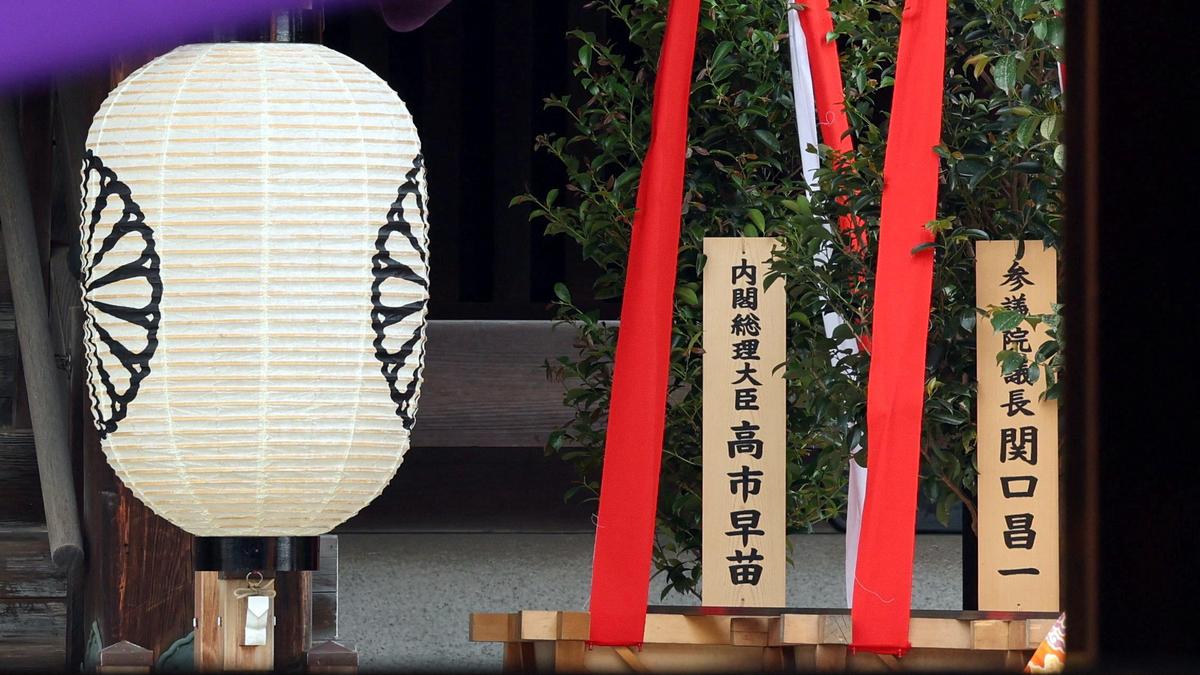
Every spring and autumn, a predictable but corrosive ritual unfolds in Tokyo that sets the geopolitical temperature of East Asia to a boil. When Japanese Prime Minister Fumio Kishida or his cabinet members send ritual offerings to the Yasukuni Shrine, it is never merely a religious act. To Beijing and Seoul, these offerings represent a calculated endorsement of a past that the rest of Asia is not permitted to forget. This is not a simple dispute over history. It is a modern diplomatic weapon used by both sides to signal domestic strength and regional dominance.
The Yasukuni Shrine honors 2.46 million war dead, but the friction stems from the 1978 secret enshrinement of 14 Class-A war criminals. These individuals were the architects of Japan’s brutal expansionism during the early 20th century. When a sitting Japanese leader acknowledges this site, they are not just mourning the fallen; they are, in the eyes of China, rehabilitating the very men who oversaw the occupation of Nanking and the enslavement of "comfort women."
The Mechanism of Intentional Friction
Diplomacy usually operates on the principle of de-escalation, yet the Yasukuni visits function as a periodic pressure test. The Japanese leadership views these acts as a matter of national sovereignty and a duty to the souls of those who died for the state. They argue that other nations have no right to dictate how Japan honors its ancestors. However, this stance ignores the strategic reality of the region.
China uses these incidents to reinforce a narrative of "eternal victimhood" and "Japanese unrepentance." This narrative is a powerful tool for the Chinese Communist Party. It helps consolidate national identity against an external antagonist. Whenever domestic economic pressures mount in China, a well-timed protest against Japanese "historical revisionism" serves as an effective distraction. It is a symbiotic cycle of provocation and outrage that serves the hardliners in both Tokyo and Beijing.
Beyond the Ritual Offerings
The recent offerings sent by Kishida are part of a broader trend of Japan’s "normalization" of its military posture. For decades, Article 9 of the Japanese Constitution—the "peace clause"—restricted the nation to a strictly defensive force. That era is ending. Japan is currently undergoing its most significant military buildup since World War II. It is doubling its defense budget and acquiring counter-strike capabilities.
Against this backdrop, Yasukuni is no longer just about the 1940s. It is about the 2030s. China interprets any sign of Japanese nationalism as a precursor to a return to the militarism that devastated the continent. By sending a masakaki tree offering, a Prime Minister signals to his conservative base that Japan will no longer apologize for its existence or its heritage. This resonates with a Japanese public that is increasingly wary of China’s maritime expansion in the East China Sea.
The Class A Problem
The core of the resentment lies in the 14 men convicted by the International Military Tribunal for the Far East. Names like Hideki Tojo are synonymous with the darkest chapters of human history. When these names were added to the shrine’s rolls in 1978, even the Emperor of Japan stopped visiting. The late Emperor Hirohito reportedly expressed deep displeasure at the inclusion of the war criminals, and his successor, Emperor Emeritus Akihito, never set foot in the shrine during his reign.
This internal Japanese division proves that the issue is not just "China being difficult." There is a legitimate, domestic debate within Japan about whether Yasukuni is the appropriate place for state-sponsored mourning. Critics within Japan argue that the shrine promotes a "Yushukan" version of history—referring to the museum on the shrine grounds—which portrays Japan as a liberator of Asia rather than an aggressor.
Economic Interdependence vs. Historical Memory
One might think that the massive trade volume between Japan and China would force a permanent truce on historical issues. It hasn't. The "cold politics, hot economics" model has defined the relationship for twenty years. Japan is one of China's largest foreign investors, and China is Japan's largest trading partner. Yet, this economic tethering has not softened the rhetoric.
Instead, we see "history wars" being fought through trade restrictions and consumer boycotts. When tensions flare over Yasukuni or the Senkaku Islands, Japanese businesses in China often face sudden "regulatory hurdles" or grassroots protests. This volatility makes Japanese boardrooms nervous, leading to the "China Plus One" strategy, where companies diversify their manufacturing bases into Southeast Asia or India to mitigate the risk of a sudden diplomatic rupture.
The Role of the United States
Washington finds itself in a perennial bind regarding Yasukuni. On one hand, the U.S. needs a strong, rearmed Japan to act as a bulwark against Chinese influence in the Pacific. On the other hand, the U.S. needs Japan and South Korea to cooperate. Historical grievances centered on Yasukuni and the colonial era frequently derail trilateral cooperation.
When a Japanese leader visits the shrine, it alienates Seoul just as much as it angers Beijing. The U.S. State Department often issues carefully worded statements of "disappointment" when visits occur, because they know that every step toward the shrine is a step away from a unified front against North Korea or China. The shrine is, in effect, a wedge that Beijing drives between the U.S. and its closest Asian allies.
The Education Gap
The conflict is exacerbated by how history is taught. In Japanese schools, the details of the war are often glossed over in textbooks, treated as a series of unfortunate events rather than a deliberate campaign of conquest. In China, the "War of Resistance Against Japanese Aggression" is the cornerstone of the national curriculum. You have two populations with fundamentally different understandings of the same timeline.
This creates a generational divide. Younger Japanese see the constant demands for apologies as an endless shakedown. They feel no personal responsibility for the actions of their great-grandparents. Meanwhile, younger Chinese are raised on a diet of patriotic education that frames Japan as a latent threat. When a news report breaks about a Japanese politician visiting Yasukuni, it feeds directly into these pre-existing biases, making any middle ground nearly impossible to reach.
The Legal and Religious Shield
The Japanese government often hides behind the separation of church and state to justify why they cannot interfere with the shrine's management or the enshrinement of war criminals. Because Yasukuni is a private religious corporation, the government claims it has no legal authority to demand the removal of the Class-A criminals.
This argument is technically true under the post-war constitution, but it rings hollow to international observers. The government manages to find ways to influence religious entities when it suits their political agenda. The refusal to exert pressure on the shrine's leadership is a political choice, not a legal necessity. It is a choice designed to avoid a backlash from the powerful nationalist lobbies that provide the backbone of the Liberal Democratic Party's support.
The Weaponization of Honor
We must look at the timing of these visits and offerings. They almost always coincide with the spring and autumn festivals or the August 15 anniversary of the war's end. These are high-visibility moments. If a leader wanted to pray for the dead privately and without controversy, they could do so at the Chidorigafuchi National Cemetery, a secular site that holds the remains of unidentified soldiers.
The choice of Yasukuni over Chidorigafuchi is intentional. It is a statement of identity. It says that Japan will define its own past on its own terms, regardless of the "victor's justice" imposed in 1945. For the analyst, the "why" is clear: the shrine is the last remaining monument to an era of Japanese exceptionalism that many in the current leadership wish to reclaim, at least in spirit.
Structural Deadlock
There is no easy exit from this cycle. China will not stop using the shrine as a litmus test for Japanese sincerity. Japan will not stop using the shrine as a symbol of national pride and sovereignty. Every "offering" is a move on a chessboard where the players are not looking for a checkmate, but for a way to keep the game going to their advantage.
The real danger is that this performance of grievance could spiral. In an era of heightened military readiness in the Taiwan Strait and the South China Sea, a symbolic dispute over a shrine could provide the spark for a much more tangible confrontation. When history is used as a shield for current policy, the facts of the past become less important than the utility of the present conflict.
Japan’s shift toward a more assertive regional role requires the trust of its neighbors. That trust cannot be built as long as the ghosts of 1945 are invited into the halls of modern power. The offerings sent to Yasukuni are not just flowers and trees; they are the fuel for a fire that the region can no longer afford to stoke.
Stop treating these visits as isolated incidents of cultural misunderstanding. They are the frontline of a psychological war for the future of Asia. If Japan wants to be a true regional leader, it must eventually choose between the symbols of its imperial past and the stability of its democratic future.