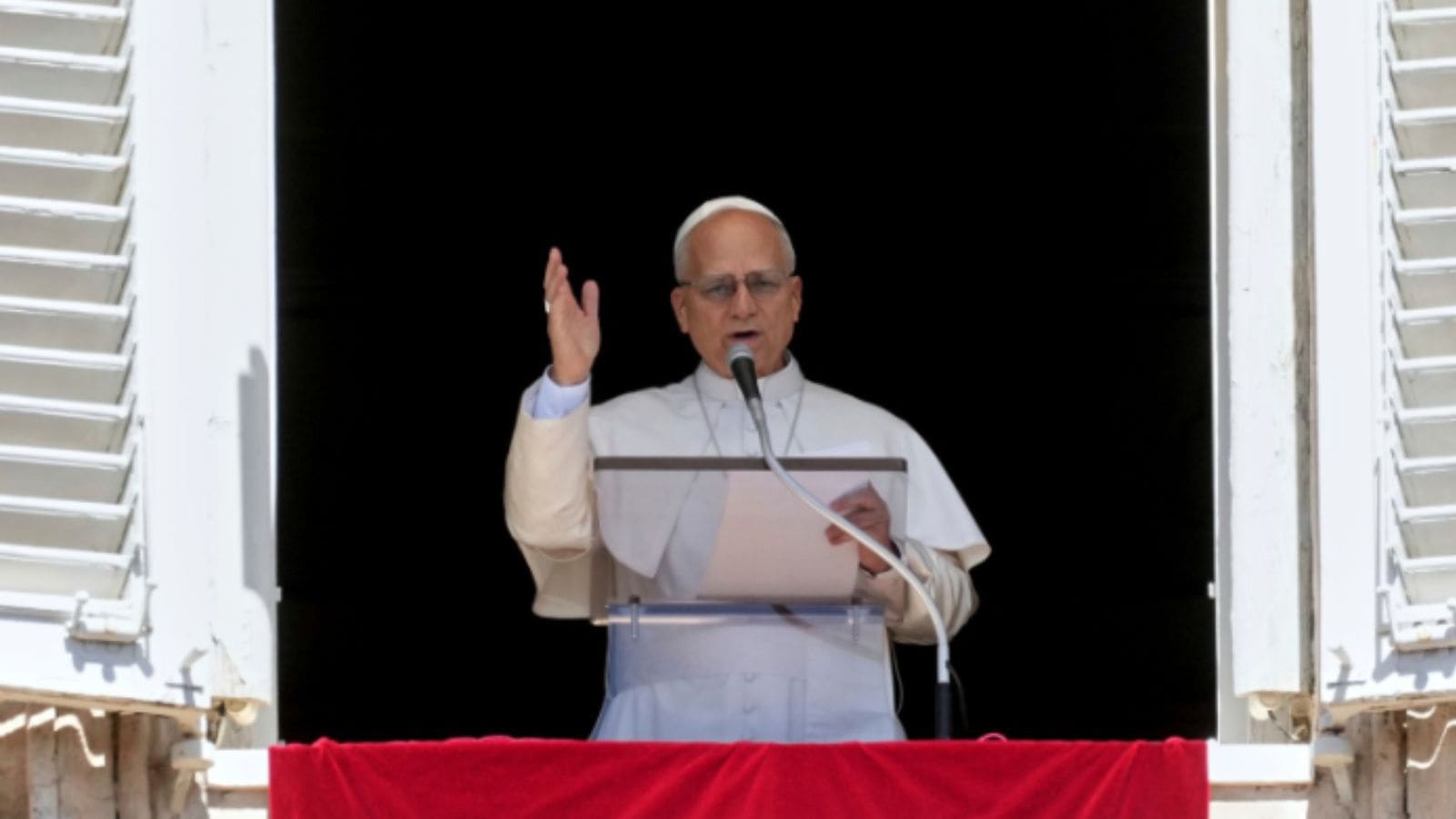
The internal geography of the Catholic Church shifted permanently this morning somewhere over the Mediterranean. Pope Leo XIV, the first American to hold the keys of St. Peter, sat in the cabin of a chartered ITA Airways flight and calmly dismantled the traditional diplomatic distance between the White House and the Holy See. Responding to a scorched-earth social media tirade from President Donald Trump, Leo told a scrum of reporters he has "no fear" of the current administration. It was a blunt rejection of the President’s attempt to frame the papacy as a political subdivision of American interests.
This is more than a spat between two powerful men. It is a collision of two competing visions for the 21st century. On one side, a President utilizing a "civilizational" war in Iran to consolidate domestic power; on the other, a Pope who views that same conflict as a "delusion of omnipotence." By openly defying Trump’s "weak on crime" and "terrible for foreign policy" labels, Leo is signaling that his American roots do not make him an American asset. He is positioning the Church as a hard-coded check on the populist nationalism currently sweeping the West.
The Chicago Pontiff and the Truth Social Broadside
The friction ignited late Sunday night when President Trump took to Truth Social to air a list of grievances that read like an indictment. He accused Leo of being "WEAK on crime," "terrible for foreign policy," and—most pointedly—suggested that the Pope owes his office to the Trump presidency. "If I wasn’t in the White House, Leo wouldn’t be in the Vatican," Trump claimed, theorizing that the College of Cardinals elected a Chicago native specifically to "deal with" his administration.
Trump’s vitriol stems from Leo’s recent condemnation of U.S.-Israeli military operations in Iran, which began in late February. The President has framed the conflict as a necessary strike against a nuclear-armed threat and a blow to "civilizational" enemies. Leo, however, characterized the threat to destroy Iranian civilization as "truly unacceptable." The President’s response was characteristically personal, even bringing the Pope's family into the fray by claiming he preferred Leo’s brother, Louis, because he is "all MAGA."
Aboard the flight to Algiers, Leo refused to take the bait of a personal feud. "I do not look at my role as being political," he said. Instead, he anchored his defiance in the Beatitudes. "Blessed are the peacemakers." In the language of the Vatican, this is a refusal to speak the dialect of the state. By invoking the Gospel, Leo is attempting to move the goalposts away from Trump’s transactional politics and toward a moral framework that the White House cannot easily co-opt or control.
Why the Iran Conflict is the Breaking Point
To understand the intensity of this rift, one must look at the specific nature of the Iran war. Unlike the counter-insurgency battles of the early 2000s, this conflict has been marketed by the Trump administration as a decisive, high-stakes reshaping of the Middle East. For the Vatican, this triggers every alarm in the "Just War" doctrine. Cardinal Robert McElroy, Archbishop of Washington, has already signaled that the current military campaign fails the Church’s prerequisites for a legitimate conflict.
Trump’s rhetoric—specifically his mention of wiping out "whole civilizations"—runs directly into the wall of Catholic social teaching, which emphasizes the protection of non-combatants and the rejection of total war. The Pope isn't just worried about the geopolitics; he is worried about the precedent. If a U.S. President can successfully frame a war of choice as a moral crusade, the Church loses its status as the world’s primary moral arbiter.
The President’s criticism that the Pope is "catering to the Radical Left" is a calculated move to alienate Leo from his American base. Nearly 70 million Catholics live in the United States. Many of them voted for Trump. By branding the Pope as a "politician" and "liberal," Trump is attempting to create a schism in the pews, forcing American Catholics to choose between their Commander-in-Chief and their Holy Father.
The Shadow of Venezuela and Migration
The Iran war is the headline, but the subtext of this conflict is found in South America and the U.S. southern border. Trump’s social media blast also targeted the Pope for criticizing the U.S. military campaign in Venezuela, which led to the capture of Nicolás Maduro. Trump views these actions as successful "law and order" operations that prevent drugs and criminals from entering the U.S.
Leo, following the trajectory set by his predecessor, Pope Francis, views these interventions through the lens of human displacement. The Vatican’s focus on migrants—exemplified by the conversion of the papal retreat at Castel Gandolfo into a job training center for refugees—is a direct ideological counter to the Trump administration’s mass deportation plans.
When Leo tells the world he does not fear the administration, he is referring to more than just verbal attacks. He is acknowledging that the Church’s infrastructure, from its charities to its parish halls, is now in a state of quiet resistance against the federal government’s immigration and foreign policy directives.
A Mission Beyond the Beltway
Leo’s choice of destination for his current ten-day trip—Algeria, Cameroon, Angola, and Equatorial Guinea—is a deliberate move to shift the spotlight. By visiting the land of St. Augustine in Algeria, a country that is 99% Muslim, he is demonstrating "fraternity" in action. It is a visual rebuttal to the "clash of civilizations" narrative coming out of Washington.
The Pope is betting that the global South, and the broader international community, will respond more favorably to a message of multilateralism and dialogue than to the unilateral exercise of power. His strategy is to isolate the White House morally on the world stage, even as the U.S. maintains military dominance.
This isn't a "game-changer" in the sense of a sudden shift in policy; it is the beginning of a long, cold war between two of the world's most influential Americans. Trump has the power of the military and the bully pulpit of social media. Leo has a 2,000-year-old institution and a refusal to be intimidated by the political cycles of a single nation.
The plane landed in Algiers shortly after the Pope finished speaking. He stepped onto the tarmac not as a "liberal politician" or a "weak" leader, but as a sovereign who has decided that the only way to deal with a bully is to show him that his threats have no currency in the kingdom of heaven. The Vatican has survived emperors and dictators for centuries. Leo is banking on the fact that he can survive a single U.S. President.
Demand for peace is not an act of cowardice; it is a declaration of independence from the machinery of war.


