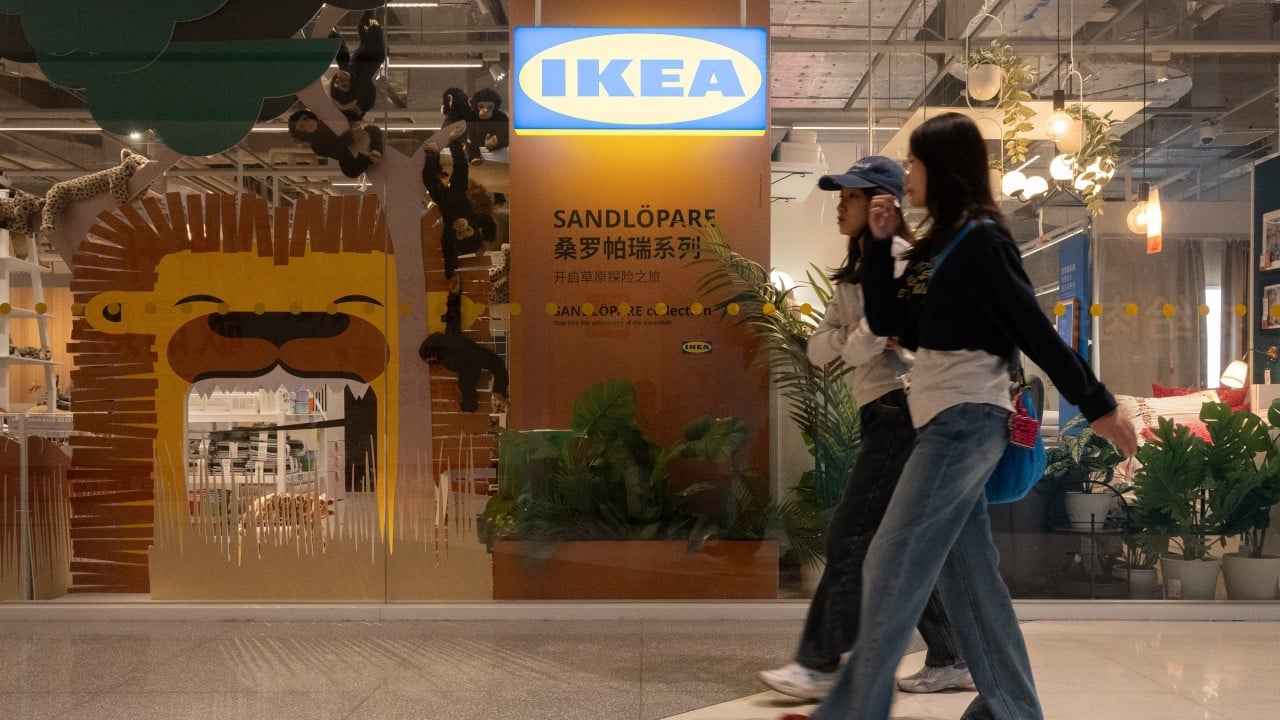
IKEA’s entry into Beijing’s small-format market is not a mere real estate adjustment; it is a fundamental reconfiguration of the customer acquisition cost (CAC) versus lifetime value (LTV) equation within high-density megacities. The traditional blue-box model—predicated on low-cost peri-urban land, high inventory volume, and the "destination shopping" psychological contract—has hit a ceiling in Tier 1 Chinese cities. As consumer behavior shifts from planned, weekend-long excursions toward immediate, frictionless convenience, the furniture giant is forced to trade floor space for proximity.
The Decomposition of the Traditional Big Box Constraint
The legacy IKEA model operates on a specific spatial logic: the consumer provides the "last mile" logistics in exchange for a lower price point and an immersive experience. This model breaks down under three specific pressures in the current Beijing market:
- The Opportunity Cost of Time: For the modern urban professional, the 4-hour round trip to a suburban warehouse represents a significant non-monetary cost. When this cost exceeds the perceived value of the physical showroom experience, the customer defaults to digital competitors.
- Inventory Velocity vs. Storage: Large-format stores carry high carrying costs for slow-moving stock. Small-format stores allow for a "showroom-only" or "curated-stock" approach, shifting the inventory burden back to centralized distribution centers.
- The Fragmentation of Demand: Consumer needs in Beijing have shifted from "whole-home furnishing" (high basket size, low frequency) to "space optimization and replenishment" (lower basket size, higher frequency).
The Triad of Urban Retail Adaptation
IKEA’s Beijing small-format store functions as a physical touchpoint for a digitally-integrated supply chain. This transition is governed by three operational pillars.
Pillar I: Hyper-Local Curation and the Pareto Principle
A standard IKEA warehouse stocks approximately 9,000 SKUs. A small-format store, often less than 10% of the square footage, must apply a rigorous Pareto analysis to its inventory. By stocking the 20% of products that drive 80% of volume—primarily home accessories and small furniture—IKEA maximizes sales per square meter. Large items are relegated to digital kiosks, transforming the store into a high-conversion lead generation funnel rather than a fulfillment center.
Pillar II: Service-Dominant Logic
In the small-format environment, the product is secondary to the service. These locations serve as "Planning Centers" where the primary value proposition is expert consultation for small-apartment living—a critical pain point in Beijing's high-rent environment. By selling the design solution rather than the individual shelf, IKEA increases the stickiness of the brand and justifies a higher price-per-square-foot of retail space.
Pillar III: Omnichannel Fulfillment Nodes
Small stores act as nodes in a hub-and-spoke distribution network. They serve as:
- Click-and-collect points to reduce last-mile delivery costs.
- Return centers to lower the friction of e-commerce.
- Data collection points to track hyper-local trend variations.
Quantifying the Shift in Consumer Gravity
The move toward small-format stores is a response to the "15-minute city" urban planning trend gaining traction across China. In this model, the "Gravity of Retail" is no longer a function of mass (store size) but of proximity.
The mathematical tension exists between Rent (R) and Customer Footfall (F). In suburban areas, $R$ is low and $F$ is dependent on marketing. In urban centers like Beijing’s commercial districts, $R$ is astronomical, but $F$ is organic. To maintain margins, IKEA must increase the Conversion Rate (C) and the Average Order Value (AOV) through high-touch services that cannot be replicated online.
The risk is "Brand Dilution." If a consumer's primary interaction with IKEA is a cramped, limited-selection storefront, the "aspirational lifestyle" component of the brand—the primary differentiator against local giants like Easyhome or digital platforms like Taobao—may erode.
Structural Obstacles in the Beijing Ecosystem
Success is not guaranteed by proximity alone. Several structural bottlenecks define the risk profile of this expansion:
- Logistical Complexity: Moving goods into central Beijing is significantly more expensive than moving them to the outskirts. Narrow streets, traffic restrictions (including license plate cooling periods), and limited loading bay access increase the "Cost of Goods Sold" at the store level.
- The Digital Dominance: Platforms like Meituan and JD.com have conditioned Chinese consumers to expect near-instant delivery. A small physical store must offer an experience or a level of immediate gratification that a smartphone cannot match.
- Competing Land Use: IKEA is competing for space with high-margin luxury goods and high-turnover F&B outlets. The furniture category, characterized by infrequent purchases, faces an uphill battle in justifying prime urban rents.
The Strategy of Product-Service Bundling
To counteract high urban rents, IKEA is shifting its revenue model toward service-heavy offerings. This includes home measurement services, interior design consultations, and customized assembly packages. In the Beijing small-format store, the "Planning Studio" concept takes center stage. This allows the company to capture data on local apartment layouts, which then feeds back into product development—creating a feedback loop where the store serves as a laboratory for urban living solutions.
This represents a pivot from a Volume-Based Model (moving as many Billy bookcases as possible) to a Solution-Based Model (solving the problem of a 40-square-meter apartment). The former relies on economies of scale; the latter relies on intellectual property and data.
Evaluating the Competitive Moat
IKEA’s primary competition in the small-format space is not other furniture retailers, but rather the "Good Enough" alternative provided by unbranded, low-cost digital vendors. To maintain its moat, IKEA must leverage its global supply chain to offer a price-quality ratio that local boutiques cannot match, while providing a physical design experience that online platforms cannot simulate.
The success of the Beijing pilot will be measured by two non-traditional metrics:
- Halo Effect: The increase in online sales within a 5-kilometer radius of the small-format store.
- Customer Acquisition Efficiency: The cost of acquiring a new member through the urban store compared to traditional digital advertising spend.
The Strategic Directive for High-Density Markets
The move into small-format retail in Beijing indicates a permanent shift in IKEA’s global strategy. The "Blue Box" is no longer the centerpiece; it is the warehouse for a network of urban satellites. For observers and competitors, the metric to watch is not total floor space, but the integration of service revenue into the traditional retail mix.
The strategic play is to decouple the brand experience from the inventory storage. By positioning small stores in high-traffic urban zones, IKEA secures the "Mental Availability" of the consumer. When the consumer eventually requires a large-scale purchase, the path of least resistance has already been established through the urban satellite. Retailers who fail to shrink their footprint while expanding their service layer will find themselves physically and psychologically alienated from the modern urban consumer. The future of furniture retail is not in the warehouse, but in the square meterage of the consumer's cognitive map.