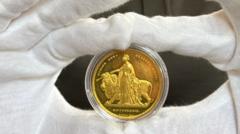
Imagine finding a small piece of gold in a dusty box during a house clearance that's worth more than a luxury sports car. It sounds like a tired cliché from a daytime TV show, but for one family in North Wales, it became a reality this month. A rare 1839 "Una and the Lion" five-pound gold piece, widely called the most beautiful coin in British history, just fetched £110,000 at auction.
If you aren't a numismatist, you might wonder why a single coin—even a gold one—could command such a staggering price. Honestly, it's not just about the metal. It's about a 19th-century PR stunt that accidentally created a masterpiece.
The story behind the gold
Most coins feature a stoic portrait of a monarch looking like they've had a very long day. The Una and the Lion is different. Struck in 1839 to mark the beginning of Queen Victoria’s reign, it was the first time a British monarch was depicted as a fictional character on legal tender.
The design, created by the legendary William Wyon, draws from Edmund Spenser’s 1590 epic poem, The Faerie Queene. Victoria is depicted as Lady Una, a figure representing truth and purity, gracefully guiding a massive lion that symbolizes the strength of the British nation.
It was a bold move. It wasn't meant for commoners to rattle in their pockets while buying a pint. It was a "pattern coin," essentially a prototype or a showpiece for collectors. Only a few hundred were ever minted. Because they weren't circulated, they didn't suffer the usual scratches and dings of 19th-century commerce. They remained pristine, tiny canvases of high-relief art.
Breaking down the £110,000 price tag
You'll see headlines about "rare coins" all the time, but the Una and the Lion is in a league of its own. The recent sale at Rogers Jones & Co in Chester isn't actually the world record—higher-grade versions have topped £600,000—but £110,000 is a massive win for a find that was tucked away in a Gwynedd home.
What makes this specific coin so valuable?
- The Designer: William Wyon was the Chief Engraver at the Royal Mint and is basically the Leonardo da Vinci of coins.
- The Inscription: The reverse features the Latin Dirige Deus Gressus Meos, which means "May God direct my steps."
- The Scarcity: Only about 300 to 400 of these were produced. When one pops up after decades in a private drawer, the market goes wild.
Most people think "old" equals "valuable." That's a mistake. You can find Roman coins for £20 because they made millions of them. Value comes from the intersection of artistic genius and extreme rarity. Wyon’s work captures a moment of Victorian optimism that’s almost tangible when you hold the coin.
How to spot a winner in your own collection
I've seen plenty of people get excited over a "rare" 50p they found in their change, only to find out it's worth exactly 50p. If you're serious about finding value, you need to look for specific markers that the average person misses.
Check the edge
The Una and the Lion comes in different varieties. Some have a plain edge, while others feature an inscribed edge that reads Decus Et Tutamen (An ornament and a safeguard). Collectors pay a premium for specific edge variations and even the number of scrolls in Victoria's hairband.
Condition is everything
In the coin world, a tiny scratch can wipe £20,000 off the value. Coins are graded on a scale from 1 to 70. A "Proof-65" coin is a different beast entirely compared to a "Proof-60." If you find something you think is valuable, don't clean it. Seriously. Using a cloth or polish can destroy the "bloom" of the gold and ruin the value instantly.
Identify the "Pattern"
Search for coins that weren't meant for circulation. Pattern coins like the 1839 Five Pounds were essentially the Royal Mint showing off. They have deeper strikes and higher relief than standard coins.
What to do if you find a rare coin
If you stumble upon something that looks special, your first move shouldn't be eBay. You need a professional appraisal from a member of the British Numismatic Trade Association (BNTA).
Auction houses like Rogers Jones & Co, Spink, or Heritage are the best routes for high-value items because they attract international bidders who have the "Una fever." The buyer of this £110,000 coin likely wasn't just a hobbyist; they were likely an investor looking for a "hard asset" that holds value better than the stock market.
Don't ignore the junk drawer. That family in Wales didn't know they were sitting on a six-figure fortune until they bothered to ask an expert. Take a close look at what you’ve inherited. You're looking for William Wyon's signature or that iconic lion. If you see them, don't touch the surface of the coin with your bare hands. Hold it by the edges and get it to a vault. It’s the difference between a nice story and a life-changing payday.


