The wind on Mars doesn’t whistle through trees. It doesn't howl against skyscrapers or rustle through dry autumn leaves. It is a thin, ghostly rasp against cold basalt and ancient dust. For billions of years, that sound has been the only music playing across the Oxia Planum. Underneath that dust, shielded from the sterilizing rain of cosmic radiation, something might be waiting. Not a monster. Not a little green man. Just a sequence of molecules that refuses to be forgotten.
We have spent decades scratching the surface of the Red Planet. Our landers and rovers have been like children playing in a sandbox, scraping the top few centimeters of dirt, finding hints of water and puffs of methane that vanish as quickly as they appear. But the surface of Mars is a graveyard of bleached bones—metaphorically speaking. The sun’s ultraviolet rays and the relentless bombardment of high-energy particles act like a planetary-scale bleach. If life ever existed there, the evidence has been scrubbed clean from the top layer of soil.
To find the truth, we have to go deep.
Deep enough to reach the places where the sun hasn't shone since the Earth was young.
The Drill and the Dream
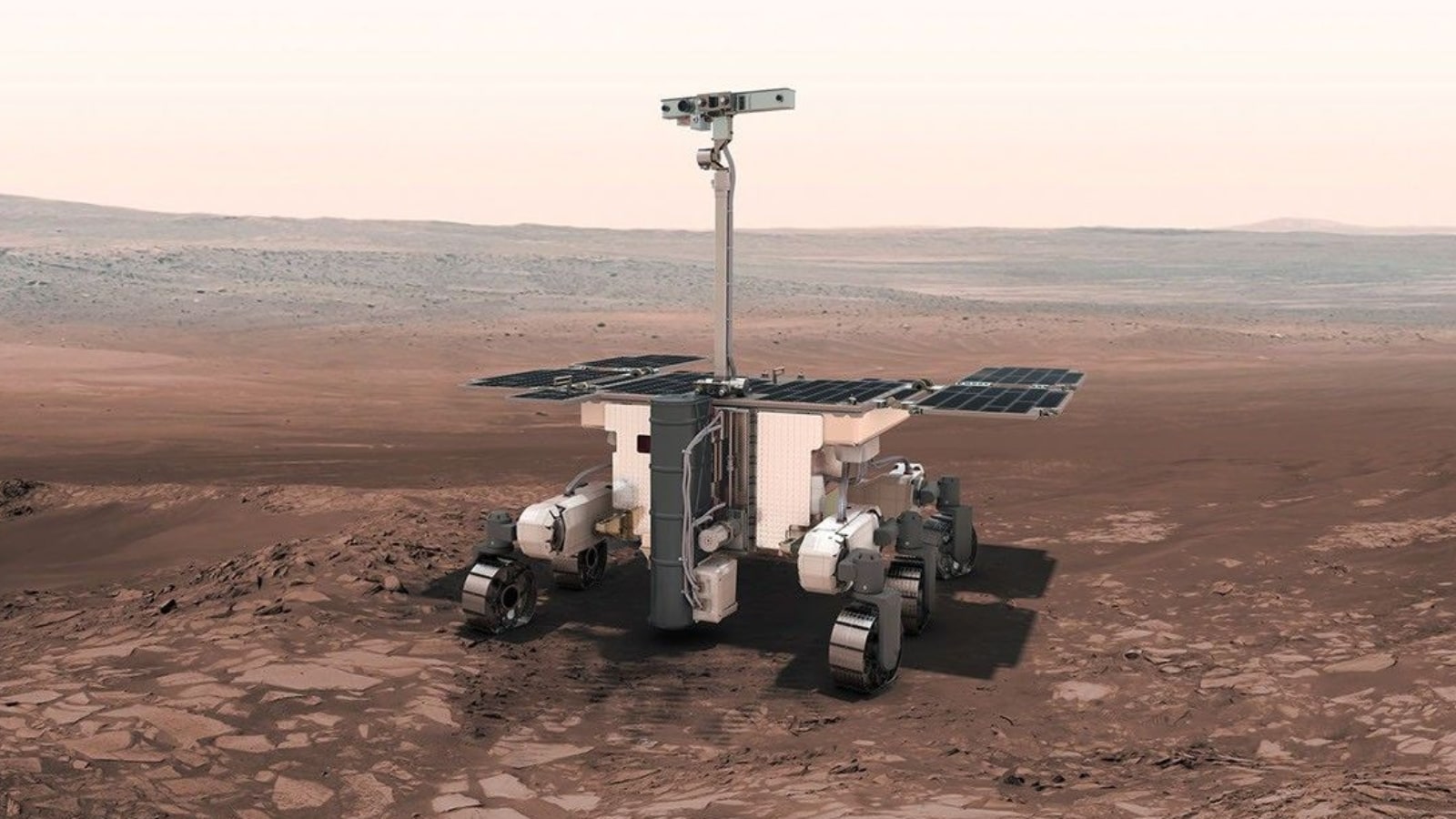
There is a machine sitting in a clean room in Europe, a suite of metal and silicon named after a woman whose own contributions to science were nearly buried by history. The Rosalind Franklin rover is not just another remote-controlled car with a camera. It is a subterranean detective. While previous missions like Curiosity or Perseverance have focused on the "here and now" of the surface or the long-range geology of craters, Rosalind is built for a singular, vertical obsession.
It carries a drill.
It sounds simple. We drill for oil, for water, and for minerals here on Earth every day. But doing it on another planet, millions of miles away from a mechanic or a spare part, is a feat of nerve-wracking engineering. This drill is designed to bite into the Martian crust and descend two meters down.
Why two meters? Because that is the magic number. At that depth, the Martian soil acts as a lead-lined blanket. It protects whatever lies beneath from the harsh radiation that renders the surface a wasteland. At two meters, we aren't just looking at rocks. We are looking at a time capsule.
Consider the sheer scale of the challenge. The rover must stabilize itself on uneven ground, deploy a multi-stage robotic arm, and grind through layers of clay and stone that have been baked hard over eons. If the bit snaps, the mission is over. If it hits a void and tips, the mission is over. Every millimeter of progress is a silent prayer sent across the void of space.
A Legacy in the Dust
Naming the rover after Rosalind Franklin wasn't just a nod to gender parity in STEM. It was a recognition of the nature of the work. Franklin was the chemist whose X-ray diffraction images were the key to unlocking the structure of DNA. She looked at the microscopic to explain the macroscopic. She found the blueprint of life in the shadows of a photograph.
The rover follows that same ethos. Inside its belly sits a miniaturized laboratory, the Analytical Laboratory Drawer (ALD). Once the drill brings up a core sample—a tiny, precious cylinder of ancient Mars—it is crushed into a fine powder and fed into this lab.
There, a suite of instruments, including the Mars Organic Molecule Analyzer, begins the hunt. They aren't looking for a heartbeat. They are looking for "biomarkers"—complex organic molecules that don't just happen by accident. On Earth, certain shapes of carbon and specific ratios of isotopes are the fingerprints of biology. If Rosalind finds these same fingerprints two meters down, the history of our solar system changes in a heartbeat.
We often think of space exploration as looking up at the stars. With this mission, we are looking down into the dark. It is a search for our own context. If life started on Mars independently of Earth, then the universe is a crowded, vibrant place. If it didn't, if Mars is truly a sterile rock all the way to its core, then our own existence becomes infinitely more precious and terrifyingly lonely.
The Long Walk to Oxia Planum
The journey to the launchpad hasn't been easy. The Rosalind Franklin rover has been a nomad, delayed by global politics, technical setbacks, and the sheer difficulty of landing a one-ton laboratory on a world where the atmosphere is too thin for easy parachutes and too thick to ignore.
The choice of the landing site, Oxia Planum, was no accident. It is one of the oldest exposed regions on Mars. Billions of years ago, this was a floodplain. Water sat here. Silt settled here. It is a place where the conditions for life weren't just possible; they were likely.
Imagine standing there four billion years ago. You wouldn't see a red desert. You might see a shoreline. You might feel a heavy, damp atmosphere. You might see clouds. The rover isn't visiting a desert; it is visiting the ruins of a world that once looked a lot like home.
When the descent stage finally fires its thrusters and the rover's wheels touch the dust, a team of engineers in Europe will hold their breath. They won't just be looking at telemetry. They will be looking at the culmination of a decade of work, a collective effort to answer the oldest question we have ever asked: Are we the only ones who ever woke up?
The Silence of the Lab
There is a specific kind of tension in a laboratory when an experiment is running. It’s a quiet, humming vibration. You check the sensors. You recalibrate the lasers. You wait for the data to scroll across the screen. Now, multiply that tension by the 200 million kilometers of vacuum separating the scientist from the sensor.
The rover will operate with a level of autonomy that would have seemed like science fiction twenty years ago. Because the time delay for signals is so great, it has to make its own decisions. It has to identify "interesting" rocks. It has to navigate around hazards. It has to manage its own power as the sun dips below the horizon and the temperature drops to a bone-shattering minus 100 degrees Celsius.
But the most human part of this mission isn't the AI. It's the curiosity.
We have built a mechanical proxy for our own wonder. We have given it eyes to see the horizon, arms to touch the ground, and a heart made of plutonium or solar cells to keep it warm. We are sending it to dig because we are a species that cannot stand a locked door. We see a surface, and we wonder what’s underneath. We see a mystery, and we build a tool to solve it.
The Invisible Stakes
If the drill comes up empty, the mission is still a success. Science is as much about proving what isn't there as what is. Knowing that life didn't take hold in the clay of Oxia Planum tells us something fundamental about the "Goldilocks" conditions required for the spark of existence. It tells us that perhaps Earth is even more of a miracle than we suspected.
But if it finds something?
If that two-meter core reveals a layer of organic complexity that screams "life"?
The world will not change overnight. We will still have to pay our taxes. The traffic will still be bad. But every time we look up at that red dot in the night sky, we will know that we aren't looking at a rock. We are looking at a neighbor. We will know that the silence of the cosmos isn't an absence of life, but perhaps just a lack of long enough drills.
Rosalind Franklin died young, never knowing how her work would change biology forever. Her namesake rover now carries that torch to another world. It carries our names, our math, and our insatiable need to know. It will sit in the red dust, a lonely outpost of human thought, grinding its way into the past to see if we have a future.
Two meters. It doesn't seem like much. A human height. A shallow grave. A deep breath. But in those two meters of Martian soil lies the difference between a universe that is a cold, empty cathedral and one that is a nursery.
We are about to start digging.