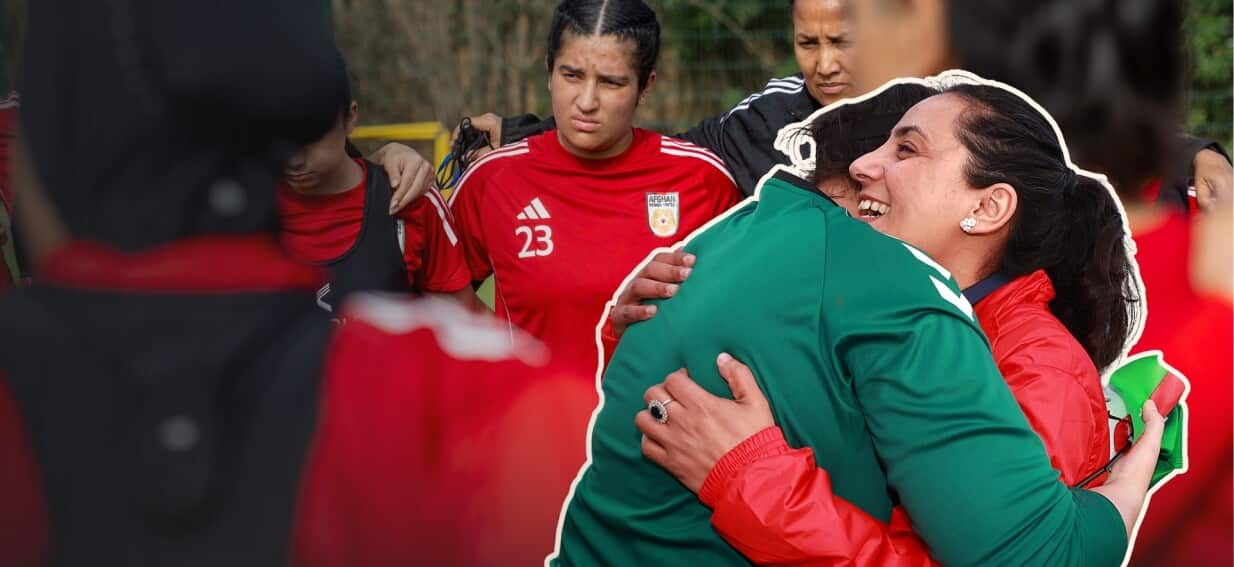
The grass under a pair of cleats shouldn't feel like a miracle. For most athletes, it is just dirt and fiber, a stage for a weekend's exertion. But for a group of women who once had to burn their jerseys to stay alive, that green expanse is holy ground.
When Kabul fell in 2021, the world watched the chaos at the airport—the desperate hands reaching for the fuselages of planes. What the cameras didn't capture was the quiet, frantic destruction of identity happening in suburban backyards. Young women, some still in their teens, were burying their medals. They were dousing their team photos in kerosene. They were hiding the very things that made them feel human because, overnight, those things had become death warrants.
They fled. They scattered across borders, eventually finding a fragile sort of safety in Australia. But they carried a ghost with them: the Afghan Women’s National Team. For years, they existed in a bureaucratic purgatory. They were players without a pitch, a national team without a recognized nation.
FIFA, the governing body that oversees the world's game, remained silent for a long time. The official stance was a tangle of red tape and legalities. Because the Taliban-led government back home didn’t recognize women’s sports, the "official" Afghan football federation wouldn't sanction the team in exile. Without that stamp of approval, they were invisible.
Until now.
The Weight of a Crest
Imagine standing in a stadium where the lights are blindingly bright, but you are not allowed to wear your own name. That was the reality for these women during their first years in exile. They played friendly matches, sure. They trained in the early morning mist of Melbourne. But every time they stepped onto the field, there was a hole where their flag should have been.
Football is often dismissed as a game of twenty-two people chasing a ball. That is a lie. Football is about belonging. When you put on a jersey, you are claiming a piece of the world. You are saying, I am here, and I represent something larger than my own skin.
For the Afghan women, the "something larger" was a generation of girls back home who were currently being told they could no longer go to school, could no longer walk in parks, and could certainly no longer kick a ball. If the team in exile stopped playing, the dream died everywhere.
The stakes were never about points on a scoreboard. They were about the preservation of a pulse.
Breaking the Silence
The breakthrough didn't come from a sudden burst of corporate generosity. It came from the relentless, exhausting persistence of the players themselves and the advocates who refused to let their files sit at the bottom of a drawer.
FIFA’s decision to finally allow the Afghan women’s refugee team to participate in sanctioned tournaments is more than a policy shift. It is a reversal of a disappearance. By recognizing this team, the sporting world is acknowledging a fundamental truth: a country is not just its borders or its current rulers. A country is its people, even—and especially—the ones who have been forced to leave.
This ruling allows the team to compete under a special status. They won't necessarily be walking out under the official flag of the current Afghan administration—a flag they don't recognize anyway—but they will be walking out as a recognized entity. They will have access to the infrastructure, the funding, and the competitive pathways that define a professional athlete’s life.
They are no longer just a "project." They are a team.
The Physics of Hope
There is a specific kind of physics involved in a long-range pass. You have to calculate the wind, the dampness of the grass, and the closing speed of the defender. It requires total presence. You cannot be worried about your family’s safety in a secret apartment in Heart while you are trying to find the corner of the net.
Yet, these women did.
Khalida Popal, one of the founders of the national team and a key figure in their evacuation, has often spoken about the "shield" of the game. For ninety minutes, the trauma of the escape—the sound of the gunfire, the frantic calls to relatives—is pushed to the periphery. The ball is the only thing that matters.
But when the whistle blows, the world rushes back in. The struggle for recognition was a battle to make that ninety-minute shield permanent. They wanted the right to be seen as athletes first, and refugees second.
Consider the logistical nightmare of maintaining an elite sports team with no home base. You have players working three jobs to afford the commute to practice. You have coaches volunteering their time between their own shifts. You have a lack of high-level competition because most "official" teams are wary of playing a side that isn't on the FIFA register.
When you remove the official status of a team, you aren't just taking away their trophies. You are taking away their ability to improve. You are starving their potential.
The Invisible Stadium
There is a hypothetical girl in Kabul right now. Let’s call her Zala.
Zala is twelve. She remembers her older sister coming home with grass stains on her knees. She remembers the illicit thrill of watching a match on a flickering screen. Now, Zala spends her days indoors. The horizon of her life has shrunk to the walls of her family’s courtyard.
For Zala, the news of this FIFA ruling is the only window left open.
When the refugee team takes the field in a sanctioned tournament, they are playing in an invisible stadium. The stands are filled with thousands of girls like Zala, watching from the shadows, measuring their own possibilities by the movement of those women on the screen.
The opposition to this team was always rooted in the idea that they were a political liability. That recognizing them would complicate diplomatic relationships with the de facto authorities in Afghanistan. But sport, at its best, is a rejection of that kind of cynicism.
If a young woman can run, she should be allowed to race. If she can play, she should be allowed to compete. To deny that is to deny the very "fair play" that FIFA claims to champion.
Beyond the Result
Will they win the next World Cup? Probably not today. They have years of missed training and systemic hurdles to overcome. They are playing against nations that have billion-dollar infrastructures and girls' academies that start at age five.
But victory, in this context, has been redefined.
The win happened the moment the paperwork was signed. The win happened when the first player pulled on a jersey that bore a crest recognized by the world. The win is the fact that they no longer have to hide who they are.
The journey from burning a jersey to having it protected by international law is a long one. It is paved with many "no's," many closed doors, and many nights of wondering if anyone was actually listening.
The grass under their cleats still feels like a miracle. But now, it is a miracle they have earned.
The next time they line up in the tunnel, the air will feel different. The silence that once surrounded them has been replaced by the low hum of anticipation. They aren't just refugees playing for survival anymore. They are strikers, midfielders, and keepers.
They are players. And they are finally, officially, back in the game.
The ball is at the center circle. The world is watching. The whistle is about to blow.