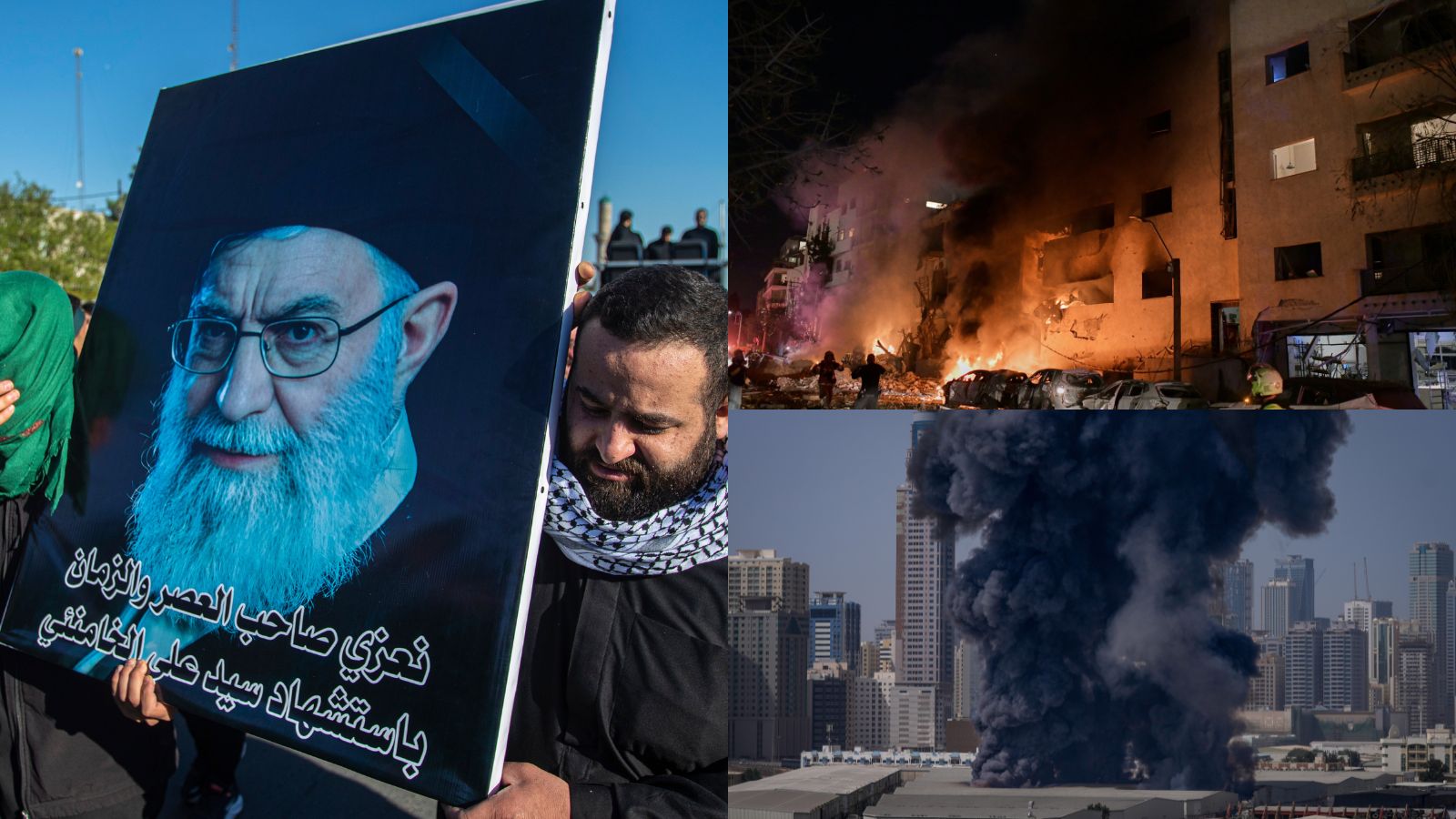
The death of Supreme Leader Ali Khamenei introduces a non-linear volatility into Middle Eastern geopolitics that traditional "stability" models fail to capture. While media narratives focus on the immediate visual of bombings and tactical exchanges, the strategic reality is defined by a total loss of the "Anchor Node" in Iran’s proxy network. Khamenei served as the ultimate arbiter of internal factional disputes and the primary architect of the "Axis of Resistance." Without this central authority, the Iranian state enters a period of structural entropy where the Revolutionary Guard (IRGC), the conventional military (Artesh), and clerical hardliners must compete for a dwindling resource base under the pressure of active US-Israeli kinetic operations.
The Triad of Institutional Paralysis
The Iranian power structure is not a monolith; it is a system of overlapping vetoes. Khamenei’s removal triggers a crisis in three specific domains:
1. The Succession Bottleneck
The Assembly of Experts is constitutionally mandated to select a successor, yet the pool of viable candidates is historically shallow. Mojtaba Khamenei, the late leader's son, lacks the formal religious credentials traditionally required to command the loyalty of the senior clergy in Qom. Conversely, established clerics lack the deep-seated integration with the IRGC necessary to project force. This creates a Governance Gap where decision-making speed drops precisely as the tempo of Israeli strikes increases.
2. Command and Control Fragmentation
Iran’s regional influence operates via a "Hub-and-Spoke" model. Khamenei was the hub. Proxies like Hezbollah in Lebanon, the Houthis in Yemen, and various militias in Iraq and Syria do not just receive funding; they receive strategic alignment.
- Vertical Disconnect: Local commanders of these groups may now prioritize provincial survival over Tehran’s broader geopolitical objectives.
- Resource Competition: With the central paymaster in a succession crisis, proxies will likely compete for a finite pool of Iranian liquidity, leading to internal friction within the proxy network itself.
3. The Intelligence Deficit
Recent precision strikes within Iranian borders and against high-ranking officials in Damascus and Beirut indicate a systemic breach of Iranian operational security. The period of mourning and subsequent political reshuffling provides an optimal window for intelligence agencies to exploit the resulting administrative chaos. Security protocols are most vulnerable during transitions of power, as loyalty tests and purges often replace objective meritocracy.
The Cost Function of Kinetic Engagement
The current US-Israeli military posture can be analyzed through the lens of Attrition-Based Deterrence. The objective is not necessarily a full-scale ground invasion—which carries prohibitive political and economic costs—but the systematic degradation of Iran’s "Strategic Depth."
Degrading the Buffer Zones
Israel’s focus on the "Northern Front" (Hezbollah) and the "Southern Front" (Hamas/PIJ) is a deliberate attempt to strip Iran of its offensive shield. By neutralizing the missile silos and tunnel networks in Southern Lebanon, Israel reduces the cost of a direct strike on Iranian soil. The logic follows a simple depletion model:
- Intercept Ratios: Using Iron Dome and Arrow systems to force Iran to expend high-cost ballistic missiles against low-probability success targets.
- Logistical Interdiction: Striking the "land bridge" from Iran through Iraq to Syria to ensure that expended munitions cannot be easily replaced.
- Targeting Hierarchy: Shifting from tactical targets (militia fighters) to high-value assets (IRGC coordinators).
The American Role as a Force Multiplier
The United States provides the "Overmatch" capability. While Israel conducts the precision strikes, US naval and air assets in the Mediterranean and Persian Gulf serve as a thermodynamic heat sink, absorbing Iranian counter-responses and signaling that any escalation to the maritime domain—such as closing the Strait of Hormuz—would trigger a disproportionate conventional response. This limits Iran’s options to "Sub-threshold" warfare, which is increasingly ineffective when their primary leaders are being eliminated.
The Economic Thermodynamics of the Conflict
Warfare is a function of fiscal capacity. Iran’s ability to sustain a high-intensity conflict while managing a transition of power is constrained by its "Survival Margin."
- Currency Volatility: The Rial historically devalues rapidly during periods of political uncertainty. This creates domestic inflationary pressure that the regime must suppress through expensive subsidies or increased internal security spending.
- Energy Infrastructure Vulnerability: Iran’s primary source of foreign exchange is its oil export capacity, specifically through the Kharg Island terminal. If kinetic operations expand to include energy infrastructure, the regime loses its ability to fund its internal security apparatus (the Basij).
- Shadow Banking Stress: The intricate network of front companies used to bypass sanctions relies on stable political patronage. A change at the top disrupts these networks, causing a temporary "liquidity crunch" for external operations.
Tactical Realignment and the Proxy Dilemma
The most significant risk in the next 48 to 72 hours is the "Lone Actor" scenario within the proxy network. When a central command becomes silent or ambiguous, mid-level commanders often default to "Maximum Aggression" to prove their utility or to preempt what they perceive as an imminent threat.
- Hezbollah’s Strategic Calculation: Does the group expend its long-range precision arsenal now to save the Iranian regime, or does it conserve those assets to ensure its own survival as a Lebanese political entity?
- The Houthi Variable: As a more autonomous actor, the Houthis may use the chaos in Tehran to escalate attacks on Red Sea shipping, seeking to force a diplomatic concession from the West that Tehran might have previously vetoed.
- The Iraqi Border Paradox: Increased US presence in Iraq aims to prevent the movement of IRGC reinforcements, effectively pinning Iranian ground forces within their own borders.
Structural Vulnerabilities in the Defensive Umbrella
The "Integrated Air Defense" model Iran has touted—largely built on indigenous platforms like the Bavar-373 and older Russian S-300 systems—has shown significant "Blind Spots" when faced with F-35 stealth signatures and electronic warfare suites.
The Electronic Warfare (EW) Gap
Modern Israeli operations utilize "Cognitive Electronic Warfare" to spoof and jam Iranian radar networks. This creates a "Fog of War" where Iranian commanders cannot distinguish between a real incoming strike and a digital ghost. This technological disparity forces Iran to rely on "Saturation Defense"—firing large numbers of interceptors blindly—which rapidly depletes their inventory.
The Problem of Symmetrical Response
Iran’s traditional doctrine is based on "Strategic Patience" and "Proportionality." However, the death of a Supreme Leader is an event without a proportional equivalent in the West or Israel. This creates a Response Asymmetry. If Iran strikes back too weakly, they signal terminal decline to their proxies; if they strike back too hard (e.g., a direct ballistic attack on a major population center), they invite a decapitation strike against the remaining clerical leadership.
The Mechanistic Probability of Regional Contagion
Escalation is rarely a choice; it is a sequence of forced moves. The current environment is characterized by "Tight Coupling," where an event in one theater (a bombing in Damascus) triggers an automated response in another (a drone launch from Yemen).
- Threshold 1: The Maritime Chokepoint. If Iran perceives its internal survival is at risk, it may attempt to internationalize the crisis by mining the Strait of Hormuz. This shifts the conflict from a regional security issue to a global economic catastrophe, forcing China and the EU to intervene—likely against Tehran to protect their energy interests.
- Threshold 2: The Nuclear Option. In a state of collapse, the "Hardline Faction" within the IRGC may see a rapid dash toward nuclear breakout as their only remaining leverage. This is the "Red Line" for Israeli planners, which would likely trigger a pre-emptive strike on the Natanz and Fordow facilities.
The strategic imperative for the West is to maintain a "Corridor of Uncertainty" for the Iranian leadership. By not defining the exact limits of the response, they force the transition teams in Tehran to remain inward-looking and defensive. The immediate goal is to prevent the IRGC from using an external war as a tool for internal consolidation.
Monitoring the movement of the 10th Armored Division and the 27th Mohammad Rasool-ollah Division in Tehran will provide the clearest signal of whether the regime is prioritizing domestic order or regional retaliation. Success for the US-Israeli alliance depends on maintaining high-tempo kinetic pressure while simultaneously using cyber and psychological operations to widen the fissures between the IRGC and the civilian populace. The collapse of the central node has turned a predictable cold war into a chaotic multi-variable simulation.