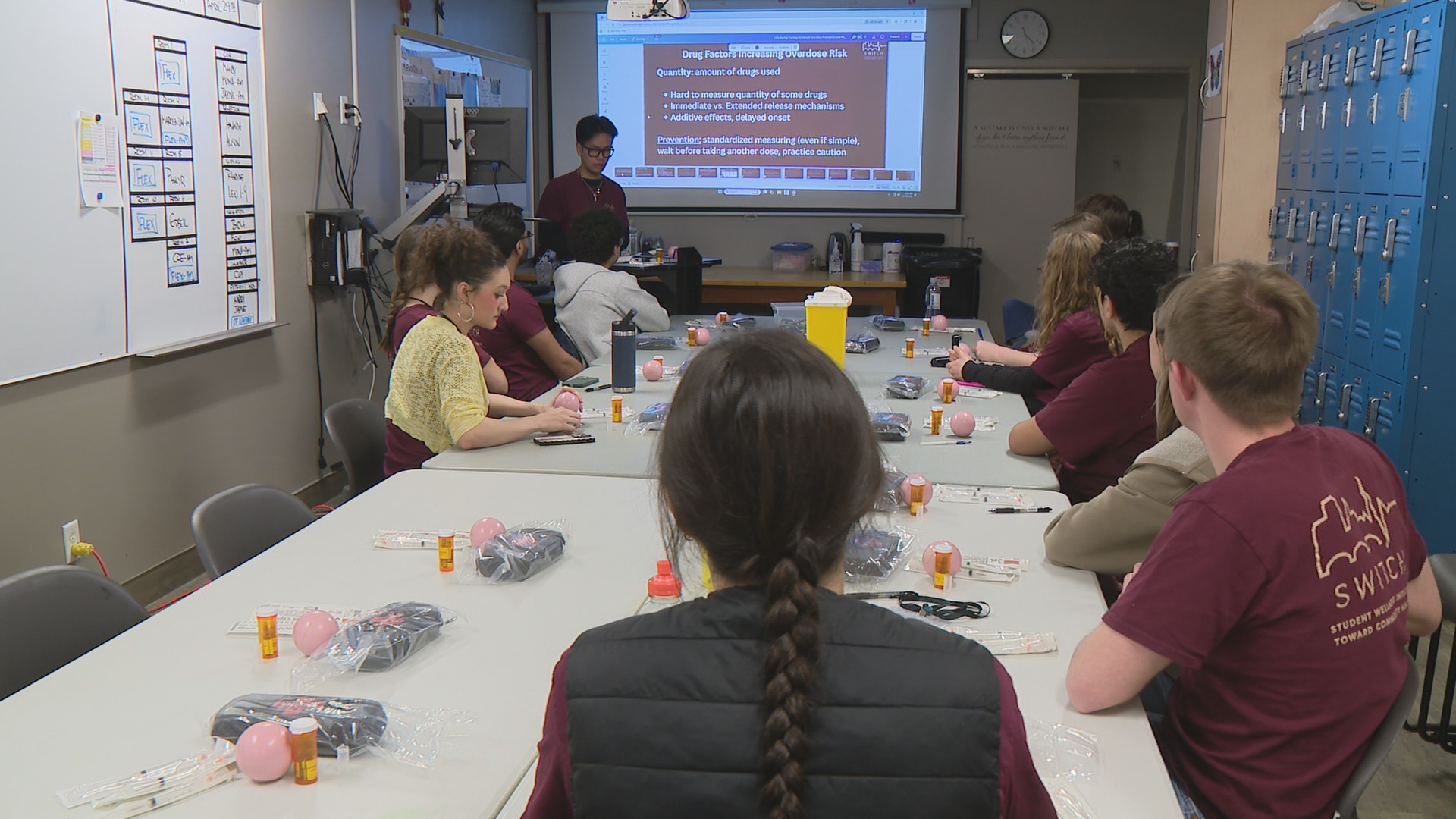
University students in Saskatoon are no longer just studying for midterms. They are training to revive their peers from the brink of death. As the toxic drug supply migrates from the back alleys of downtown into the dorm rooms of higher education, the University of Saskatchewan has become a microcosm of a national public health disaster. The surge in students seeking naloxone training and overdose response kits is not a sign of a "vibrant campus culture." It is a desperate admission that the institutional safety nets designed to protect the next generation have frayed beyond repair.
The Quiet Infiltration of Student Life
For years, the narrative surrounding the opioid crisis focused on the marginalized and the unhoused. That shield of distance has evaporated. Fentanyl does not care about your GPA or your career aspirations. In Saskatoon, the reality of the crisis has forced student unions and campus security to pivot from managing noise complaints to distributing life-saving medication. This shift represents a fundamental change in the Canadian university experience. Meanwhile, you can explore other events here: Why France Is Forcing Kids To Learn About Real Food.
The data suggests a grim trend. Saskatchewan consistently reports some of the highest per-capita overdose rates in the country. While official provincial statistics often lag behind the reality on the ground, the demand for harm reduction supplies on campus tells the real story. Students are not just curious; they are terrified. They are seeing friends stumble and stop breathing in library stalls and at house parties. The sudden urgency for training sessions proves that the threat is no longer theoretical.
Why the Campus is a High Risk Zone
Universities are high-pressure environments. They are also places of experimentation and, occasionally, profound isolation. When you mix the intense stress of academic performance with a drug supply that is increasingly contaminated with benzodiazepines and ultra-potent synthetic opioids, you create a perfect storm. To explore the complete picture, check out the excellent analysis by Psychology Today.
One of the most dangerous factors is the "recreational" user. These are students who might only use substances occasionally and have zero tolerance for opioids. They think they are buying a study aid or a pill to help them relax after an exam. If that pill contains even a grain of fentanyl, they have no biological defense. They don't have the "street smarts" or the community connections of long-term users who know how to test their supply or use in supervised settings. They die alone in locked rooms.
The Limits of Naloxone
While the push to get naloxone into the hands of every student is necessary, it is not a cure. There is a common misconception that naloxone is a magic "reset" button. It is a temporary bridge. Naloxone works by knocking opioids off the brain's receptors, but it wears off in 30 to 90 minutes. If the drugs in the user's system are stronger or longer-lasting than the naloxone—which is almost always the case with modern synthetics—the person will slip back into a fatal overdose once the medication fades.
Furthermore, the emergence of "benzodope"—opioids mixed with benzodiazepines—has complicated the rescue process. Naloxone does not work on benzodiazepines. A student might administer multiple doses of the nasal spray and see no movement, no breath, and no life. This creates a secondary trauma for the rescuer, who feels they have failed despite doing everything right. We are asking nineteen-year-olds to perform high-stakes medical interventions that would rattle a seasoned paramedic.
The Institutional Gap
University administrations are in a difficult position. Admitting there is a drug problem on campus can hurt recruitment and donor relations. However, silence is becoming a liability. For too long, the response was buried in student wellness handbooks or relegated to a single slide during freshman orientation.
The movement in Saskatoon is largely bottom-up. It is driven by students who realized that if they didn't act, their classmates would keep dying. They are setting up booths, organizing workshops, and pushing for more accessible harm reduction kits. They are doing the work that, arguably, the provincial government and university leadership should have prioritized years ago.
We see a massive disparity in how different faculties handle the issue. Nursing and medicine students are often at the forefront, but the risk is just as high in engineering, arts, or business. If the training isn't universal, the safety net has holes. A response kit in a student union building is useless if the overdose happens three kilometers away in a basement apartment.
Beyond the Kit
If we want to stop the body count, we have to look past the nasal spray. Harm reduction is a spectrum, not a single tool. This includes drug checking services—technologies that allow a student to see exactly what is in their baggie before they take it. In some jurisdictions, this is seen as "enabling," but the alternative is a game of Russian roulette.
There is also the issue of the "Good Samaritan" law. While Canada has legislation to protect those who call 911 during an overdose, many students still fear the consequences. They worry about their academic standing, their future careers, or their parents finding out. This fear of authority often outweighs the fear of death. We need a cultural shift where the survival of the person on the floor is the only priority, and legal or academic repercussions are completely off the table.
The Economic Reality of the Toxic Supply
The reason fentanyl has taken over is simple: economics. It is cheap to produce, easy to transport, and incredibly potent. Traditional heroin has almost disappeared from the prairies because the profit margins on synthetics are insurmountable. This means that even if a student is looking for something relatively "safe," the supply chain they are tapping into is inherently lethal.
The illegal market is not regulated by a pharmacy board. There is no quality control. A batch of pills pressed in a basement can have wildly different concentrations of active ingredients. One student might get a pill that does nothing; their roommate might get a pill that stops their heart. This volatility is what makes the current era of drug use so much more dangerous than the eras of the 1970s or 90s.
The Psychological Burden on Rescuers
We must talk about the aftermath. When a student saves a life with naloxone, they don't just go back to their 2:00 PM lecture. They carry that experience. The adrenaline dump is followed by a massive emotional crash. Many of these student responders are reporting symptoms of PTSD. They are checking on their friends every hour. They are hyper-vigilant.
This is a hidden cost of the crisis. We are creating a generation of students who are functioning as unpaid, untrained first responders. Without adequate psychological support, these "saviors" will eventually burn out or drop out. The university must provide more than just the kits; it must provide the long-term mental health infrastructure to handle the fallout of a campus that has become a front line.
Political Inertia in Saskatchewan
The provincial political climate adds another layer of difficulty. Saskatchewan has been slow to embrace some of the more progressive harm reduction strategies seen in British Columbia or Ontario. There is a lingering belief in some circles that abstinence-only programs are the only moral path. This ideology ignores the reality that people are dying right now.
When the government hesitates to fund supervised consumption sites or drug-checking equipment, the burden falls back onto the community—and in this case, the campus. The students in Saskatoon are essentially filling a gap left by legislative gridlock. They are operating in a grey area where their actions are technically legal but often lack the full-throated support of the state.
The Myth of the "Bad" Kid
The stigma remains the biggest hurdle. There is still a prevailing image of who an "addict" is, and it rarely looks like a Dean's List student in a sweatshirt. This stereotype prevents people from seeking help early. It prevents parents from having honest conversations. It prevents roommates from asking the hard questions.
If we keep pretending that this is a problem for "those people" over there, we will continue to lose the people right here. Every time a student in Saskatoon picks up a naloxone kit, they are fighting against that stigma. They are acknowledging that anyone can be a victim of a poisoned supply.
Structural Changes Required
What would a truly safe campus look like? It wouldn't just be a place with naloxone in every hallway. It would be a place where drug testing is available without judgment. It would be a place where mental health services are available on demand, not after a six-month waiting list. It would be an environment where the pressures of "success" are balanced with a genuine concern for human life.
The current model relies on the bravery of individuals. We are hoping that a student happens to be nearby, happens to have a kit, and happens to have the courage to use it. Hope is not a policy. It is a gamble.
Immediate Action for the Student Body
For those currently on the ground, the instructions are clear but heavy. Carry naloxone. Learn the signs of an overdose: the blue lips, the gurgling sounds, the pinpoint pupils. Do not use drugs alone. If you are going to use, have someone there who is sober and prepared to act.
This isn't about being a rebel or "partying." This is about basic survival in a landscape where the stakes have been raised to a lethal level. The students of Saskatoon are showing remarkable resilience, but they shouldn't have to be this resilient. They should be allowed to be students.
The presence of overdose response kits in university dorms is a failure of the state, a failure of the healthcare system, and a failure of our social contract. It is a sign that we have accepted a certain level of death as the cost of doing business. Until the root causes of the toxic supply and the lack of support are addressed, the best these students can do is keep their classmates breathing for one more day.
Order your kits, get trained, and never assume the person in the next room is just "sleeping it off."