The diesel fumes on a Philippine resupply boat don't smell like geopolitics. They smell like old grease, sweat, and the pungent tang of dried fish. For a young sailor staring at the horizon, the South China Sea isn't a "strategic maritime corridor" or a "zone of overlapping sovereignty." It is a vast, unpredictable expanse of turquoise that might, at any moment, be shattered by the grey hull of a Chinese Coast Guard cutter or the blinding arc of a water cannon.
The water hits with the force of a physical blow. It isn't just liquid; it’s a message sent from Beijing to Manila, written in high-pressure hydraulics.
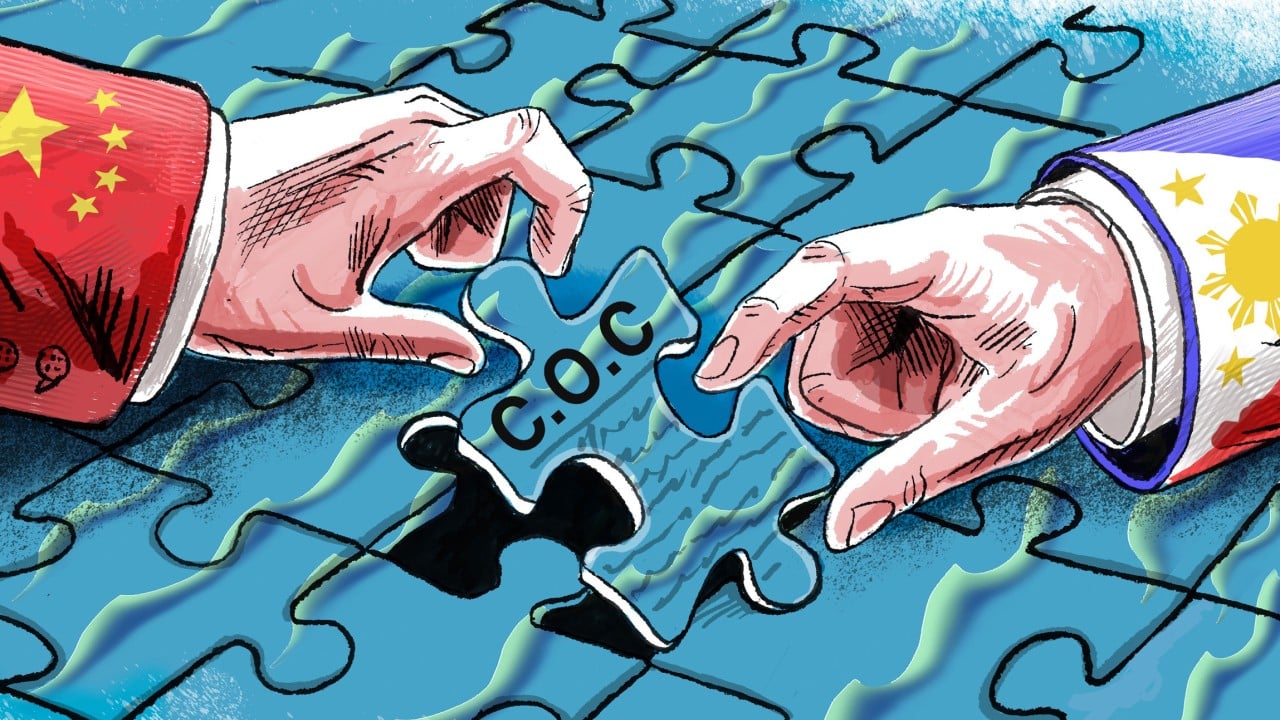
Diplomats in wood-paneled rooms in Jakarta or Singapore talk about a Code of Conduct (COC) as if it were a magical spell. They believe that if they can just find the right sequence of words—the perfect legal incantation—the ships will stop bumping, the lasers will stop blinding, and the tension will evaporate. But while the ink remains wet on draft after draft, the reality on the waves is hardening into something much more dangerous than a mere disagreement.
History is a heavy anchor.
For decades, the Association of Southeast Asian Nations (ASEAN) and China have been dancing a slow, agonizing waltz around this code. The goal was simple: create a set of rules to prevent an accidental spark from turning into a regional inferno. Yet, twenty years after the initial declaration of intent, the document remains a ghost. It haunts every summit, yet it has no substance.
Consider the "Global South" identity that both China and many Southeast Asian nations claim to share. In theory, this shared history of overcoming colonialism should make them natural allies. They should be able to sit across from one another, look past the influence of outside powers like the United States, and settle their own backyard. But the ocean is a cruel place for theories.
When a Chinese vessel maneuvers within meters of a Philippine wooden boat, the "shared identity" of the Global South vanishes. It is replaced by the raw, ancient logic of the schoolyard. The bigger kid is pushing; the smaller kid is refusing to move.
The problem isn't a lack of vocabulary. The problem is a lack of restraint.
Beijing views the South China Sea as its historical front porch. To China, the presence of American carriers and the vocal defiance of Manila are not just security concerns—they are perceived as insults to a rising power’s dignity. On the flip side, for the Philippines, this isn't about global power dynamics. It’s about the fisherman who can no longer afford to fill his tank because he’s been chased away from his traditional grounds. It’s about the sovereignty of a kitchen table.
We often treat "sovereignty" as a dry legal term found in textbooks. It isn’t. Imagine someone moving into your backyard, setting up a tent, and then telling you that you need their permission to use your own grill. You wouldn’t want a "Code of Conduct" that merely tells the intruder how softly they have to speak while they occupy your lawn. You would want them gone.
This is the fundamental disconnect stalling the COC.
China wants a code that manages the friction while effectively solidifying the status quo—a status quo where they hold the keys to the gate. Manila, emboldened by its mutual defense treaty with Washington and a 2016 international tribunal ruling that invalidated China’s expansive claims, wants a code that has teeth. They want a document that can actually stop the encroachment.
ASEAN, as an organization, is caught in the middle. It operates on the principle of consensus, which is a polite way of saying that everyone has to agree before anything happens. But how do you find consensus when member states like Cambodia and Laos are economically tethered to China, while Vietnam and the Philippines are physically clashing with it?
The "ASEAN Way" of quiet diplomacy and non-interference is being tested by high-decibel confrontation.
If you look at the map of the South China Sea, you see the "Nine-Dash Line," a series of markings that encompass nearly eighty percent of the water. To a cartographer in Beijing, those dashes represent historical justice. To a navigator in Manila, they represent a cage.
There is a psychological exhaustion setting in. Every few months, a new round of talks is announced. There are smiles, handshakes, and vague statements about "progress" and "milestones." Then, a week later, a video surfaces of a collision near Second Thomas Shoal. The cycle repeats.
The danger of this repetitive failure is that it breeds cynicism. When diplomacy becomes a performance, people stop believing in the script. They start looking for other ways to protect themselves. This is why we see the Philippines pivoting back toward a massive military footprint for the United States. It’s why we see China's "maritime militia"—essentially fishing boats acting as a paramilitary force—growing in size and aggression.
The invisible stakes are the most terrifying.
It’s not just about fish or oil or gas, though billions of dollars' worth of those resources sit beneath the seabed. The real stake is the precedent. If the world’s most contested waterway is governed by "might makes right" rather than a negotiated rule of law, the ripples won't stop at the Pacific. Every rising power with a grievance and a navy will take note.
The Code of Conduct has become a proxy for the future of international order.
If China and ASEAN can't deliver a meaningful agreement, it signals that we are returning to an era of spheres of influence. It suggests that the small must endure what they must, while the strong do what they can. That is a bleak horizon for everyone involved.
A breakthrough requires more than just a change in legal language. It requires a fundamental shift in how both sides view the water.
China would have to accept that a code without third-party enforcement or clear, binding constraints is seen by its neighbors as nothing more than a surrender document. Manila would have to find a way to stand its ground without turning every incident into a potential spark for a Third World War.
Both sides are currently trapped in a "sunk cost" fallacy. They have invested so much nationalistic pride into these reefs and shoals that any compromise feels like a betrayal of the ancestors.
But the ancestors aren't the ones who will drown if a skirmish turns into a battle.
The young sailor on the Philippine boat doesn't care about the 1982 UN Convention on the Law of the Sea when he sees the grey wall of a Chinese ship bearing down on him. He feels the vibration of the engines in his teeth. He feels the spray of the salt on his skin. He feels the terrifying, lonely reality of being a very small pawn in a very large game.
The diplomats can keep talking about the "finality of the draft" or the "next phase of negotiations." They can continue to massage the adjectives and polish the prepositions. But as long as the ships are jostling for position in the dark, the code is just paper.
Paper doesn't stop water. It just gets soaked, turns to pulp, and eventually disappears into the deep.
The true test of the South China Sea isn't whether a document can be signed. It is whether two nations, staring each other down through the mist of a spray-filled morning, can find the courage to blink. Right now, both eyes are wide open, bloodshot, and filled with a cold, unwavering stare.
The ocean remains indifferent to the tragedy. It merely waits for the next hull to crack.
The tragedy of the South China Sea isn't that a solution is impossible. The tragedy is that everyone knows exactly what the solution looks like, but no one is willing to be the first to lower their guard. We are watching a slow-motion collision where both drivers are looking directly at each other, hands gripped tight on the wheel, waiting for the other to swerve.
The silence between the crashes is getting shorter.
Eventually, the diesel will run out, the fish will be gone, and all that will be left is the bitter taste of salt and the memory of a peace that was talked about until it was too late to save.
The light is fading over the Spratlys, turning the water from a bright, hopeful blue to a deep, bruising purple. On the deck of a small boat, a man watches the silhouette of a massive ship on the horizon. He doesn't know if tomorrow will bring a new treaty or a new wave of pressure. He only knows that the sea is getting crowded, and the room for error has vanished entirely.