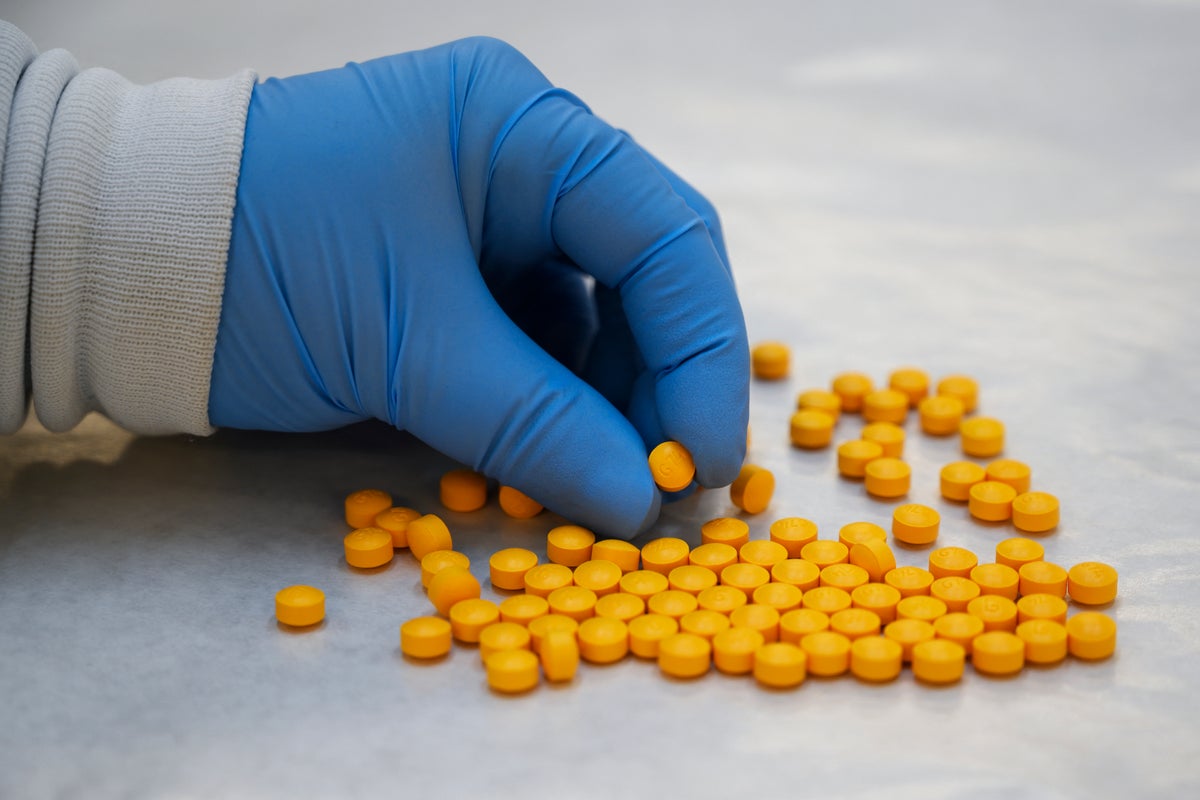
The iron grip fentanyl held on the illicit American drug market is slipping, but the replacement is a nightmare of pharmacological engineering. For a decade, fentanyl was the apex predator of the opioid crisis—predictable in its lethality and known to first responders. That era ended when a class of synthetic compounds known as nitazenes began appearing in street-level toxicology reports across Tennessee and the Midwest. These aren't just "stronger" drugs; they are a fundamental shift in the chemistry of addiction.
Nitazenes are a family of 2-benzylbenzimidazole opioids that were discarded by Big Pharma in the 1950s for being too dangerous for human consumption. Now, they have been resurrected by clandestine labs to bypass the legal restrictions currently strangling the fentanyl supply. In Tennessee alone, these substances have been linked to over 90 deaths in a brief window, with 2024 and 2025 data showing a sharp, vertical climb in detection rates. The problem isn't just that they are ten to twenty times more potent than fentanyl. The problem is that our current safety net—from test strips to emergency room protocols—was never designed to catch them.
The Chemistry of a Ghost Drug
To understand why nitazenes like protonitazene and isotonitazene are so devastating, you have to look at the receptor site. While fentanyl binds tightly to the mu-opioid receptors in the brain, nitazenes do so with a savage efficiency that triggers respiratory failure almost instantly. In many cases, the "window of life"—the time between ingestion and the last breath—is cut by more than half compared to traditional heroin or even fentanyl.
Traffickers are moving toward these compounds because they are a logistical dream. Because a few grams of a nitazene analog can be more potent than a kilogram of heroin, smuggling is trivial. We are seeing these chemicals arrive in the United States through standard international mail in small, innocuous envelopes that contain enough "product" to fuel thousands of lethal doses.
More concerning is the "poly-substance" trend. Nitazenes are rarely sold as nitazenes. They are the hidden ingredient in counterfeit Oxycodone tablets (the infamous "blue M30s") and are increasingly found mixed into xylazine (tranq) and even cocaine. In 2025, the DEA reported a 17% rise in nitazene detections within fentanyl-positive samples. The market is becoming a toxic stew where the user has zero visibility into what they are actually consuming.
Why Naloxone is Losing the Race
The most terrifying aspect of the nitazene surge is the failure of the standard toolkit. For years, public health officials have leaned on Naloxone (Narcan) as the ultimate "undo" button for overdoses. It still works on nitazenes, but the math has changed.
Because nitazenes have such a high affinity for opioid receptors, they often "outcompete" the Narcan. First responders in Nashville and Knoxville are now reporting cases where four, five, or even six doses of Narcan are required to bring a victim back to consciousness. Often, the victim will wake up briefly, only to slip back into a fatal respiratory depression minutes later as the nitazene—which can have a longer half-life than the antidote—re-attaches to the brain.
- Detection Gaps: Standard five-panel and even advanced drug tests often fail to register nitazenes.
- Test Strip Limitations: Most fentanyl test strips are chemically incapable of detecting the benzimidazole structure of a nitazene.
- Active Metabolites: Unlike many drugs, the body breaks nitazenes down into "active metabolites" that are sometimes even more potent than the original drug.
The Tennessee Ground Zero
Tennessee has become a grim laboratory for this crisis. The state's Department of Health recently warned that the true death toll is likely "vastly underestimated" because many county coroners simply do not have the specialized testing equipment required to identify these specific molecules. If you don't look for a nitazene, you will only see an "opioid overdose" of unknown origin.
This lack of data creates a dangerous feedback loop. Policymakers see fentanyl deaths plateauing and think the battle is being won. In reality, the body count is simply being shifted to a new, invisible column. This isn't a "new drug" in the way we usually think of them; it is a tactical evolution by cartels and independent labs to stay one step ahead of the DEA’s scheduling actions. Every time a specific nitazene is banned, a chemist in a lab thousands of miles away tweaks a single molecule to create a legal, and often more potent, alternative.
The Infrastructure of a New Epidemic
We are currently witnessing the transition from an epidemic of "addiction" to an epidemic of "poisoning." When the potency of a substance reaches the level of protonitazene, the line between a recreational dose and a lethal dose becomes microscopic. It is a level of precision that is impossible to achieve in a basement lab using a $500 pill press.
The response from the federal government has been predictably slow. While the DEA moved to emergency-schedule several nitazene analogs in late 2025, the supply chain is too fragmented and too digital to be stopped by traditional interdiction. This is no longer about stopping "mules" at the border. This is about an invisible chemical flow through the global postal system.
Survival in this new era requires a brutal admission: the "Fentanyl Crisis" is now a "Synthetic Crisis." The era of "safe" illicit drug use—if it ever existed—has been permanently buried under a wave of high-potency research chemicals. Until the testing infrastructure catches up to the chemistry, the death toll in states like Tennessee will continue to rise, hidden in plain sight.
Equip every first responder with double the standard Narcan supply and mandate high-resolution mass spectrometry for every overdose death. Anything less is just guessing while the bodies pile up.