The air in Ukraine at 3:00 AM doesn’t smell like fresh morning dew anymore. It smells like ozone, charred concrete, and the metallic tang of adrenaline. When the sirens begin, they don’t just make a sound; they vibrate in the marrow of your bones. It is a low, mournful howl that signals the end of sleep and the beginning of a cold, calculated lottery.
Last night, the lottery numbers came up short for at least seven people.
They were not soldiers in a trench. They were not strategists huddled over maps in a command center. They were people who had, hours earlier, brushed their teeth, set their alarms for work, and tucked children into beds that they believed—or hoped—were safe. They were civilians living in the crosshairs of a persistent, high-altitude indifference.
The Geography of Grief
The statistics are cold. Seven dead. Dozens wounded. A handful of apartment blocks reduced to skeletal remains. But statistics are a veil. They hide the reality of a kitchen table split in half, a child’s backpack buried under a meter of pulverized brick, and the silence of a phone ringing in a pocket that will never be answered again.
The strikes didn't hit a single point. They were a scattered fist, striking at the heart of the country's civilian infrastructure. In the darkness, drones and missiles crossed the border, tracing invisible lines through the atmosphere. Each one carries enough explosive force to turn a home into a tomb in less than a second.
Consider the mechanics of the impact. A missile traveling at supersonic speeds doesn't just hit a building; it creates a vacuum of pressure followed by a wall of heat. Windows miles away blow inward. The very air is sucked out of the lungs of those nearby. This isn't a "surgical strike." It is an amputation of a neighborhood.
The Ghost of Normalcy
Ukraine has become a master of the surreal. In the daytime, you see people drinking espresso at sidewalk cafes. They discuss the news, they argue about politics, and they walk their dogs. But look closer at their eyes. There is a specific kind of fatigue there—a shadow that never lifts.
This is the hidden stake of the war: the slow, systematic erosion of the human psyche.
When the sun goes down, the "normalcy" dissolves. Every low-flying plane, every heavy truck hitting a pothole, every sudden thunderclap sends a jolt of cortisol through the population. Living under a sky that can turn lethal at any moment isn't just dangerous; it is exhausting. It is a marathon where the finish line keeps moving.
Last night’s casualties were mothers. They were grandfathers. They were the people who make a society function. When seven people are killed in an overnight raid, it isn't just seven lives lost. It is seven voids left in a social fabric that is already being pulled to the breaking point. It is seven families who now have to navigate a world that feels fundamentally broken.
The Architecture of Ruin
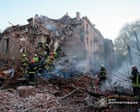
There is a specific sound to a rescue operation. It is the rhythmic scraping of shovels against grit. The bark of a search dog. The sudden, terrifying silence when a worker shouts for everyone to stop, hoping to hear a faint tap or a muffled cry from beneath the rubble.
Working these scenes requires a heart of stone and the hands of a surgeon. Rescuers climb over unstable piles of debris, knowing that the "double tap"—a second strike aimed at those coming to help—is a very real tactic. They move through the dust, illuminated by floodlights that make the scene look like a stage play of the apocalypse.
They find the mundane things first. A single shoe. A scorched frying pan. A high school diploma. These objects are the anchors of a life. Seeing them scattered across a wasteland of gray dust is a reminder that the distance between "everything is fine" and "everything is gone" is exactly the length of a missile's flight path.
A Language of Iron and Fire
We often talk about these events in the language of geopolitics. We discuss escalation, defense systems, and international aid packages. We treat the map like a chessboard. But for the person standing in front of a burning apartment complex, geopolitics is an abstraction. The only thing that is real is the smoke stinging their eyes and the heat on their face.
The air defense systems—the Patriots, the IRIS-Ts, the NASAMS—are the only reason that number isn't seven hundred. They are the invisible shield that intercepts the majority of the metal rain. But no shield is perfect. Some things always get through.
Every time a missile is intercepted, the debris still has to fall somewhere. Even "success" in this war involves shrapnel raining down on playgrounds and parking lots. It is a win, but it is a win that leaves scars.
The Weight of the Morning After
When the sun finally rises over the smoldering ruins, the world moves on. The headlines shift. The news cycle refreshes. But for the survivors of last night's strikes, the morning brings no relief. It brings the crushing weight of realization.
They have to find a way to explain to a child why their bedroom wall is gone. They have to identify bodies in a morgue that is already too full. They have to figure out how to breathe in a city that feels like a target.
This is the true cost of the conflict. It isn't just the billions of dollars in damage or the hectares of lost territory. It is the stolen sleep. It is the permanent flinch. It is the fact that an entire generation of children will grow up knowing exactly what a drone sounds like before it hits.
The world watches the footage on a screen, scrolls past the photos of the fire, and notes the death toll. Seven. It seems like a small number in the context of a global war. But for those seven people, it was the end of the world. For their neighbors, it was a reminder that they are still on the list.
The fire is eventually extinguished. The dust eventually settles. But the sky remains, wide and indifferent, waiting for the next time the sirens begin their hollow scream.
In the silence that follows, you can hear the heart of a country beating—fast, terrified, but refusing to stop.