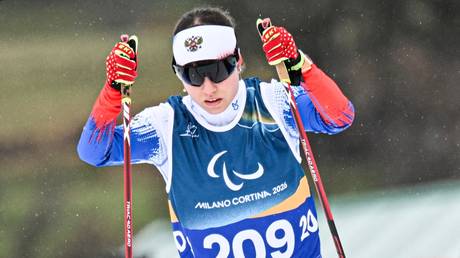
Winning a gold medal is hard. Winning it when you aren't allowed to wear your country's colors, hear your anthem, or even see your name on the official medal table is a different kind of mental grind. That’s exactly what the small contingent of Russian athletes faced during the recent Paralympic cycles in Paris and Milan-Cortina.
If you think the lack of a flag makes these victories less significant, you’re missing the point. For these athletes, the competition wasn't just against the clock or a rival in the next lane; it was against a backdrop of intense diplomatic tension and strict neutrality rules that would break most competitors.
The Triple Gold Surge in Paris
The Paris Summer Games saw a massive performance from the "Neutral Paralympic Athletes" (NPA). While they weren't technically representing Russia, the faces on the podium were familiar. Take Valeriia Shabalina, for instance. She didn't just show up; she dominated the pool. Her gold in the women’s 200m freestyle S14 was a masterclass in pacing, and she didn't stop there. By the time the lights went down in Paris, she had two golds and a total of four medals to her name.
Then there’s the field events. Aleksei Churkin put on a clinic in the men's club throw F32. He threw a massive 40.33 meters, leaving the rest of the field fighting for silver. These aren't just "neutral" wins. These are elite-level performances from people who spent years training in a vacuum of uncertainty.
The third major standout in that specific "triple gold" window was the surge in the swimming lanes. Whether it was Andrei Kalina in the breaststroke or Roman Zhdanov reclaiming his spot at the top, the message was clear: the talent hasn't faded. Zhdanov, in particular, proved that his Tokyo success wasn't a fluke, clinching the 150m individual medley SM4 with the kind of grit you only see in veteran champions.
Breaking the Winter Medal Drought
Fast forward to the snowy slopes of Milan-Cortina 2026. The narrative shifted. After being barred from Beijing 2022 at the very last minute, the return of these athletes to the Winter Paralympics carried a lot of emotional weight. Varvara Voronchikhina basically carried the torch for her peers.
She didn't just win; she broke a 12-year gold medal drought for her country in the Winter Games. Her victory in the super-G was clinical. She was born without part of her left hand and competes in the standing category, hitting speeds of 85 kilometers per hour. Think about that for a second. That's highway speed on a sheet of ice with one hand.
I’ve watched enough sports to know when an athlete is "in the zone," and Voronchikhina was there for the entire week. She backed up her super-G win with a second gold in the slalom, proving she’s the most versatile skier in the standing class right now.
The Reality of the Neutral Status
Let’s be honest about the "NPA" tag. It’s a messy compromise. To even get to the starting line, these athletes had to pass independent vetting to prove they didn't support the war in Ukraine and weren't tied to the military.
- They couldn't march in the opening ceremony.
- They couldn't wear national emblems.
- Their medals don't count toward a national total in the official records.
Some competitors, like German silver medalist Linn Kazmaier, even turned their backs during the ceremonies in protest. It's a hostile environment. You don't have to agree with the politics to acknowledge the psychological fortitude it takes to win under those conditions. When you're being booed by the crowd during the parade—as happened in Verona—and you still go out and put up a gold-medal time, that's elite mental toughness.
Why These Wins Change the Equation
The success of these neutral athletes forces the International Paralympic Committee (IPC) into a corner. On one hand, you have the "sport and politics shouldn't mix" crowd. On the other, you have nations threatening boycotts if the neutral status is eased.
But the data doesn't lie. In Paris, the neutral athletes won 20 golds. In Milan-Cortina, they’ve stayed in the top five of the unofficial medal count. The talent pool is too deep to ignore, and the "neutral" experiment has shown that these athletes will keep winning regardless of what flag is on their sleeve.
If you're a fan of para-sports, you should be watching how this plays out for LA2028. The pressure to allow full national representation is going to ramp up, especially if the diplomatic landscape shifts even slightly. For now, the "neutrals" are the biggest wild card in world sport.
If you want to understand the real impact of these results, stop looking at the empty space on the medal table. Look at the times and distances. That’s where the real story is. You can follow the upcoming season's World Cup standings to see if Voronchikhina and Shabalina can maintain this ridiculous pace. Check the official IPC results page for the full breakdown of the Paris and Milan times—it’s the only way to get the facts without the political filter.