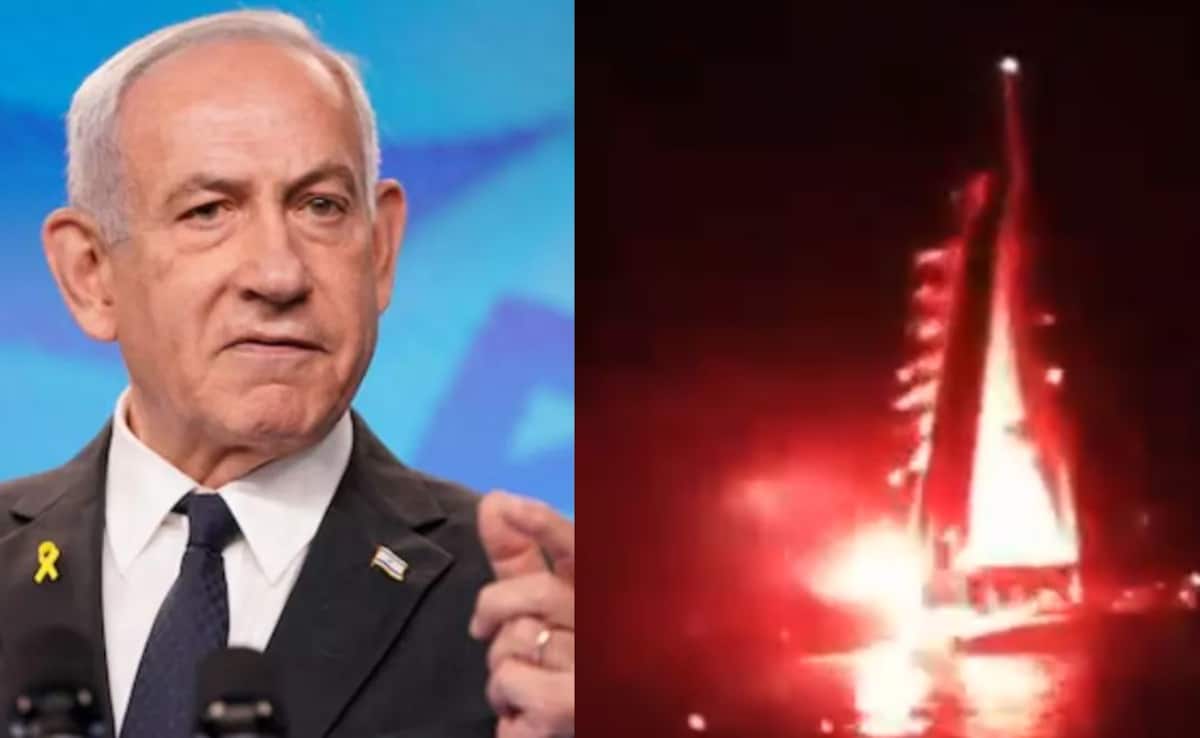
Benjamin Netanyahu doesn't care about your optics. While the world watched grainy footage of Israeli commandos boarding the "Global Sumud" flotilla near Crete, the Israeli Prime Minister was already busy writing the punchline. His message to the 175 activists currently being hauled back to Greece wasn't a diplomatic apology or a legal defense. It was a playground taunt: "They will continue to watch Gaza on YouTube."
It’s blunt. It’s inflammatory. And it’s exactly how Netanyahu wants to play this.
For the activists on those 20 boats, this was a mission to break a naval blockade they view as a crime against humanity. For Netanyahu, it was a "Hamas-supporting stunt" that didn't even deserve a serious rebuttal. By telling them to watch the war from their computer screens, he's basically saying that the era of "activist diplomacy" at sea is dead. He’s not just stopping the boats; he’s mocking the very idea that a few hundred people with flags can change the facts on the ground.
The Mid-Sea Interception You Didn't See
Most people think these confrontations happen right off the coast of Gaza. They don't. This time, the Israeli Navy moved in hundreds of miles away, near the southern Greek island of Crete. This wasn't a panicked last-minute stop. It was a calculated, long-range operation to ensure these ships never even smelled Palestinian waters.
Activists are claiming the raid was violent. They’re telling stories of smashed engines, destroyed navigation arrays, and being left stranded in the path of an approaching storm. The Israeli Foreign Ministry, on the other hand, calls the operation "peaceful and without casualties."
You’ve got two completely different realities. One side sees piracy in international waters; the other sees a necessary security filter. But here’s the thing: while the activists were busy documenting the "abduction," the Israeli government was already moving the pieces to Greece. By striking a deal with the Greek government to offload the participants there, Israel neutralized the legal headache of bringing them into Israeli territory for processing. It’s a clean, efficient removal that keeps the story away from Israeli courtrooms.
Why the YouTube Comment Hits a Nerve
Netanyahu’s "Watch Gaza on YouTube" line isn't just a random insult. It's a callback to a decade of tension. If you remember the 2010 Mavi Marmara incident, you know how badly these things can go. Back then, nine people died. It was a PR disaster that took years to patch up.
By framing the 2026 flotilla as something to be "watched on YouTube," Netanyahu is signaling that Israel has perfected the art of the bloodless shutdown. He’s telling the world that he can stop these convoys without making martyrs. To him, these activists aren't heroes; they’re tourists in a conflict they don't understand, better suited for a comment section than a combat zone.
It’s a strategy of de-escalation through humiliation. When you make your enemy look like a frustrated social media user rather than a persecuted revolutionary, you win the narrative war before the first court case is even filed.
The Numbers Behind the Blockade
Let’s look at why Israel feels they can be this cocky. The Board of Peace—the body set up under the Trump peace plan—claims that aid into Gaza is actually up.
- Food aid is reportedly reaching three times more people than it was before the October ceasefire.
- Hamas’ reported theft of aid has plummeted from 90% to less than 1% because of new distribution checks.
- Nutrition levels are allegedly improving, according to some UN metrics.
Whether you believe those numbers or think they're laundered statistics, they give Netanyahu the cover he needs. His argument is simple: why do we need a "Global Sumud" flotilla if the legal aid channels are working better than ever? He’s painting the activists as people who don't actually care about food or medicine, but only about the "provocation" itself.
The Legal Grey Zone of International Waters
This is where things get messy. Spanish Prime Minister Pedro Sánchez is already screaming about violations of international law. Iran is calling it "piracy." They’re not entirely wrong to ask questions. If you’re 600 miles away from a conflict zone, what right does a military have to board your boat?
Israel relies on a specific interpretation of maritime law that allows for the enforcement of a blockade even in international waters if there’s a "clear intent" to breach it. It's a legal loophole big enough to sail a destroyer through. Because the flotilla organizers openly stated their goal was to reach Gaza, Israel argues the "intent" was proven the moment they left Barcelona.
Honestly, the legal debate is a sideshow. The real story is the shift in power. In 2010, a flotilla could spark a global crisis. In 2026, it results in a snarky tweet and a boat ride to Greece.
What Happens to the Activists Now?
Don't expect these people to be in a jail cell for long. Most are being processed and sent back to their home countries. Two "suspects" were taken for deeper questioning, but for the rest, the journey ends at a Greek airport.
If you're following this and wondering if another flotilla will try its luck, the answer is almost certainly yes. But they're facing a much tougher environment.
- The US is firmly on Israel's side, calling the flotilla a "baseless, counterproductive stunt."
- Regional partners like Greece are cooperating with Israel to keep the activists out of the headlines.
- Technology allows the Israeli Navy to track and disable these boats long before they get close to a camera crew on the shore.
The "Watch Gaza on YouTube" era is here. It’s a world where the physical act of protest is being systematically outmaneuvered by a mix of high-seas tech and aggressive PR. If you want to see what's happening in Gaza, Netanyahu is happy to let you—as long as you stay behind your screen.
For those looking to actually influence the situation, the lesson is clear: the sea isn't the shortcut it used to be. You're better off focusing on the legal aid corridors or political lobbying in D.C. and Brussels. The days of "Love Boat activism" breaking a blockade are, for now, officially over. If you're planning on joining the next one, make sure your Wi-Fi is strong—you're going to need it to watch the footage of your own deportation.


