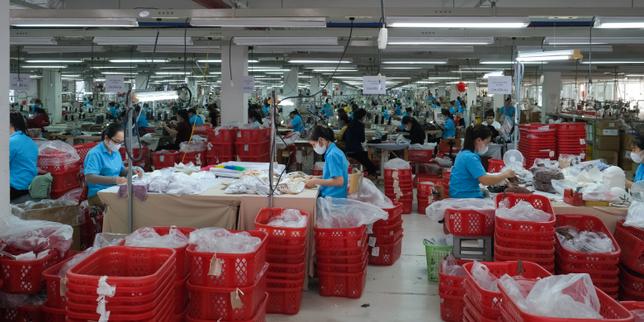
Lan sits at a workstation in a sprawling facility on the outskirts of Ho Chi Minh City. The hum of industrial sewing machines is the only rhythm she has known for a decade. It is a deafening, metallic song. In her hands, a synthetic fabric—destined to become a fast-fashion jacket for a suburban mall in Ohio—moves with the precision of a practiced surgeon.
She does not know the name Donald Trump. She does not track the intricacies of trade policy or the shifting currents of protectionist tariffs. To Lan, the world is a series of orders placed, materials sourced, and boxes shipped. But lately, the frantic energy of her factory floor has shifted. The rhythm has quickened.
For years, global manufacturing was a game of musical chairs. When costs rose in one nation, companies simply packed their bags and moved to the next cheapest locale. China held the crown for decades, an unstoppable juggernaut of production. But as the geopolitical winds shifted and the American administration began tightening the screws on trade, the music stopped.
The strategy was simple, even blunt: make it prohibitively expensive to import goods from the world’s largest manufacturer.
This policy was designed as a fortress wall, meant to encourage domestic production and punish foreign reliance. Instead, it acted as a tectonic plate shifting the global supply chain. Where the United States exerted pressure, the supply chain simply bent, finding the path of least resistance.
That path led straight to Vietnam.
Consider the mechanics of this migration. When tariffs strike, companies look for a loophole. They do not necessarily return to the country of origin to manufacture; they look for a new hub that sits outside the crosshairs. Vietnam emerged not just as an alternative, but as the primary beneficiary of this geopolitical redirection. It is a classic case of economic displacement. The investment that once poured into Shenzhen now flows into the industrial zones of Binh Duong and Hai Phong.
The statistics are sterile. They speak of increased export volume, shifts in Foreign Direct Investment (FDI), and a growing reliance on Vietnam as a cornerstone of the American apparel market. But the reality is measured in the callus on Lan’s thumb and the frantic pace of midnight logistics.
There is a strange, invisible tether between a voter in the American Midwest and a worker in a Vietnamese factory. The voter wants jobs back home; they want the security of local industry. The policy they support is meant to serve that vision. Yet, the outcome—at least for now—is a transformation of life thousands of miles away.
This is the hidden cost of trade wars. The ripples do not stop at the border; they travel across the ocean.
As factories expand to meet this surge in demand, the social landscape of Vietnam changes. Younger workers flock to the cities, leaving behind ancestral villages. The air near industrial zones grows heavy. The infrastructure strains under the weight of a rapid, forced modernization. This is the "Vietnam Miracle" in action, but it is a miracle fueled by the frantic need of global brands to keep prices low while circumventing American customs duties.
But what happens when the next wave of policy hits?
Global manufacturing is notoriously fickle. It operates on the principle of maximum efficiency. If the costs in Vietnam begin to rise—through labor shortages, environmental regulations, or, eventually, the same tariffs that drove them here—the capital will move again. The machines will go silent. The workers will be left to find new rhythms.
I remember talking to a logistics manager in a port city during a previous shift in market winds. He looked at a container ship as if it were a ghost. He explained that these global movements are not driven by loyalty or long-term growth for the host country. They are driven by the search for the absolute bottom line.
"We are just a stop on the map," he told me. "We are the current destination because it makes the math work."
The irony is sharp. The protectionist measures meant to insulate the American consumer from foreign competition have instead created a massive, temporary boom for a nation that was never meant to be the focus of the policy. It is a lesson in the unintended consequences of high-level maneuvering. You can try to wall off an economy, but you cannot stop the flow of capital; you can only change its direction.
For the American consumer, the jacket arrives on time. It is affordable. It is available. They do not see the frantic assembly. They do not see the massive logistical apparatus that shifted across continents in months rather than years to ensure that the label remains "Made in Vietnam" rather than "Made in China."
The system is remarkably robust, yet terrifyingly fragile. It is held together by spreadsheets, shipping manifests, and thousands of people like Lan. They are the shock absorbers for policies they cannot influence and impacts they cannot predict.
As we look at the current state of these trade relationships, we must acknowledge that this is not a permanent solution. It is a temporary accommodation. The factories are bustling today, and the shipping containers are stacking high in the ports. But the wind is always shifting.
One day, the machines will slow down. A different country will offer a lower wage. A different tariff will close a different door.
For now, the work continues. The sewing machine hums. The fabric moves. The global economy, in its relentless search for the path of least resistance, continues its long, winding journey, indifferent to the individuals caught in the undertow. The story is not about tariffs. It is about the people who survive them.
The sun rises over the factory roof, casting long, sharp shadows across the floor. Lan picks up the next jacket.
She pushes the needle through.
The machine starts again.