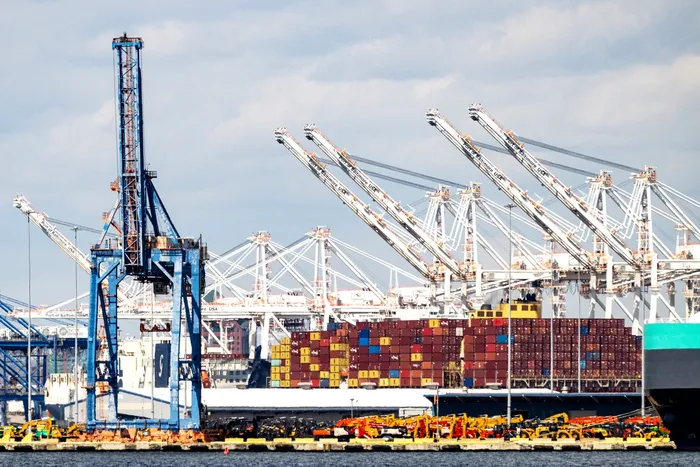
Arthur sits at a mahogany desk that has seen three generations of upholstery. Outside his window, the rhythmic clanging of shipping containers echoes off the harbor, a metallic heartbeat that usually signals prosperity. But today, the sound is a taunt. On his screen is a spreadsheet—a digital graveyard of margins bled dry by 25 percent tariffs. He is a small-scale importer of specialized industrial valves, the kind of quiet, essential hardware that keeps regional water treatment plants humming. For two years, he has been paying a "tax" he didn't choose on goods he can’t source elsewhere.
He is not alone. Across the country, thousands of business owners are staring at similar ledgers, feeling the weight of a geopolitical chess match they never signed up to play. They see the headlines about trade wars and global shifts, but for them, the "war" is a line item that threatens their ability to keep a warehouse manager on staff.
Then, a whisper of a chance appears: the refund.
Most people view trade law as a sedative in text form. It is perceived as a dense thicket of codes, Harmonized Tariff Schedule (HTS) numbers, and bureaucratic jargon designed to repel the human spirit. Yet, buried within the Federal Register are the "Exclusions." These are the golden tickets. They are the legal admissions that, perhaps, a specific tax was applied too broadly or unfairly. For a tiny sliver of American businesses, there is a path to claw that money back from the government’s grasp.
The Invisible Ledger
To understand the stakes, we have to look at how this money vanishes in the first place. When a shipment hits the pier, the importer doesn't just pay for the goods. They pay a duty—a percentage of the value—to U.S. Customs and Border Protection. Under Section 301 of the Trade Act of 1974, those duties skyrocketed on hundreds of billions of dollars worth of Chinese-origin goods.
For a massive tech conglomerate, a 25 percent hike is a rounding error or a nudge to move a factory to Vietnam. For Arthur, it is the difference between a new delivery truck and a repair job held together with duct tape and hope.
The refund process is formally known as a "Duty Drawback" or a "Section 301 Exclusion Refund." It isn't a gift. It is more like a forensic audit of a crime scene. To get the money back, a business must prove that their specific product was granted an official exclusion by the Office of the United States Trade Representative (USTR).
Consider a hypothetical scenario involving a company we’ll call "Solaris Components." They import a very specific grade of tempered glass used in solar panels. For months, they paid the heavy Section 301 tariffs. Then, the USTR ruled that because this glass cannot be produced in sufficient quantities within the United States, it should be exempt. The window for a refund opens, but it doesn't stay open long. The clock is a silent killer in the world of trade.
The Anatomy of the Lucky Few
Who actually gets the check? It isn't just the lucky; it’s the meticulously organized. The "lucky few" are those who can bridge the gap between a physical box in a warehouse and a digital entry in a customs portal.
The first group includes those whose products fall under "active exclusions." These are specific HTS codes that the government has signaled out for relief. If you are importing medical-grade gloves during a pandemic or specific electric motors that have no domestic equivalent, you might be standing on a gold mine of overpayments.
The second group is more tragic: those who had an exclusion but didn't know it. They are the businesses that used a generic customs broker who didn't bother to check the updated exclusion lists. These lists change with the volatility of a weather report in a hurricane. A product that was taxed on Tuesday might be exempt on Wednesday, but if your paperwork still lists the old status, the government keeps the change.
The third group consists of the innovators—the ones who successfully petitioned for a "Product Exclusion." This requires proving that the tariff causes "severe economic harm" or that the product is not available outside of China. It is an adversarial process. You are essentially telling the government, "Your policy is breaking my back."
The Paperwork Labyrinth
Imagine standing in a dark room filled with a million filing cabinets. You are told that one of them contains a check for eighty thousand dollars. To find it, you need a key that only fits if you can prove exactly which boat your goods were on, which day they cleared the dock, and that the chemical composition of your valves matches a 10-digit code precisely.
This is the reality of filing a "Post-Summary Correction" (PSC) or a "Protest."
If a business discovers they qualify for a refund, they can't just send an invoice to the Treasury. They must file a PSC if the entry hasn't been "liquidated" (a fancy term for the government finalized the transaction). If it has been liquidated, they have to file a formal Protest under 19 U.S.C. § 1514. You have 180 days from the date of liquidation to find your voice. If you miss it by a day? The money belongs to the sky.
The complexity is the point. It serves as a natural filter that keeps the timid and the disorganized away from the vault.
Let's look at the math, because the math is where the emotion hides. If Arthur’s company imported $2 million worth of valves over eighteen months, a 25 percent tariff means he handed over $500,000. If he secures an exclusion, that half-million dollars returns to his cash flow. That is not just "capital." That is three new hires. That is a down payment on a larger facility. That is the survival of a family legacy.
The Human Cost of Silence
There is a specific kind of exhaustion that comes from being right but being ignored. I have talked to business owners who spent late nights scouring the USTR website, their eyes blurring over "Subchapter III of Chapter 99." They feel like they are shouting into a void.
One importer told me about the moment his refund finally hit his bank account. He didn't celebrate with champagne. He went into his warehouse and told his lead foreman that the layoffs they’d been whispering about for months were officially off the table. He described it as a "weight lifting off his lungs."
The tragedy is that billions of dollars in eligible refunds go unclaimed every year. Small businesses often assume that these programs are for the "big guys"—the Boeings and the Apples of the world. They assume the cost of the legal help to get the refund will outweigh the refund itself. Sometimes they are right. Often, they are wrong.
The barrier isn't just the law; it's the intimidation factor. The language of trade is designed to sound like a foreign tongue. Terms like "Value Added," "Country of Origin," and "Substantial Transformation" act as gatekeepers.
The Strategy of the Recovered
How do the survivors do it? They treat their customs data like a high-value asset rather than a chore.
- The Audit: They don't trust their brokers blindly. They run their own reports to see exactly what they paid and under which codes.
- The Monitor: They set up alerts for USTR announcements. When an exclusion is extended or a new one is granted, they know within minutes.
- The Pivot: If an exclusion is denied, they look at "Tariff Engineering." This isn't illegal; it’s the art of modifying a product just enough—perhaps by changing a non-essential component—so it falls under a different, lower-taxed HTS code.
It is a game of inches. A game of 10-digit numbers where a "9" instead of an "8" can cost a fortune.
The money sitting in the Customs House isn't some abstract government fund. It is the blood and sweat of people who moved freight, signed contracts, and took risks. It is a debt owed back to the economy.
Arthur still listens to the containers clanging at the harbor. But now, he has a folder on his desk labeled "Exclusion 9903.88.XX." Inside that folder is the evidence of his tenacity. He has spent forty hours documenting the chemical properties of a single brass fitting. He has mapped the journey of a cargo ship across the Pacific with the precision of a navigator.
He is waiting for the government to admit its mistake. He is waiting for his money to come home.
The path to a tariff refund is not a walk; it is a siege. It requires a level of stubbornness that most people reserve for religious debates or marathons. But for the few who refuse to blink, the reward is more than just a line on a balance sheet. It is the restoration of fairness in a system that often feels anything but fair.
The vault is heavy. The doors are thick. The paperwork is mountainous. But the keys exist, and for those willing to learn the lock, the payoff is the ultimate lifeline.