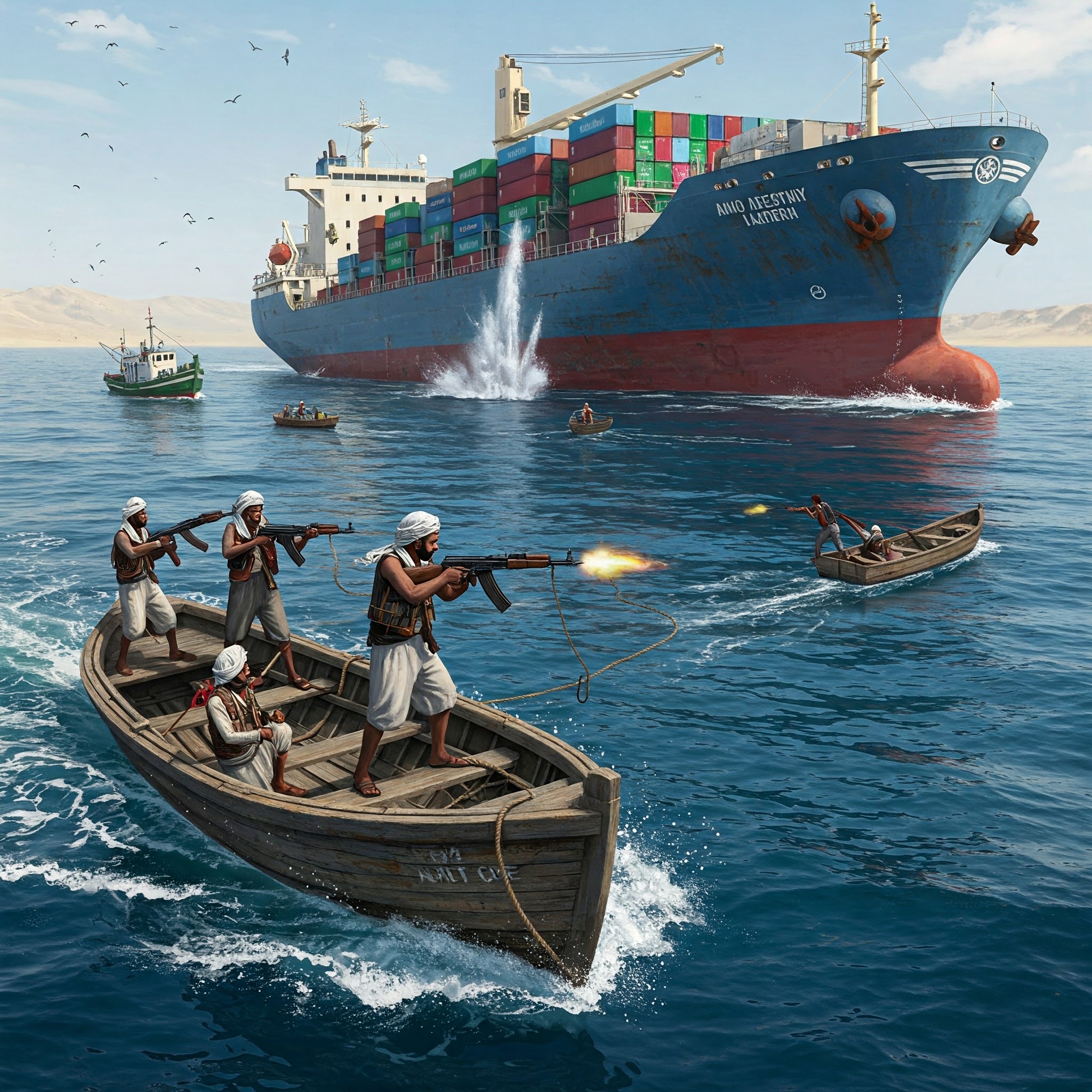
The recent engagement involving two Iranian fast attack craft (FAC) firing upon a commercial tanker in the Strait of Hormuz represents a calculated shift in maritime grey-zone tactics. This incident transcends simple piracy or random aggression; it is a demonstration of the Iranian "Mosquito Fleet" doctrine, designed to test the response thresholds of international maritime security Task Forces while exerting psychological pressure on global energy supply chains. By analyzing the mechanics of the engagement, the technical limitations of merchant vessel defense, and the broader geopolitical friction points, we can map the strategic calculus governing this chokepoint.
The Mechanics of Asymmetric Engagement
The deployment of small, agile gunboats against massive, slow-moving commercial hulls creates a distinct tactical imbalance. The Iranian naval strategy relies on high-speed maneuverability to negate the size advantage of merchant vessels. In this specific kinetic event, the use of small arms or light autocannon fire serves three distinct operational objectives:
- Compliance Testing: Forcing a vessel to alter course or stop without the immediate intent to sink it allows the aggressor to gauge the crew's discipline and the efficacy of onboard private maritime security teams (PMSTs).
- Signal Transmission: The act of firing, even if it results in negligible structural damage, communicates a readiness to escalate that exceeds standard boarding procedures.
- Response Latency Mapping: By initiating contact in proximity to United Kingdom Maritime Trade Operations (UKMTO) monitored zones, the aggressor measures the "sensor-to-shooter" timeline of nearby Western naval assets.
The technical specifications of these gunboats—likely derived from modified Boghammar or Zulfiqar-class designs—allow them to operate in the cluttered radar environment of the Strait. Their low radar cross-section (RCS) makes early detection difficult for standard commercial X-band or S-band radars, which are optimized for larger navigational hazards rather than small, high-speed threats.
The Fragility of the Maritime Energy Corridor
The Strait of Hormuz functions as a physical bottleneck where nearly 20% of the world's liquid petroleum passes daily. The operational reality of a tanker—specifically a Very Large Crude Carrier (VLCC) or Suezmax—is defined by extreme inertia. A fully laden tanker requires miles to execute a significant course change and even longer to come to a full stop. This lack of agility makes them "sitting ducks" for FACs.
The cost function of these incidents extends beyond the physical risk to the crew. The maritime insurance industry, specifically the Lloyd’s Market Association’s Joint War Committee (JWC), reacts to kinetic events by adjusting "Listed Areas" or War Risk zones.
- Additional Premium (AP): Shipowners must pay a surcharge to enter high-risk zones, often calculated as a percentage of the hull value for a specific duration.
- Operational Friction: Increased security protocols, such as the deployment of PMSTs or the implementation of Best Management Practices (BMP5), add significant overhead to every transit.
- Deviation Costs: If a carrier decides to avoid the Strait, the fuel and time costs of rerouting around the Cape of Good Hope can run into the millions of dollars per voyage, depending on current bunker prices.
The Iranian strategy leverages this economic sensitivity. By maintaining a state of "perpetual volatility," they can manipulate global oil futures without needing to initiate a full-scale blockade, which would invite a definitive military response.
Structural Limitations of Merchant Defense
Current maritime law and international conventions limit the defensive capabilities of commercial vessels. While many tankers now employ armed guards, their Rules of Use of Force (RUF) are strictly defensive. They are equipped with small arms meant to repel boarders, not to engage in naval warfare against state-actor gunboats equipped with heavy machine guns or man-portable air-defense systems (MANPADS).
The mismatch is not just in firepower but in legal standing. A merchant vessel that returns fire against a state-owned vessel (even a small gunboat) risks being reclassified as a "combatant" under certain interpretations of international maritime law, potentially voiding insurance policies and complicating diplomatic protections. This creates a "hesitation gap" that Iranian forces exploit.
The Triad of Regional Escalation
To understand why this specific incident occurred now, one must examine the intersection of three specific regional stressors:
1. Sanctions-Related Seizures
The history of "tit-for-tat" maritime seizures remains the primary driver of Hormuz instability. When Iranian oil shipments are intercepted in international waters due to sanctions enforcement, the IRGC (Islamic Revolutionary Guard Corps) typically responds by targeting Western-linked or high-value tankers within the Strait. This creates a cycle where maritime security is used as a proxy for diplomatic leverage.
2. Tactical Proximity and Territorial Ambiguity
The Strait is narrow, with the shipping lanes passing through the territorial waters of Oman and Iran. This proximity ensures that any commercial vessel is constantly within the "strike range" of shore-based anti-ship cruise missiles (ASCMs) and fast-attack craft bases. The ambiguity of "innocent passage" versus "transit passage" provides a legal gray area that Iran uses to justify stopping or harassing vessels for "technical inspections" or "environmental violations."
3. The Failure of Deterrence Frameworks
The presence of Operation Sentry or International Maritime Security Construct (IMSC) forces provides a persistent watch, but they cannot be everywhere at once. The "swarm" capability of the IRGC Navy (IRGCN) means they can mobilize dozens of small craft simultaneously, potentially overwhelming the local response capacity of a single destroyer or frigate.
Digital and Information Warfare Integration
Modern maritime aggression is rarely just physical. It is increasingly paired with GPS spoofing and AIS (Automatic Identification System) manipulation. In several past incidents, vessels have reported "ghost" targets on their radar or have found their GPS coordinates drifted, leading them unknowingly into Iranian territorial waters.
This technical interference serves as a force multiplier. If a tanker's bridge team is confused about their exact position or the intent of nearby vessels, their reaction time is slowed. The use of kinetic fire (as seen in this incident) acts as the final "hard" signal in a sequence of "soft" electronic disruptions. It forces the crew to prioritize immediate physical safety over navigational precision, often leading to the vessel stopping and becoming easier to board or redirect.
Strategic Forecast: The Shift to Autonomous Harassment
The logical progression of these tactics involves the integration of Unmanned Surface Vessels (USVs) and Loitering Munitions. The IRGC has already demonstrated advanced drone capabilities. We should anticipate a transition from manned gunboats to "hybrid swarms" where a single manned command boat controls several autonomous, explosive-laden USVs.
This evolution will significantly lower the "political cost" for the aggressor. If a manned Iranian gunboat is sunk by a Western warship, it constitutes a casus belli. If an autonomous drone is destroyed, the escalation ladder remains manageable. This allows for a higher frequency of harassment with lower risk to personnel.
Operational Recommendations for Maritime Stakeholders
Shipowners and operators must move beyond the passive adherence to BMP5. The current environment demands a more robust, data-driven approach to transit security:
- Hardening of the Citadel: Enhancing the internal "safe room" with independent communication arrays that are shielded from external jamming.
- Dynamic Risk Profiling: Utilizing real-time intelligence feeds that track IRGCN port activity rather than relying on historical incident maps. If fast-craft activity spikes at Bandar Abbas, transits should be delayed or rerouted to the extreme edges of the shipping lanes.
- Visual Deterrence Upgrades: The installation of high-intensity non-lethal deterrents, such as Long Range Acoustic Devices (LRADs) and high-output strobe systems, can provide a layer of defense that disrupts gunboat crews without the legal complications of kinetic return fire.
The incident in the Strait of Hormuz is not an isolated skirmish; it is a refined component of a larger strategy to commoditize maritime insecurity. Operators who treat these events as outliers rather than systemic features of the Hormuz corridor will find themselves unprepared for the inevitable increase in technical and kinetic pressure. Success in this environment requires a transition from reactive safety protocols to proactive, intelligence-led maneuver.