In the heart of Kinshasa, where the humidity clings to the skin like a second thought, the air feels heavy with a specific kind of silence. It is the silence of anticipation. For the people who navigate the dust and the neon of the Democratic Republic of Congo, the future isn't a distant concept. It is a physical weight.
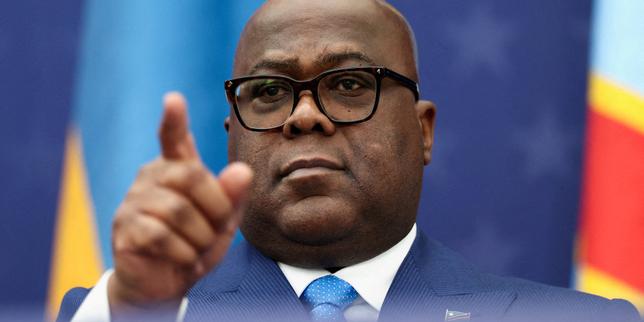
Félix Tshisekedi stands at the center of this weight. He is a man who arrived on a promise of "Le Peuple d’Abord"—the people first. Yet, as the sun sets over the Congo River, the whispers in the street aren't about the next harvest or the price of bread. They are about the clock. Specifically, how many times that clock is allowed to reset.
The Architecture of Ambition
Power in the DRC is not a simple baton pass. It is an intricate, often dangerous dance. To understand why a president might look at the constitution and see a suggestion rather than a rule, you have to look at the ghosts of the Palais de la Nation.
Consider a hypothetical citizen named Moïse. He is twenty-four. He has never known a version of his country that wasn't defined by the struggle to move beyond the "Big Man" era of politics. Moïse watches the news and sees the same patterns repeating. He hears the rhetoric about "stability" and "the need for continuity." These are the classic ingredients of a political recipe that has been simmering in Central Africa for decades.
The current tension boils down to a single, explosive possibility: the revision of the constitution. Under the current rules, Tshisekedi is in his second and final term. But the language shifting out of the ruling party, the Union for Democracy and Social Progress (UDPS), suggests that the rules might be due for an upgrade. They argue that the current document, drafted in 2006, is a foreign-born relic that doesn't fit the "Congolese reality."
This is a seductive argument. It plays on pride. It suggests that by rewriting the laws, the country is finally reclaiming its soul. But the invisible stake is much simpler. If you change the rules of the game while you are winning, are you still playing the same game?
The Weight of the Past
History here is not found in textbooks; it’s carved into the memories of the elders. They remember Mobutu Sese Seko. They remember the decades of a single face on the television, a single name on the currency. When a leader begins to speak about the "limitations" of a two-term limit, those memories start to ache.
Tshisekedi is navigating a labyrinth. On one side, he faces an escalating conflict in the East, where the M23 rebels and various militias have turned the soil into a graveyard. On the other, he deals with an economy that, despite its staggering mineral wealth, leaves the average person struggling to buy a single bag of charcoal.
In this context, the presidency becomes more than a job. It becomes a fortress. To leave the palace is to lose the ability to control the narrative of your own legacy—and perhaps your own safety.
The logic used by the UDPS is that the people voted for a vision that cannot be completed in ten years. They point to the infrastructure projects, the free primary education, and the efforts to formalize the mining sector. They ask: why stop the momentum now?
But momentum is a double-edged sword. If you move too fast toward total control, you risk breaking the very institutions you claim to be building.
The Invisible Border
There is a line that exists in the mind of every voter. It is the line between a leader and a ruler. A leader serves a term; a ruler defines an era.
The opposition, though fractured and often sidelined, sees this constitutional talk as a declaration of war on democracy. Figures like Moïse Katumbi and Martin Fayulu aren't just arguing about legal clauses. They are fighting for the idea that the DRC can be a place where power is borrowed, not owned.
Imagine the scene at a local "Parlement Debout"—the street-corner political debates that define Kinshasa’s intellectual life. Men and women gather under the shade of a mango tree. They argue with a passion that would put any Western senate to shame.
"If he stays, we stay still," one says, gesturing to the potholes in the road.
"If he goes, who protects us from the rebels?" another counters.
The tragedy of the DRC is that both might be right. The fear of the vacuum is often more powerful than the frustration with the status quo. This is the emotional leverage that the presidency uses. It isn't just about a thirst for power; it is about the weaponization of uncertainty.
The Cost of the Reset
When a constitution is rewritten to accommodate a person rather than a principle, the cost is rarely paid by the politicians. It is paid by the Moïses of the country. It is paid in the form of investor jitters, in the suspension of international aid, and in the slow erosion of public trust.
If the 2006 constitution is discarded, the message to the youth is clear: the law is a tool for the powerful, not a shield for the weak.
There is a specific rhythm to this process. First, there is the hint. Then, the "popular demand" orchestrated by provincial governors. Finally, the "emergency" that requires a firm hand. We are currently in the stage of the "hint." It is a delicate time. It is the moment before the concrete sets.
The international community watches with a mixture of fatigue and concern. They want the cobalt. They want the copper. They want the "Green Heart" of Africa to remain stable so the world can meet its climate goals. Often, this desire for "stability" leads to a quiet acceptance of "continuity." It is a cynical trade-off.
The River Does Not Turn Back
The Congo River is one of the deepest in the world. It is relentless. It carries everything toward the sea, regardless of what humans build on its banks. Politics in Kinshasa often tries to mimic this power—to seem inevitable, to seem like a force of nature that cannot be questioned.
Tshisekedi stands at a crossroads that is familiar to many who have held his office. He can choose to be the man who broke the cycle, or the man who became another link in the chain. The rhetoric of "protecting the sovereignty of the nation" is a powerful shield, but it cannot forever hide the reality of a population that is tired of waiting for the "tomorrow" they were promised.
Every time a leader decides that they are the only person capable of saving the country, they inadvertently insult the millions of citizens they lead. They suggest that the nation is so fragile, so broken, that it cannot survive without a specific hand on the tiller.
The stakes are not found in the legal jargon of the constitutional court. They are found in the eyes of the vendors in Goma, the miners in Kolwezi, and the students in Lubumbashi. They are waiting to see if their voices matter more than the ink on a new piece of paper.
The shadow of the palace is long, but it is cast by the sun. And the sun, eventually, must move.
The question isn't whether Félix Tshisekedi can stay. In a system he controls, the answer is almost certainly yes. The real question is what remains of the DRC's soul once the law has been bent to the will of a single man. When the music stops and the dance ends, the Congolese people will still be there, standing by the river, waiting for a dawn that doesn't belong to a president, but to them.


