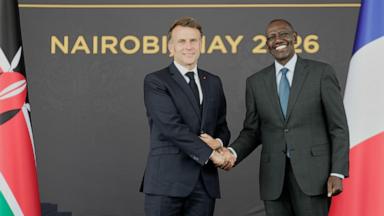
The air in Nairobi doesn’t smell like Paris. It smells of red earth, roasting maize, and the frantic, electric hum of a city that isn’t waiting for permission to grow. Yet, in May 2026, the scent of expensive French cologne drifted through the halls of the Kenyatta International Convention Centre.
France has a problem. For decades, its relationship with Africa was defined by a tight, often suffocating embrace of its former colonies in the West and Center—the "Franc Zone." But the walls of that old house are crumbling. Anti-French sentiment is no longer a fringe whisper; it is a roar in the streets of Bamako and Niamey. To survive on the continent, Paris has realized it must learn to speak a different language. Not just English, but the language of raw, unsentimental business.
Enter the French-African Business Summit in Kenya.
The Language of the Deal
Consider a hypothetical entrepreneur named Amina. She runs a tech logistics firm in Nairobi. To Amina, France has always been a distant museum—a place for vacations or luxury handbags, not a serious partner for her fiber-optic ambitions. She looks to China for infrastructure, the US for venture capital, and India for service models.
When French President Emmanuel Macron sends a delegation to her doorstep, Amina doesn't care about "la francophonie" or shared colonial history. She cares about interest rates, technology transfer, and whether a French bank will actually lend to a Kenyan startup without demanding a pound of flesh.
France is betting billions that they can win over thousands of Aminas.
This isn't about soft power. It’s about hard currency. The French development agency, Proparco, and massive entities like TotalEnergies and CMA CGM are shifting their gaze eastward. They are moving away from the "pré carré"—the private backyard of Francophone Africa—and toward the high-growth engines of the Anglophone East.
Moving Beyond the Shadow of the CFA Franc
The shadow France is trying to outrun is long and cold. In West Africa, the CFA franc is increasingly viewed as a relic of monetary servitude. While France insists the currency provides stability, a new generation of African economists sees it as a leash.
By pivoting to Kenya, France is attempting a historical "reset." In Nairobi, there is no colonial baggage. There is no shared currency to argue over. There are no ghosts of the 1960s lurking in the corner of the boardroom. Here, the relationship is transactional, which, ironically, makes it feel more honest.
The numbers tell a story of desperation and opportunity. French exports to Kenya have surged, yet they still pale in comparison to China’s dominance. France is currently Kenya’s fifth-largest foreign investor, but they are hungry for more. They are targeting the Strategic Partnership for 2026-2030, focusing on green energy, transport, and the "Silicon Savannah."
But the friction is real.
French companies are often perceived as rigid. They arrive with heavy contracts and a preference for "G2G" (government-to-government) deals that bypass the local private sector. Kenya’s business environment is a different beast altogether. It is scrappy. It is digital-first. It is impatient.
The Kenyan Hustle vs. the Parisian Process
Watch a meeting between a French CEO and a Kenyan tech founder. The CEO wants to talk about five-year plans and institutional frameworks. The founder wants to know if the French API can integrate with M-Pesa by Friday.
This cultural collision is where the future of French influence will be decided. If France can adapt to the "hustle" of Nairobi, they may find a blueprint to save their reputation across the rest of the continent. If they remain trapped in their bureaucratic traditions, they will remain a secondary player, a boutique partner in a world of industrial giants.
The stakes are invisible but massive. If France fails to diversify its African partnerships beyond its old colonies, it faces a total eclipse on the continent. Russia is moving in with security deals. China is moving in with bridges and ports. Turkey and the UAE are moving in with trade and aviation.
France is the old power trying to prove it can still learn new tricks.
The Cost of the Pivot
There is a quiet tension in this strategy. As France "woos" Kenya, Nigeria, and South Africa, the leaders in Senegal, Ivory Coast, and Gabon are watching. There is a feeling of a spouse looking for a newer, more exciting partner.
"We stayed loyal to the French language and the French systems," an official from a Francophone nation might grumble, "and now the investment is flowing to those who never spoke a word of French."
It is a cold calculation. Paris has realized that sentimentality is a bad investment strategy. The growth is in the English-speaking hubs. The innovation is in the Lagos-Nairobi-Johannesburg triangle.
A Quiet Resignation of the Past
The summit in Nairobi wasn't just about signing MoUs for water treatment plants or regional railway links. It was an admission of a fundamental shift in the global order.
The era of Françafrique—that murky world of backroom deals and military interventions—is being replaced by a frantic scramble for market share. Macron knows that the youth of Africa, who will make up a quarter of the world's population by 2050, do not care about the grandeur of France. They care about jobs. They care about high-speed internet. They care about who is going to help them build the future without patronizing them.
As the sun sets over the Nairobi skyline, reflecting off the glass of new skyscrapers built with foreign capital, the French delegates pack their leather briefcases. They leave behind promises of billions in credit lines and green energy cooperation.
The success of this mission won't be measured in the headlines of today. It will be measured in whether Amina, our hypothetical entrepreneur, decides to buy a French software suite or sticks with her current providers. It will be measured in whether the red dust of Nairobi eventually settles on French machinery, or if that machinery stays in the crates, a symbol of a bridge that was built too late.
The ground is moving. Paris is finally trying to keep pace.