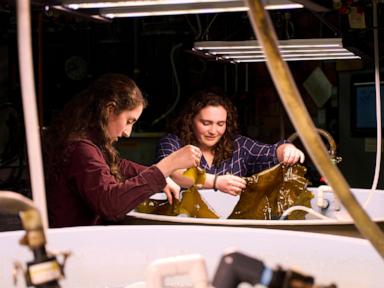
Jet engines and massive cargo ships have a carbon problem that batteries just can’t fix. You can’t pack enough lithium-ion cells onto a Boeing 787 to get it across the Atlantic without the plane becoming too heavy to actually take off. That’s why everyone is obsessed with finding a "drop-in" fuel—a liquid that burns like petroleum but comes from plants.
Kelp is the current darling of this movement. It grows fast. It doesn't need fresh water. It doesn't take up prime real estate where we could be growing corn or soy. But if you think we're just a few years away from filling up tankers with seaweed juice, you're being sold a dream that doesn't account for the brutal physics of the ocean.
The giant seaweed dream vs the logistical nightmare
Seaweed is incredible at capturing carbon. Giant kelp can grow up to two feet a day under the right conditions. It's basically a biological machine for turning sunlight and CO2 into biomass. Unlike corn ethanol, which competes with our food supply and drains our aquifers, kelp lives in the "blue economy." It's out of the way.
Or is it?
The biggest lie in the kelp biofuel narrative is that the ocean is "empty space." To grow enough kelp to power even a fraction of global shipping, we’d need underwater farms the size of small countries. We aren't talking about a few ropes tied to a pier. We're talking about massive, offshore structures that have to survive hurricanes, salt-water corrosion, and the constant battering of deep-sea currents.
Current pilot programs, like those funded by the ARPA-E MARINER program in the United States, are trying to solve this. They're looking at autonomous "elevators" that move kelp up and down the water column. During the day, the kelp sits near the surface to soak up sun. At night, it sinks to the nutrient-rich depths. It’s brilliant engineering. It’s also wildly expensive.
Why the energy math doesn't add up yet
Energy density is the only metric that matters in the world of heavy transport. You need a lot of "oomph" in a very small, light package. Kelp, in its natural state, is about 90% water.
Imagine you’re a refiner. You receive a shipment of raw kelp. Before you can even begin turning those complex carbohydrates into something resembling jet fuel, you have to get rid of that water. Drying out millions of tons of seaweed takes energy. If you use fossil fuels to dry your "green" kelp, you’ve already lost the game.
Then there’s the conversion process. You have two main paths:
- Biochemical conversion: Using microbes or enzymes to ferment the sugars into ethanol or butanol.
- Thermochemical conversion: Using high heat and pressure (hydrothermal liquefaction) to turn the wet kelp into a "bio-crude."
The second option is actually more promising for kelp because it handles wet biomass better. Research from the Pacific Northwest National Laboratory (PNNL) has shown we can turn algae into oil in less than an hour. That’s impressive. But doing it at a price point that competes with $80-a-barrel crude oil? That's the part no one has figured out.
The salt problem no one talks about
Kelp is salty. That sounds obvious, but it’s a mechanical disaster. Salt and minerals (ash content) are "catalyst killers." When you try to refine bio-oil into high-grade aviation fuel, those minerals gunk up the works. They corrode the expensive catalysts used in refineries.
To make kelp fuel "drop-in" ready—meaning it can go straight into a Delta Airlines jet without modification—you have to strip every trace of salt and sulfur. This adds another layer of cost and complexity. Right now, the aviation industry is leaning heavily toward Sustainable Aviation Fuel (SAF) made from used cooking oil or animal fats. These are "easy" feedstocks. Kelp is "hard" feedstock.
Scaling up means moving offshore
Most kelp today is grown in protected coves for the food and cosmetics industry. That won't work for fuel. We need the open ocean.
When you move offshore, costs don't just go up; they explode. You need specialized vessels to harvest the crop. You need deep-sea moorings that won't snap during a Nor'easter. And you have to deal with the "not in my backyard" (NIMBY) crowd. Even though these farms are underwater, they can interfere with fishing routes, whale migration, and naval operations.
The carbon debt of infrastructure
We often hear that kelp is carbon-negative. While the plant itself inhales CO2, the Life Cycle Assessment (LCA) tells a different story.
If you build a fleet of steel and plastic harvesting ships, manufacture thousands of miles of synthetic ropes, and run high-heat processing plants, you're starting with a massive carbon debt. For kelp to be a net win for the planet, the farming systems have to be incredibly efficient and long-lasting. If a storm destroys your farm every three years, you'll never break even on the carbon cost of the materials you used to build it.
Don't count it out just yet
Despite these hurdles, there's a reason companies like Primary Ocean and research teams at UCSB are still pushing. Kelp doesn't just provide fuel. It can be a "multi-stream" crop.
You can extract high-value proteins for food, alginates for industry, and then use the leftovers for fuel. This "biorefinery" model is the only way the math works. If you're only growing kelp for the fuel, you'll go broke. If you're growing it for five different products and the fuel is the "waste" byproduct, you might have a business.
How to actually move the needle
If we're serious about kelp-powered planes, we need to stop treating it like a small-scale gardening project. We need heavy industrial investment.
- Automated Harvesting: We can't have divers or small boats pulling kelp by hand. We need "mowers" that operate like combine harvesters on the grain belt.
- Genetic Selection: We need to breed kelp strains that are higher in lipids (fats) and lower in ash. This isn't GMO fear-mongering; it's basic agricultural science applied to the sea.
- Carbon Credits: Kelp fuel will never be cheaper than oil on a raw gallon-for-gallon basis. It only wins if we put a real price on the carbon footprint of traditional fuels.
Stop looking for a "miracle" fuel that solves everything by next Tuesday. Kelp is a slow-burn solution. It requires us to rethink how we treat the ocean—not as a resource to be mined, but as a farm to be managed.
If you're an investor or a policy maker, stop funding "feasibility studies." We know it's feasible. Start funding the boring stuff: better rope materials, salt-tolerant catalysts, and autonomous offshore barges. That's where the real breakthrough is hiding.
Focus on the logistics of the "wet-to-dry" pipeline. Until we can move and process seaweed with the same efficiency we move crude oil, kelp remains a scientific curiosity rather than a global energy solution. Check the latest reports from the Global Seaweed Coalition for the most recent data on farm yields. Look for the gaps in their harvesting tech. That's where the opportunity lives.