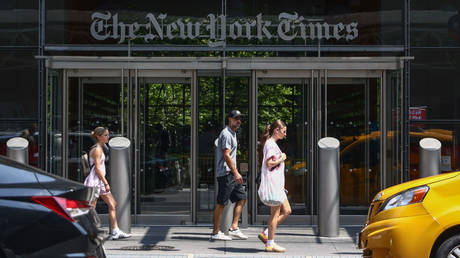
The federal government has officially targeted the crown jewel of American liberal media, turning its own diversity promises into legal ammunition. In a lawsuit filed in federal court in Lower Manhattan, the U.S. Equal Employment Opportunity Commission (EEOC) accused The New York Times of violating Title VII of the Civil Rights Act of 1964 by passing over a highly qualified White male editor for a promotion, allegedly favoring race and gender aspirations over actual journalistic experience. The lawsuit is not just a localized HR dispute. It represents a coordinated, federal offensive against corporate Diversity, Equity, and Inclusion (DEI) policies, signaling a major battleground in the legal war over corporate hiring.
The anonymous plaintiff is a veteran editor who has been with the Times since 2014, including a nine-year tenure as a senior staff editor on the prestigious international desk. When the position of Deputy Real Estate Editor opened up in early 2025, he applied. He had the direct experience in real estate journalism that the job posting explicitly required.
Yet, according to the lawsuit, he was excluded from the final round of interviews. Four candidates advanced; none were White males. The job eventually went to Monica Burton, an outside hire who previously worked at the Vox Media food site Eater. The EEOC alleges that Burton possessed little to no real estate journalism experience, and that the hiring panel itself rated her less favorably than two other final candidates.
The DEI Document Trail
The EEOC’s case does not rely on hearsay. It uses the newspaper's own corporate pledges as the primary evidence of systemic intent.
In February 2021, amid a national reckoning on race, the Times published its "Call to Action" plan. The public document set an ambitious target to increase the representation of Black and Latino leaders by 50% by the year 2025. According to internal data cited in the complaint, the publisher actually achieved this milestone ahead of schedule in 2022.
The federal complaint argues that the logical consequence of establishing fixed percentage targets for underrepresented groups is the systematic exclusion of others.
"A necessary consequence of NYT’s intent to increase the percentage of non-White leaders would be a decrease in the percentage of White leaders," the complaint states. "Particularly, decreasing the percentage of White males in leadership would contribute to the NYT’s dual goals."
This is the central friction point of modern employment law. Where a corporation sees a benign aspiration to make its leadership "reflect the public," the federal government now sees an illegal quota system that inherently discriminates against individual applicants based on immutable characteristics.
A Politically Charged Commission
The timing and aggressive posture of the lawsuit are inseparable from the current ideological makeup of the EEOC. Under the leadership of Chair Andrea Lucas, an appointee of Donald Trump, the agency has actively sought out cases that test the legal limits of DEI programs.
In late 2024, Lucas went so far as to issue a public call on social media, encouraging White men to come forward if they believed they had been passed over due to corporate diversity initiatives.
"There is no such thing as 'reverse discrimination'; all race or sex discrimination is equally unlawful," Lucas said in a statement accompanying the filing. "Federal law is clear: making hiring or promotion decisions motivated in whole or in part by race or sex violates federal law. There is no diversity exception to this rule."
The aggressive push has exposed deep fractures within the EEOC itself. Commissioner Kalpana Kotagal, the lone Democrat on the five-member panel, voted against authorizing the lawsuit. She publicly criticized the action, characterizing it as a politically motivated attempt to weaken broader civil rights protections.
Internal friction has spilled into public view, with reporting suggesting that EEOC career staff face immense pressure to deliver high-profile cases that align with the administration's broader anti-DEI agenda. The Times is not the only target. Similar federal investigations and legal maneuvers are currently aimed at other major American brands, including Nike and Planned Parenthood of Illinois, which recently agreed to a $500,000 settlement over allegations of discrimination against White employees.
The Defense Strategy
The New York Times has chosen to fight rather than settle, rejecting the allegations as "meritless" and politically motivated.
The publisher's defense rests on a few key arguments:
- Isolation of the Incident: The newsroom employs over a hundred deputy editors. The Times argues that a single disputed hiring decision does not prove a systemic pattern of discrimination.
- Deviation from Protocol: Spokesperson Danielle Rhoades Ha asserted that the EEOC deviated from standard investigation practices in highly unusual ways to rush the case to court.
- Merit-Based Selection: The paper maintains that Burton was simply the best candidate for the role, irrespective of her identity, and that her performance as an editor has justified the hire.
The legal defense will likely try to distance the general corporate aspirations of the 2021 "Call to Action" from the specific, localized decisions made by the real estate hiring committee in 2025.
The Legal High Wire
Corporate America is watching this case with intense anxiety. For a decade, human resources departments have operated under the assumption that public diversity goals were both socially desirable and legally safe, provided they did not implement explicit, rigid quotas.
The EEOC’s lawsuit challenges that exact assumption. If the court rules that merely publishing a diversity target serves as evidence of discriminatory intent in individual hiring decisions, it will fundamentally alter how major corporations recruit, promote, and retain staff.
The litigation represents a calculated effort to force a judicial reinterpretation of Title VII. If successful, the lawsuit will effectively turn corporate diversity plans into self-incriminating documents, forcing companies to choose between public progressive branding and federal legal liability.