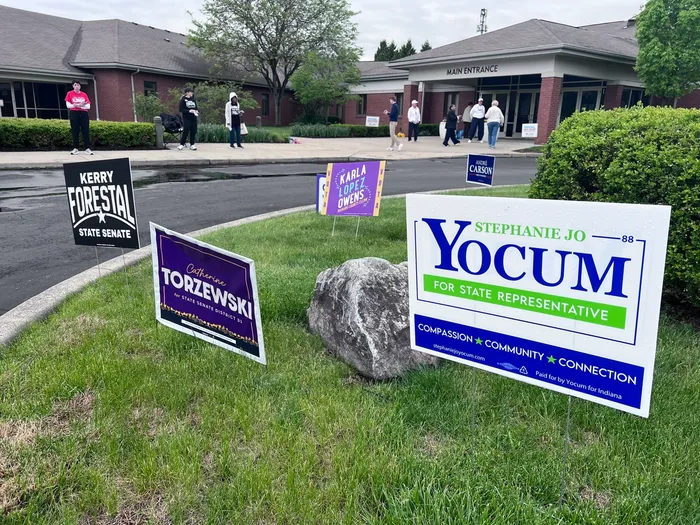
The results of Tuesday’s primary in Indiana were not just an election; they were an execution. In a state where incumbency usually acts as an ironclad insurance policy, five veteran Republican state senators were systematically removed by voters after a targeted campaign directed by the highest levels of the national party. The catalyst was a single vote cast five months ago—a refusal to participate in a mid-decade redistricting effort designed to eliminate the state’s remaining Democratic congressional strongholds. By rejecting the gerrymander, these lawmakers signed their own political death warrants, proving that in the modern Republican party, institutional tradition is no shield against a populist vendetta.
The fallout is a stark warning to any Republican official who believes local governance can remain insulated from national power plays. For decades, the Indiana Senate operated as a deliberate, sometimes stubborn body that prioritized state-level stability over federal theater. That era ended when $9 million in outside spending flooded into races that typically cost a fraction of that amount. This was a clinical demonstration of political force, where the "why" had less to do with Indiana policy and everything to do with the math of the U.S. House of Representatives.
The Mathematics of Vengeance
The conflict began in late 2025, when a push to redraw Indiana's congressional maps emerged. The goal was transparent: dissolve the two Democratic-leaning districts to ensure a 9-0 Republican sweep in future federal elections. While the map sailed through the Indiana House, it hit a wall in the Senate. Twenty-one Republicans, including Senate President Pro Tem Rodric Bray, joined Democrats to kill the bill. Their reasons varied from concerns over legal challenges to a simple belief that mid-decade redistricting set a dangerous, chaotic precedent.
The response from the Trump-aligned wing of the party was immediate and scorched-earth. The logic was simple: if you aren't willing to use every lever of power to ensure a Republican majority in Washington, you are a "RINO" (Republican In Name Only). This label was applied regardless of a legislator’s actual voting record on taxes, guns, or abortion.
Among the casualties was State Senator Travis Holdman, a pillar of the GOP leadership who had served 18 years. He faced over $1.3 million in attack ads—an astronomical sum for a state primary. Holdman’s defeat, alongside others like Greg Walker, signals a shift from the "Big Tent" philosophy to a "Blood Oath" requirement. The primary was effectively turned into a single-issue referendum on loyalty to a national strategy, stripping away the nuances of local representation.
The Architecture of the Purge
This wasn't a grassroots uprising; it was an engineered takedown. The funding and logistics were funneled through organizations tied to U.S. Senator Jim Banks and Governor Mike Braun, creating a pincer movement against the incumbents. By framing a technical vote on redistricting as a betrayal of the "America First" movement, challengers were able to bypass traditional debates about infrastructure, education, or the state budget.
The Survival of Greg Goode
Only one incumbent targeted by the purge managed to survive: Greg Goode of Terre Haute. His survival is the exception that proves the rule. Goode, who was early to report being the victim of a "swatting" attempt during the height of the redistricting tension, ran a campaign that leaned heavily into his personal resilience. However, his win was a lonely one in a night that otherwise belonged to the challengers.
The survival of a single incumbent does not suggest a split in the base. Rather, it highlights the extreme difficulty of fighting a multi-million dollar narrative when you are being attacked from your own flank. The challengers, such as Blake Fiechter who unseated Holdman, didn't need to be better known; they just needed to be the ones standing next to the "Endorsed by Trump" logo.
The Cost of Sovereignty
The broader implication for Indiana—and other red states—is the loss of legislative independence. When state senators are punished for following their caucus or their conscience over a national mandate, the Statehouse effectively becomes a subsidiary of the national party. Senate President Rodric Bray, who survived his own primary but saw his caucus decimated, now faces a leadership crisis. The newcomers heading to Indianapolis aren't there to deliberate; they are there to execute a specific, pre-determined agenda.
This primary proves that the "incumbent advantage" is a myth when faced with a centralized, well-funded ideological purge. The "Indiana Way" of slow, methodical governance has been replaced by the "D.C. Way" of high-stakes, high-spend warfare. The losers on Tuesday didn't lose because they failed their constituents on local issues. They lost because they refused to participate in a power grab that would have altered the national landscape.
The doors are now wide open for a fresh redistricting effort in the next legislative session. With a new, more compliant Senate majority, the maps that were rejected in December will likely be resurrected and passed with ease. This was never just about five seats in Indiana; it was about the path to the Speaker's gavel in Washington. The Hoosier State was simply the laboratory for a new kind of political discipline, and the experiment was a resounding success.
Legislators across the country are now looking at Indiana and calculating the cost of saying "no." For five Indiana senators, that cost was a career. For the Republican party, it is the final consolidation of power under a single, national banner. The era of the independent state legislator is over.