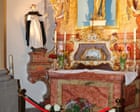
The lock didn’t stand a chance. It was a simple mechanism, designed more to keep out curious children than a determined ghost. In the small, quiet town of Milevsko, nestled in the South Bohemian region of the Czech Republic, the Church of Saint Giles has stood as a silent witness to eight centuries of human frailty. But on a Tuesday that felt like any other, the silence was violated.
When the sacristan entered the church, the air felt different. Thinner. The gilded reliquary, a container that had held the physical remains of a nameless, 800-year-old saint, sat agape. The skull was gone.
This wasn't just a theft of bone and calcium. It was the surgical removal of a community’s anchor.
The Weight of Old Bone
To a modern skeptic, a skull is a biological artifact. It is a calcium-rich housing for a brain that stopped firing long before the printing press was invented. But inside the cool, damp stone walls of a Bohemian church, that skull functions as a battery. It stores centuries of prayers, whispered confessions, and the desperate hopes of a thousand peasants who believed that touching the glass of the reliquary might cure a fever or save a failing harvest.
The Czech police are currently scouring the region, looking for a thief who likely doesn't understand the physics of what they’ve stolen. They are looking for fingerprints, CCTV footage, and black-market chatter. They are hunting for a person who looked at a holy relic and saw a payday.
Consider the hypothetical path of the thief. Let’s call him Marek. Marek isn't a historian. He isn't a devotee. He is likely a man with a debt or a habit, someone who has noticed that while the world moves toward digital currencies and high-tech security, the rural churches of Eastern Europe remain porous. They are museums with the lights turned low. Marek slips through a side door, uses a crowbar with the practiced ease of a mechanic, and lifts the weight of eight centuries into a duffel bag.
He feels the heft of it. He doesn't feel the sacrilege.
A Dark Pedigree
The theft in Milevsko is not an isolated tremor. It is part of a larger, tectonic shift in the illicit trade of cultural heritage. We often imagine art thieves as sophisticated figures in tuxedos, stealing Impressionist paintings from high-security galleries in Paris. The reality is much grittier. It is a world of damp basements and "gray market" collectors who find a perverse thrill in owning something that was never meant to be owned.
The market for human remains is surprisingly robust. On the darker corners of the internet, a "clean" human skull can fetch thousands of dollars. When you add the pedigree of sainthood—the 800-year-old provenance verified by church records—the price scales vertically. The thief isn't just selling a skull; they are selling a story.
But there is a catch that these thieves rarely consider. You cannot hang a stolen saint in your living room. You cannot show it to your friends. The buyer of such an object is a person who wants to sit alone in a room and know that they possess a piece of the divine, or at least a piece of history that the rest of the world has lost. It is an act of ultimate ego.
The Czech police face a wall of silence. In small towns like Milevsko, everyone knows the church, but few see the strangers who linger too long near the altar. The investigation is a race against time. Once a relic like this crosses a border, it vanishes into the private vaults of the ultra-wealthy, hidden away like a secret sin.
The Architecture of Loss
Walking through a church like Saint Giles, you realize that the architecture is built around the presence of the relic. The pews point toward it. The light from the stained glass is choreographed to land upon it. When the relic is removed, the building becomes a hollow shell. It’s like a ribcage with the heart cut out.
For the local parishioners, the theft is a violation of the collective memory. Imagine a family that has lived in the same village for ten generations. Your great-great-grandfather knelt before that skull. Your mother lit a candle near it when you were sick. It is a physical link to a past that is rapidly being erased by the digital age.
We live in a world where everything is reproducible. We have 3D printers, digital archives, and high-definition photography. But you cannot 3D print the "Aura" of an 800-year-old object. You cannot replicate the fact that this specific piece of bone was present during the Black Death, the Hussite Wars, and the fall of the Iron Curtain.
The thief didn't just steal a skull. They stole a witness.
The Mechanics of the Hunt
The police are focusing on local pawn shops and known traffickers of antiquities, but the real challenge lies in the psychology of the crime. Most religious thefts are "crimes of opportunity" gone wrong. A thief breaks in looking for silver chalices or collection box cash, sees the gold-leafed reliquary, and takes the whole thing, only realizing later that the most valuable part is the bone inside.
There is a desperate irony here. The saint, whose name has been lost to the fog of time, likely spent their life in poverty and contemplation. They would have been horrified to know that eight centuries later, their mortal remains would be the subject of a police dragnet and a black-market bidding war.
Consider the logistical nightmare of the recovery. Unlike a painting, which has a signature and a recorded visual history, one ancient skull looks remarkably like another to the untrained eye. Without DNA testing or specialized forensic analysis of the soil and minerals trapped in the bone, proving that a recovered skull is the "Milevsko Saint" is a monumental task.
The investigators are working with historians to document every unique fissure and dental record available from old church surveys. They are building a digital ghost of the skull, hoping that if it ever surfaces, they will be able to recognize it.
The Invisible Stakes
Why does this matter to someone sitting thousands of miles away?
It matters because the theft of a relic is a bellwether for the value we place on our shared human story. If we allow our history to be carved up and sold to the highest bidder, we lose the map of how we got here. Every time a church is looted or a tomb is desecrated, a page is torn out of the book of us.
The situation in Milevsko is a reminder that our heritage is fragile. It is protected by nothing more than a thin pane of glass and a sense of common decency. When that decency fails, we are left with empty pedestals and a feeling of profound, unnameable grief.
The search continues. The police patrol the borders, the detectives interview the disgruntled, and the townspeople wait. They leave the lights on in the Church of Saint Giles, perhaps hoping that the thief will have a change of heart, or perhaps just to ward off the new, crushing darkness that occupies the space where the saint used to rest.
The reliquary remains on the altar, its doors swung wide, catching the afternoon sun. It is a golden box filled with nothing but dust and the sudden, sharp realization of what it means to be truly robbed.
Somewhere, in a dark room or the trunk of a car, an 800-year-old saint is waiting to be returned to the silence. Until then, the church is just a building, and the bone is just a commodity, and we are all a little more disconnected from the ghosts that made us who we are.