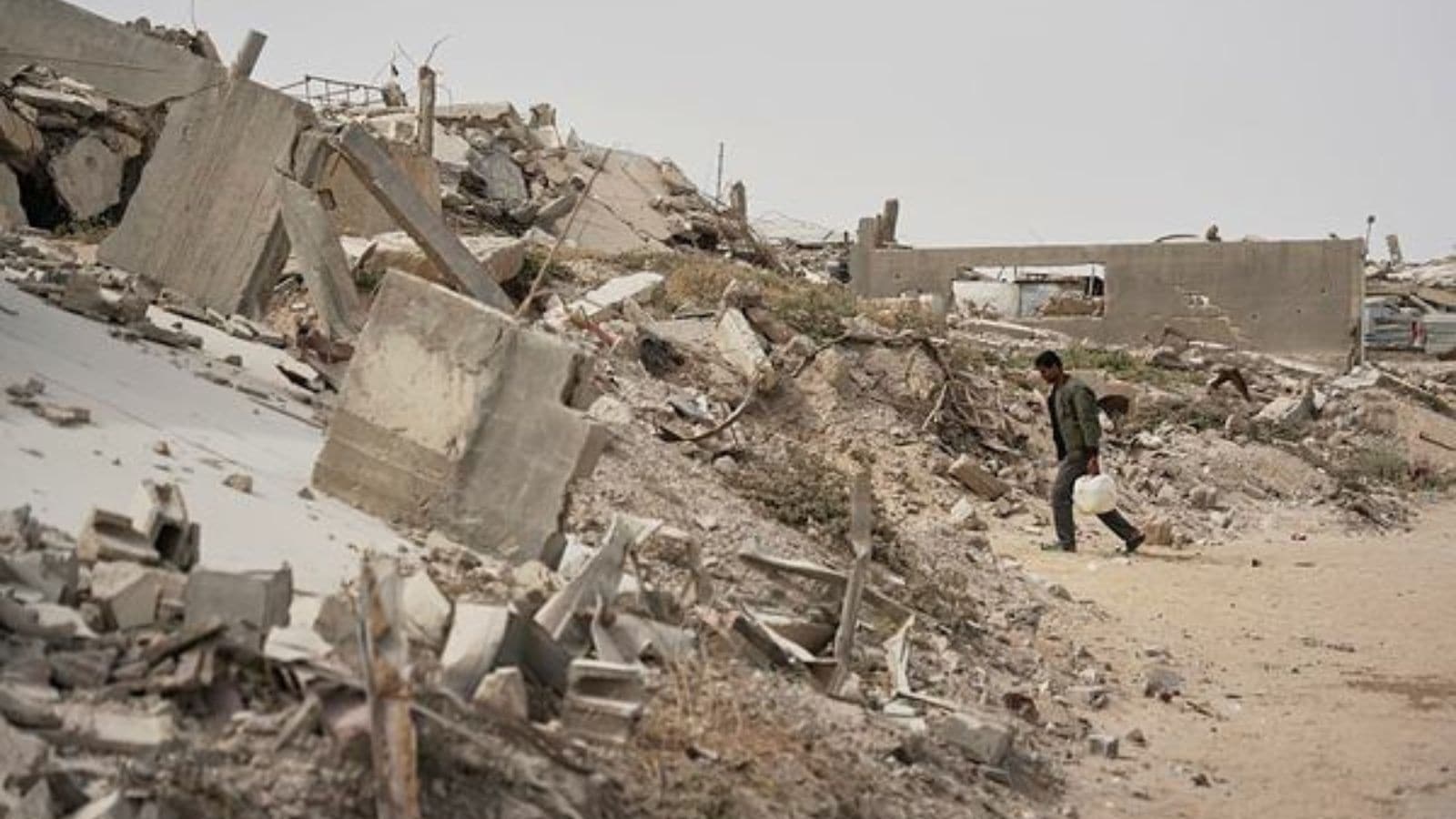
The headlines are bleeding again. The standard narrative is predictable: Israel ramps up strikes because Hamas is "rearming" during a fragile truce. It is a neat, linear story of cause and effect. It is also a fundamental misunderstanding of how asymmetric warfare actually functions.
If you believe a few weeks of "truce" is what allows a militant group to replenish its stocks, you haven't been paying attention to the last two decades of urban insurgency. Hamas does not need a truce to rearm; they rearm because the very environment of Gaza is a self-sustaining munitions factory.
Military analysts often treat Gaza like a conventional state with a supply chain that can be "cut off." This is a fantasy. The reality is far more grim and far more complex. The "rearming" isn't just rockets coming through tunnels; it is the recycling of the very infrastructure being leveled by the Israeli Defense Forces (IDF).
The Kinetic Feedback Loop
Every bomb dropped that fails to explode—and in dense urban environments, duds are a statistical certainty—is a gift of high-grade explosives to the insurgency. Every destroyed building provides the rebar and piping necessary to manufacture rocket casings.
We see the "stepped-up attacks" as a proactive measure to prevent future violence. In reality, we are watching a kinetic feedback loop. Israel strikes to destroy the capacity for violence, but the debris of that destruction provides the raw materials for the next generation of improvised weaponry.
This isn't just theory. I have spent years analyzing the movement of dual-use goods in conflict zones. You can monitor the Rafah crossing until the sun goes down, but you cannot monitor the chemical composition of the rubble. When the IDF says Hamas is rearming, they are stating a tautology. As long as there is wreckage, there is rearmament.
The Truce is a Tactical Mirage
The media treats a truce as a pause button. For a guerrilla force, a truce is merely a change in the frequency of operations. The idea that "now" Hamas is suddenly getting busy is a failure of intelligence and a failure of logic.
Guerrilla movements operate on a 24/7 cycle of procurement. They don't wait for a ceasefire to dig; they dig while the bombs are falling. The truce doesn't create the opportunity; it only changes the risk profile of the movement. If the military objective is to "stop the rearming," then the military objective is inherently impossible under the current strategy of massive bombardment.
Why the "Hamas is Weakening" Metric is Fraudulent
Military briefings love to cite "tunnels destroyed" or "commanders neutralized." These are vanity metrics.
- Redundancy: Insurgent networks are built on a hydra model. You lop off a head, the body barely notices.
- Knowledge Transfer: The "commander" is less important than the "engineer." The blueprints for Qassam rockets are decentralized.
- The Martyrdom Multiplier: Every strike that kills a mid-level operative creates a recruitment surge that replaces them tenfold.
If you measure success by the number of targets hit, you are winning the battle and losing the reality. The competitor articles focus on the "escalation" as if it’s a choice made in a vacuum. It isn't. It is the only move left for a military establishment that has tied its prestige to a goal—the total eradication of Hamas—that is physically impossible through air power alone.
The Logistics of the Rubble
Let’s talk about the math of the "Gaza Rocket." A standard Qassam rocket doesn't require a factory. It requires:
- Industrial piping (Found in every destroyed residential block).
- Sugar and potassium nitrate (Fertilizer and food supplies).
- TNT or PETN (Harvested from unexploded IDF ordnance).
When the IDF "steps up attacks," they increase the volume of raw materials available to their enemy. It is the ultimate irony of modern siege warfare: the more you break, the more you provide.
"In urban warfare, the debris is the ammunition of the defender."
If you want to actually stop the rearming, you don't drop more bombs. You change the economic and structural reality of the strip. But that is "soft" and "complex," and it doesn't look good on a thermal camera feed during the nightly news.
The Intelligence Failure of "Truce Monitoring"
The "lazy consensus" suggests that Hamas used the Iran-brokered truce to smuggle in high-tech Iranian hardware. While Tehran certainly provides the R&D and the high-end components, the bulk of the threat is domestic Gaza manufacturing.
Focusing on the "Iran connection" during the truce is a convenient political distraction. It allows the narrative to shift from a failed local strategy to a grand geopolitical struggle. It makes the problem feel bigger, and therefore, the lack of progress more excusable.
The truth is much more embarrassing: Israel is being out-logisticsed by a group operating out of basements and ruins.
The False Choice of Escalation
We are told the choice is between "allowing Hamas to rearm" or "stepping up strikes." This is a false dichotomy designed to silence dissent.
The third option—the one nobody wants to talk about because it lacks the catharsis of an explosion—is the Systemic Decoupling of the population from the insurgency. You cannot kill an ideology with a 2,000-pound JDAM. You can only kill the people currently holding the ideology, while simultaneously radicalizing everyone standing within a five-mile radius of the blast.
By "stepping up attacks" post-truce, the military is effectively admitting that the truce was a strategic failure. They are trying to bomb their way out of a diplomatic hole. It has never worked in the history of counter-insurgency, and it won't work now.
The Cost of the Status Quo
There is a massive downside to my contrarian view: it offers no quick fix. It suggests that the current military path is a treadmill of violence that consumes billions of dollars and thousands of lives without moving the needle on actual security.
The establishment hates this because it demands accountability for a failed doctrine. They would rather talk about "tactical shifts" and "rearming threats" than admit that the very nature of their campaign is self-defeating.
People Also Ask (and the answers they hate):
- Is Israel's military strategy working? No. If your goal is "security," and your actions create more militants and more rocket fuel, you are failing.
- Can Hamas be eliminated? As an organization, maybe. As a movement? Not by bombs. You are trying to use a hammer to perform surgery on a ghost.
- Why is the truce over? Because a truce requires both sides to see a path toward a better status quo. Currently, both sides see more value in the optics of the struggle than the boredom of a stalemate.
The Reality of "Precision"
We hear about "precision strikes" targeting "rearming centers." In a city as dense as Gaza, a precision strike is an oxymoron. When you hit a workshop in a basement, you collapse the three floors of civilian housing above it.
The "military necessity" of these strikes is the shield used to justify a strategy that is clearly failing its primary objective: the return of hostages and the cessation of rocket fire.
Stop looking at the maps of where the bombs are falling. Start looking at the supply chain of the rubble. Until you understand that the destruction is the rearmament, you are just watching a tragedy on a loop.
The IDF isn't stopping the next war; they are unknowingly manufacturing the parts for it.
Every building leveled is a warehouse of steel. Every Dud is a mine. Every casualty is a recruiter. If this is "stepping up," I’d hate to see what falling down looks like.
The war isn't being won because the war, as currently defined, is a logistical impossibility. Stop buying the "rearming" excuse as a reason for escalation. It's not the reason. It's the confession.