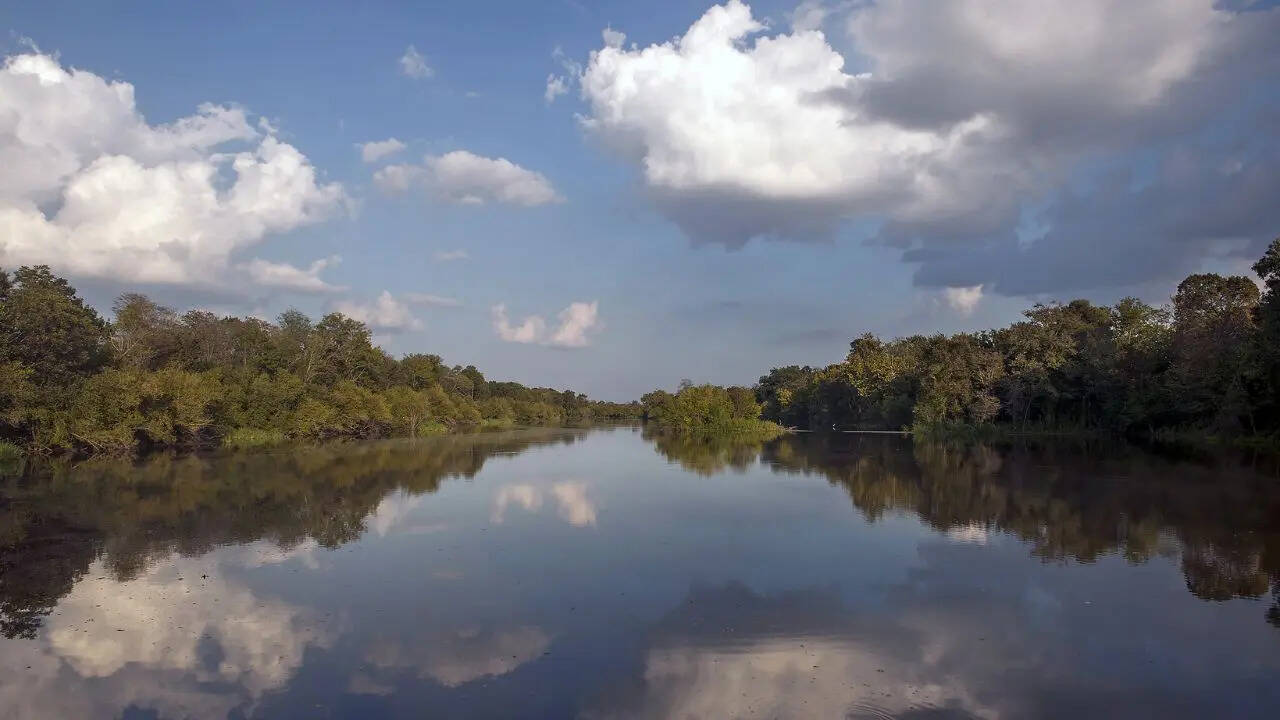
The Mississippi River is not a stream. It is a three-million-cubic-foot-per-second heartbeat of a continent, a brown, muscular god that dictates the life of every person living within its reach. We are taught from childhood that gravity is the law: water flows south, searching for the Gulf of Mexico, carrying the silt of thirty-one states and two Canadian provinces with it. It is the one constant in an unpredictable world.
Then came August 29, 2012.
For twenty-four hours, the law of gravity was repealed. The river didn't just slow down. It stopped. It vibrated with a confused energy and then, in a slow-motion act of defiance that defies the senses, it began to climb. It flowed north.
To understand the sheer wrongness of this, you have to stand on the levees in Plaquemines Parish. On a normal day, the current is a freight train. You feel the vibration in the soles of your boots—a low-frequency hum of millions of tons of water grinding against the mud. But as Hurricane Isaac lumbered toward the coast, the rhythm changed. The wind wasn't just a gale; it was a physical wall, a sustained pressure that began to shove the Atlantic Ocean into the mouth of the river.
The Physics of a Rejection
Imagine a hypothetical fisherman named Elias. He’s spent forty years watching the water move past his dock. He knows the river’s moods. On that Wednesday, Elias would have seen the debris—the logs, the plastic bottles, the swamp grass—halt its southern journey. It hovered in place for a moment of eerie stillness. Then, as if a giant had tilted the Earth on its axis, the debris began to drift back toward New Orleans.
This wasn't a trick of the light or a localized eddy. The United States Geological Survey (USGS) sensors near Belle Chasse recorded the impossible. The river was moving upstream at a rate of 182,000 cubic feet per second. For perspective, that is roughly the volume of three Olympic-sized swimming pools passing a single point every second, all heading the wrong way.
Scientists call this a "storm surge." It sounds clinical. It sounds like something you can manage with a spreadsheet. But for the people on the ground, it is a spiritual crisis. When the natural order breaks, the fear is different. It isn't just about a flood; it's about the realization that the foundations of our geography are fragile.
The Invisible Stakes of a Saltwater Tongue
The reversal of a river isn't just a visual spectacle. It is a biological invasion. The Mississippi is a freshwater artery, but when it flows backward, it brings the ocean with it. This is the "saltwater wedge," a dense, heavy tongue of brine that creeps along the river bottom.
Consider the municipal water intakes for the towns lining the banks. They are designed to suck in fresh, silt-heavy river water. When the river reverses, those intakes begin to swallow salt. Salt corrodes the pipes of ancient infrastructure. It kills the gardens. It makes the very thing we need to survive—the river—poisonous to the touch.
During Isaac, the height of the river rose ten feet in a matter of hours. This wasn't because of rain falling from the clouds, though there was plenty of that. It was because the river had become a cul-de-sac. The water coming down from the north had nowhere to go. It hit the wall of the ocean-driven surge and stacked up. The riverbed became a pressure cooker.
Why the Levees Weren't Enough
We spent billions of dollars after Katrina building the most sophisticated flood defense system on the planet. Massive gates, hardened walls, and pumping stations that could drain a lake in minutes. But Isaac was a different kind of monster. It was slow. It was methodical. It didn't punch; it leaned.
Because the storm lingered, the "backward" flow lasted for nearly a full day. In standard hydrology, a river reversal is a freak occurrence that lasts an hour or two. Isaac pushed the Mississippi into reverse for twenty-four hours. This put a relentless, static pressure on the levees. Earth doesn't like being soaked for that long. It softens. It slumps.
The invisible stakes were the integrity of the soil itself. Engineers watched the gauges with a hollow feeling in their chests. If the river stayed backward for another twelve hours, the saturation could have led to a catastrophic failure of the very walls built to save the city. We were witnessing a battle between the atmospheric power of a hurricane and the geological momentum of a continent.
The Memory of 2005
The fear in 2012 was rooted in the scars of 2005. When the water started moving north, every person in New Orleans felt a phantom chill. They remembered the sound of the breaches. They remembered the smell of the mud.
The reversal was a reminder that we live on a narrow strip of borrowed time. The Mississippi wants to change its course. It has been trying to jump its banks and flow down the Atchafalaya River for decades. The Army Corps of Engineers spends every waking moment preventing this, using massive concrete structures to force the river to stay in its lane.
But when a hurricane forces the river backward, it exposes the hubris of that control. For those twenty-four hours, the river was out of our hands. It was a wild animal that had slipped its leash.
The Mechanics of the Surge
How does air move water with such violence? It’s a combination of two forces. First, the low pressure at the center of the storm acts like a vacuum, literally pulling the surface of the ocean upward. Second, the "fetch"—the distance the wind blows over open water—creates a massive mound of liquid energy.
When that mound hits the narrow funnel of the Mississippi River, it has nowhere to go but up and in. The river channel acts like a syringe. The ocean is the plunger.
The USGS reported that at the height of the reversal, the river's stage reached 10.24 feet. Just twenty-four hours earlier, it had been at zero. This wasn't a flood in the traditional sense; it was a tidal bore of such magnitude that it effectively erased the river’s identity. For one day, the Mississippi was an arm of the Gulf.
The Quiet Return to Order
Eventually, the storm moved inland. The wind shifted. The atmospheric "plunger" was pulled back.
The river didn't just snap back to normal. It hesitated. There was a period of stagnation where the water was neither going north nor south. It was a heavy, brown soup, thick with the debris of the coast and the salt of the deep. Then, slowly, gravity reasserted its authority. The first ripples began to move south. The logs that had been heading toward the city turned around and began their long-delayed trip to the sea.
Elias, our hypothetical observer, would have seen the water level drop as quickly as it rose. The danger passed, but the lesson remained.
The Fragility of the Map
We look at maps as if they are etched in stone. We see blue lines and think of them as permanent features of the landscape. But the 2012 reversal proved that the map is a suggestion. Our relationship with the Mississippi is a negotiation, not a conquest.
We live in an era where these "once in a lifetime" events are beginning to happen with a rhythmic, terrifying frequency. The reversal of the Mississippi wasn't just a scientific curiosity or a data point for a USGS report. It was a warning shot.
It was the moment the most powerful river in North America was told to turn around, and it obeyed.
The next time you stand on a bridge over a great river, look at the water. Notice the direction of the ripples. We take that southern flow for granted, assuming it is as inevitable as the sunrise. But there are forces in the Gulf—warm, rotating, and hungry—that can change the rules of physics in an afternoon.
The river is a giant. We are just the small things living on its back, hoping it stays on the path we've paved for it. But as 2012 showed us, sometimes the giant decides to walk the other way.