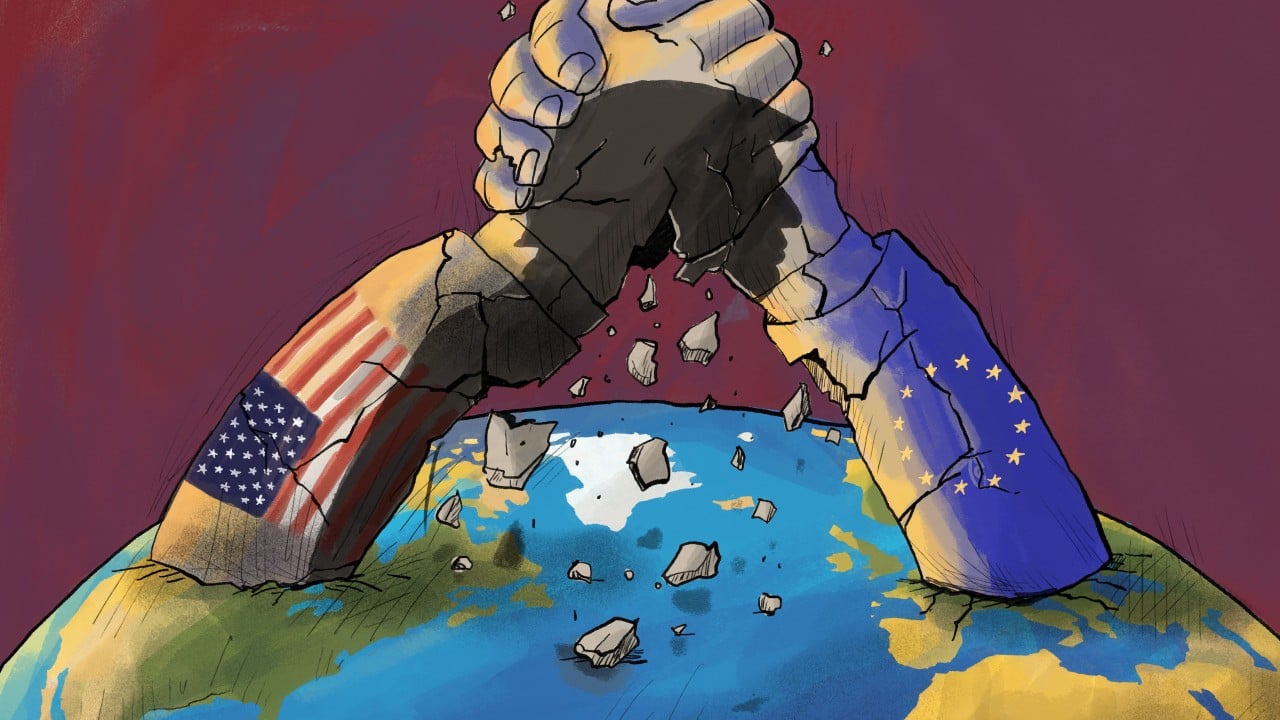
The era of European deference to American strategic interests has hit a concrete wall. For decades, the relationship between Washington and Brussels operated on a predictable frequency of security-for-trade, but that frequency is now jammed by static. Europe is no longer "falling out of love" with America; it is performing a cold, calculated audit of a partnership that feels increasingly one-sided. This isn't a breakup sparked by a single election or a specific trade tariff. It is a fundamental structural divergence driven by energy costs, industrial survival, and the realization that the American security umbrella now comes with a price tag that includes the deindustrialization of the European continent.
The Industrial Guillotine
Europe is facing an existential threat that is being misdiagnosed as simple political friction. When the United States passed the Inflation Reduction Act (IRA), it didn't just incentivize green energy; it effectively declared open season on European manufacturing. By offering massive subsidies to companies that relocate their production to American soil, Washington created a vacuum that is sucking the lifeblood out of German and French industrial hubs. For another look, see: this related article.
The math is brutal. European manufacturers are paying significantly higher prices for energy than their American counterparts. This is not a temporary spike. It is a permanent shift resulting from the loss of cheap Russian pipeline gas and the subsequent reliance on expensive American Liquefied Natural Gas (LNG). While the U.S. celebrates its energy independence, Europe is essentially subsidizing that independence by purchasing American fuel at a premium while its own factories go dark.
The Energy Disconnect
The price of natural gas in Europe has historically hovered at a level that allowed its heavy industry—chemicals, steel, and automotive—to remain globally competitive. That floor has dropped out. Steel plants in the Ruhr valley cannot compete with plants in Ohio when their input costs are three to four times higher. This isn't just about "green transitions" or "innovation." It is about the basic physics of the global economy. If it costs more to make a widget in Stuttgart than it does in South Carolina, and the South Carolina widget gets a tax credit from the U.S. Treasury, the Stuttgart factory will eventually close. Further insight on this trend has been shared by TIME.
Security as a Subscription Service
For seventy years, the North Atlantic Treaty Organization (NATO) was the bedrock of the relationship. It was a clear deal. The U.S. provided the nuclear and conventional shield, and Europe provided a stable, wealthy market for American goods and a forward base for American geopolitical interests. That deal is being rewritten into a subscription model.
Washington is increasingly vocal about its pivot to the Pacific. This shift leaves Europe in a precarious position. The continent is being told to spend more on its own defense—reaching the 2% GDP threshold that was once a suggestion but is now a demand—while simultaneously being pressured to align with American policy toward China.
The China Dilemma
This is where the friction becomes heat. For Germany, China is not just a geopolitical rival; it is its largest trading partner. For the Netherlands, companies like ASML are the crown jewels of their economy, and their ability to sell high-tech lithography machines to Chinese buyers is a matter of national prosperity.
When the U.S. demands that Europe restrict these exports, it is asking European nations to commit economic suicide in the name of American national security. This creates a resentment that goes deeper than Twitter spats or diplomatic snubs. It is a conflict of interest that cannot be smoothed over with a state dinner. Europe sees a future where it is expected to be a junior partner in a Cold War 2.0 that it cannot afford and did not start.
The Digital Sovereignty Gap
The tension extends into the fiber optic cables of the modern world. Europe has largely failed to produce its own tech giants. There is no European Google, no European Meta, no European Amazon. Instead, the continent has become the world’s regulator.
Regulation as Resistance
The General Data Protection Regulation (GDPR) and the Digital Markets Act (DMA) are often framed as consumer protection measures. In reality, they are the only tools Europe has to exert power over a digital economy dominated by Silicon Valley. By imposing massive fines and strict operational requirements on American tech firms, Brussels is attempting to claw back some semblance of sovereignty over its own data and markets.
This regulatory warfare creates a cycle of hostility. American tech executives view Europe as a hostile environment that stifles innovation through bureaucracy. European leaders view American tech as a predatory force that avoids taxes, ignores local laws, and extracts value without contributing to the social fabric. This is not a misunderstanding. It is a fundamental disagreement about how a society should be organized and who should profit from its data.
The Euro vs the Dollar
The weaponization of the dollar has sent shivers through European central banks. When the U.S. froze Russian foreign exchange reserves, it proved that the global financial system is an extension of American foreign policy. While Europe supported the move in the context of the Ukraine conflict, the long-term implications are terrifying for any sovereign state.
If the dollar can be turned off like a light switch, then any nation that disagrees with Washington is vulnerable. This has accelerated discussions about "strategic autonomy" and the need to bolster the international role of the euro. However, the euro is hampered by the lack of a common fiscal policy and a unified banking union. Europe wants the independence of a superpower without the political integration required to achieve it. This leaves the continent in a state of arrested development, unable to fully break away from the dollar but increasingly resentful of its dominance.
Cultural Divergence and the New Guard
The demographic and cultural shifts on both sides of the Atlantic are widening the gap. The older generation of European leaders, who grew up with the memory of the Marshall Plan and the Cold War, is being replaced. The new guard did not see America as the liberator of the continent. They see it as a volatile superpower with a crumbling domestic political system.
A Mirror of Dysfunction
Europeans watch American news with a mixture of horror and fascination. The extreme polarization of the U.S. political system makes Washington an unreliable partner. A treaty signed by one administration can be torn up by the next. A trade agreement negotiated over years can be discarded with a single social media post.
This instability makes long-term planning impossible for European capitals. If the U.S. cannot guarantee its own political stability, it cannot guarantee the stability of the Western alliance. This realization is pushing Europe toward a "Third Way"—a path that seeks to balance relations between Washington and Beijing while trying to build its own internal strength.
The Myth of the Unified West
The phrase "The West" is increasingly a marketing term rather than a geopolitical reality. On issues ranging from climate change to Middle Eastern policy to the regulation of Artificial Intelligence, the U.S. and Europe are moving in different directions.
Take AI as a prime example. The U.S. approach is largely "move fast and break things," driven by private capital and a race for dominance. The European approach is the AI Act, a comprehensive framework focused on ethics, risk management, and human rights. These are not just different policies; they are different philosophies of progress.
The High Cost of the Status Quo
The current path is unsustainable. If Europe continues to follow the American lead on security and trade without receiving reciprocal economic benefits, it will face a populist backlash at home. We are already seeing this in the rise of parties across the continent that question the value of the transatlantic alliance and call for a "Europe First" approach.
These movements are not just fueled by xenophobia or nationalism. They are fueled by the very real economic pain of a middle class that sees its industries fleeing to the U.S. or China. When a factory in northern France closes because energy costs are too high, the workers don't blame the Kremlin; they blame the leaders in Paris and Brussels who failed to protect their interests.
The Brutal Reality of Power
The United States is a maritime power focused on global hegemony. Europe is a collection of continental powers focused on social stability and regional peace. These two goals were aligned when there was a shared existential threat in the form of the Soviet Union. Without that glue, the natural friction of competing economic interests has taken over.
Washington is currently playing a game of "America First," regardless of which party is in power. The Biden administration’s trade policies have been, in many ways, more protectionist than those of its predecessor. The message to Europe is clear: you are an ally when it suits us, but a competitor when it comes to the jobs and technologies of the future.
Europe's response has been a series of panicked committees and white papers. There is much talk of "strategic autonomy," but very little action. To actually achieve independence, Europe would need to significantly increase defense spending, integrate its capital markets, and develop its own energy resources—all while maintaining the social safety nets that its citizens demand. It is a Herculean task that the current leadership seems ill-equipped to handle.
The rupture is not a temporary break in a long-term romance. It is the end of a specific historical epoch. The Transatlantic relationship is shifting from a familial bond to a transactional arrangement. It is becoming a partnership of convenience, where every deal is scrutinized for its immediate benefit and every promise is met with skepticism.
Europe is waking up to the fact that it is a peninsula on a massive Eurasian landmass, not an island in the middle of the Atlantic. Its future is tied to its neighbors to the east and south as much as it is to the superpower across the ocean. The "love" is gone because the necessity that created it has changed form. What remains is a cold, hard calculation of survival in a world where the old rules no longer apply.
Stop looking for a reconciliation. Start looking for the exit signs.