Industrial arbitrage—the practice of locating manufacturing where costs are lowest and selling where prices are highest—is hitting a wall of diminishing returns. Cao Dewang, the chairman of Fuyao Glass Industry Group, recently signaled a potential retreat from U.S. operations, a move that exposes the fracturing logic of the "American Factory" model. This is not merely a reaction to trade friction; it is a calculated response to the breakdown of a specific economic equation that balanced high U.S. energy and land subsidies against expensive labor and rising regulatory friction.
The Fuyao Equation and the Erosion of Margin
To understand why a billionaire who invested over $1 billion in the Rust Belt is now reconsidering, one must deconstruct the original incentive structure. Fuyao’s entry into Ohio in 2014 was predicated on a clear cost-benefit analysis:
- Energy and Utility Arbitrage: Natural gas and electricity in the U.S. Midwest were significantly cheaper than in coastal China, reducing the high thermal costs of glass production.
- Land and Capital Subsidies: Local government tax credits and nearly free industrial infrastructure offset initial CAPEX.
- Logistics Compression: Moving heavy, fragile glass across the Pacific is a margin killer. Proximity to the "Big Three" automakers in Detroit theoretically eliminated the "freight-as-a-percentage-of-sales" burden.
The variables have shifted. The "hidden costs" of U.S. manufacturing—specifically legal compliance, labor turnover, and the administrative burden of cross-cultural management—have scaled faster than the energy savings. When trade tariffs are layered on top of these operational frictions, the U.S. site ceases to be a profit center and becomes a geopolitical hedge that is too expensive to maintain.
The Three Pillars of Industrial Attrition
The threat of exit by Fuyao identifies three specific pillars of attrition that are currently hollowing out mid-stream manufacturing in North America.
1. The Labor Efficiency Gap
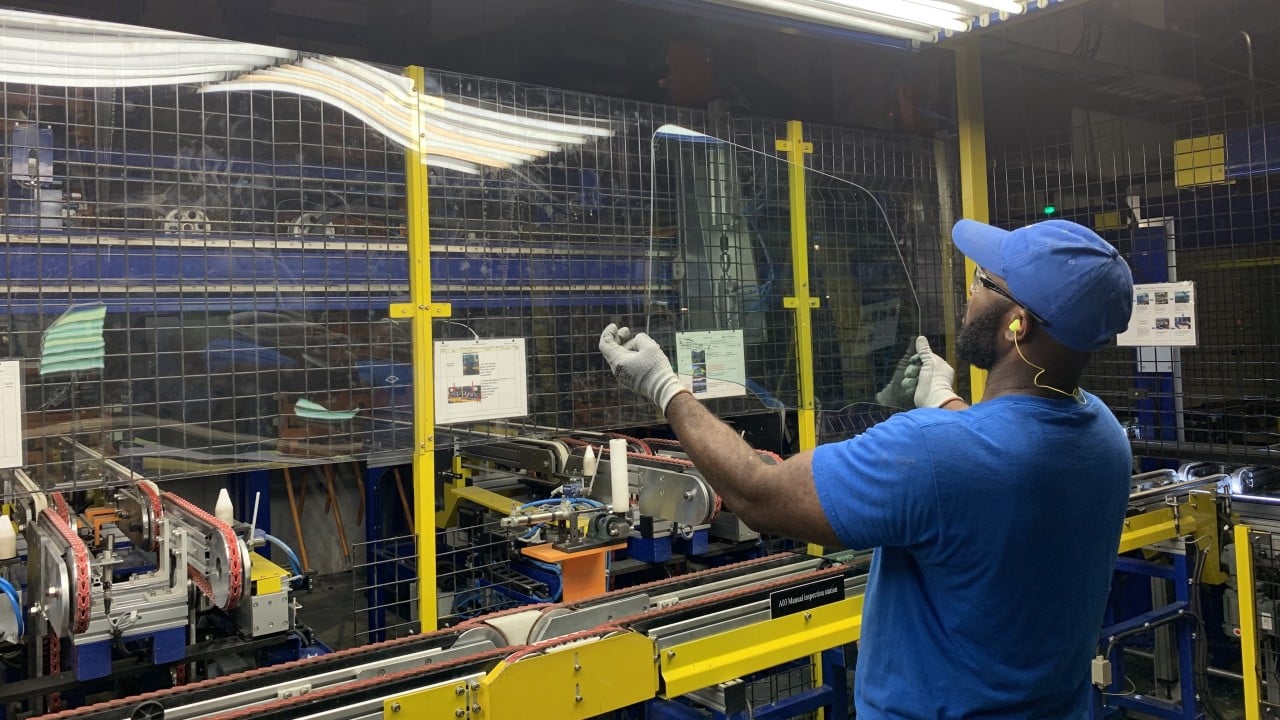
In the glass industry, uptime is the primary driver of profitability. A furnace cannot be turned off; it must run 24/7 for years. The "American Factory" experiment revealed a fundamental misalignment between Chinese industrial management styles—which prioritize extreme flexibility and high-intensity labor—and the U.S. labor market's expectations of work-life balance and safety protocols. This isn't a cultural "clash" so much as a structural productivity gap. The cost of labor in the U.S. is not just the hourly wage; it is the cost of recruitment, training, and the high attrition rates that disrupt continuous flow production.
2. Regulatory and Legal Friction
The U.S. operating environment carries a heavy "litigation premium." For a foreign firm, navigating OSHA requirements, NLRB oversight, and environmental regulations requires a massive administrative layer that does not exist in the same form in China. For Fuyao, these are not just "costs of doing business"—they are variables that fluctuate based on the political climate, making long-term forecasting impossible.
3. The Tariff Ceiling
Trade policy has transformed from a manageable tax into a hard ceiling on growth. If the raw materials or specialized components required for high-end automotive glass are subject to 25% or higher duties, the local manufacturing advantage evaporates. Fuyao is trapped in a pincer movement: it cannot easily source everything locally due to a degraded U.S. supply chain, but it cannot import from its own Chinese mother-factories without incurring prohibitive costs.
The Decoupling Paradox
The push for "near-shoring" or "friend-shoring" assumes that capital is mobile and will simply relocate to the most politically aligned geography. However, industrial capital is remarkably "sticky." A glass plant is not a software office; it is a massive, localized investment in heavy machinery.
Cao Dewang’s warning suggests that the U.S. is reaching a "break-even" point where it is cheaper to pay the tariffs on finished Chinese goods than to deal with the operational volatility of a U.S.-based plant. This exposes the Decoupling Paradox: the more the U.S. tries to force manufacturing back through protectionism, the more it risks driving away the very foreign direct investment (FDI) that possesses the technical expertise to run those factories.
The Mechanics of Supply Chain Displacement
If Fuyao exits, the void will not be filled by a domestic U.S. startup. The barrier to entry in glass manufacturing is too high, and the margins are too thin for venture-backed or traditional private equity models. Instead, we would see a shift toward "Neutral-Zone Manufacturing."
Companies are looking at Vietnam, Mexico, and Thailand not because these locations offer the best labor, but because they act as "geopolitical buffers." They allow firms to maintain Chinese ownership and expertise while slapping a "Made in [Country]" label on the product to bypass Section 301 tariffs. This does nothing to revitalize U.S. industry; it simply adds a layer of middleman costs to the global consumer.
The Predictive Model for Strategic Withdrawal
A firm of Fuyao's scale follows a specific sequence before a full exit. We can quantify this through three markers:
- CAPEX Freezing: The immediate cessation of new line installations. If Fuyao stops upgrading its Moraine, Ohio facility, the exit clock has started.
- Inventory Bloat at Ports: An increase in finished goods imports from China, signaling that the U.S. facility is being relegated to a "top-off" role rather than a primary production role.
- Executive Repatriation: The quiet replacement of high-level Chinese management with local "caretaker" managers.
Quantifying the Risk to the U.S. Auto Sector
The U.S. automotive industry is uniquely vulnerable to a Fuyao exit. Glass is a "Tier 1" critical component with a limited number of global suppliers (AGC, NSG/Pilkington, Saint-Gobain). If the largest player in the market signals that the U.S. is "uninvestable," the resulting supply shock would force Ford, GM, and Tesla to renegotiate their entire cost structures.
The assumption that "onshoring" creates resilience is flawed if the onshored entity remains tethered to a foreign parent company facing hostile trade conditions. True resilience requires a localized supply chain that is ownership-agnostic, which the U.S. currently lacks in the industrial materials sector.
Strategic Play: The Diversification Mandate
For stakeholders watching the Fuyao situation, the strategy must pivot from "geographic proximity" to "supply chain elasticity."
- For Automakers: Diversify Tier 1 sourcing immediately. Reliance on a single "American-based but foreign-owned" entity is a single point of failure in a trade war.
- For Policy Makers: The focus must shift from "jobs" to "operating environment stability." If the U.S. wants to retain foreign industrial giants, it must offer a "Regulatory Sandbox" for manufacturing that provides long-term certainty on tariffs and labor law, or risk a mass exodus to Mexico.
- For Investors: Watch the "Cost of Goods Sold" (COGS) for companies with heavy U.S. manufacturing footprints. If their energy savings are being eaten by "compliance and friction" costs, their valuation multiples must be adjusted downward.
The "American Factory" was a bridge between two eras of globalization. If that bridge is burned, the result is not a return to 1950s domestic manufacturing, but a fragmented, higher-cost world where the consumer pays the price for geopolitical posturing. The next move is not a return to China, but a retreat into the "Global South" where the cost of friction is lower and the political stakes are less volatile. Firms should begin scouting sites in "Buffer States" now, as the U.S.-China industrial corridor is no longer a viable long-term bet for high-volume, low-margin production.