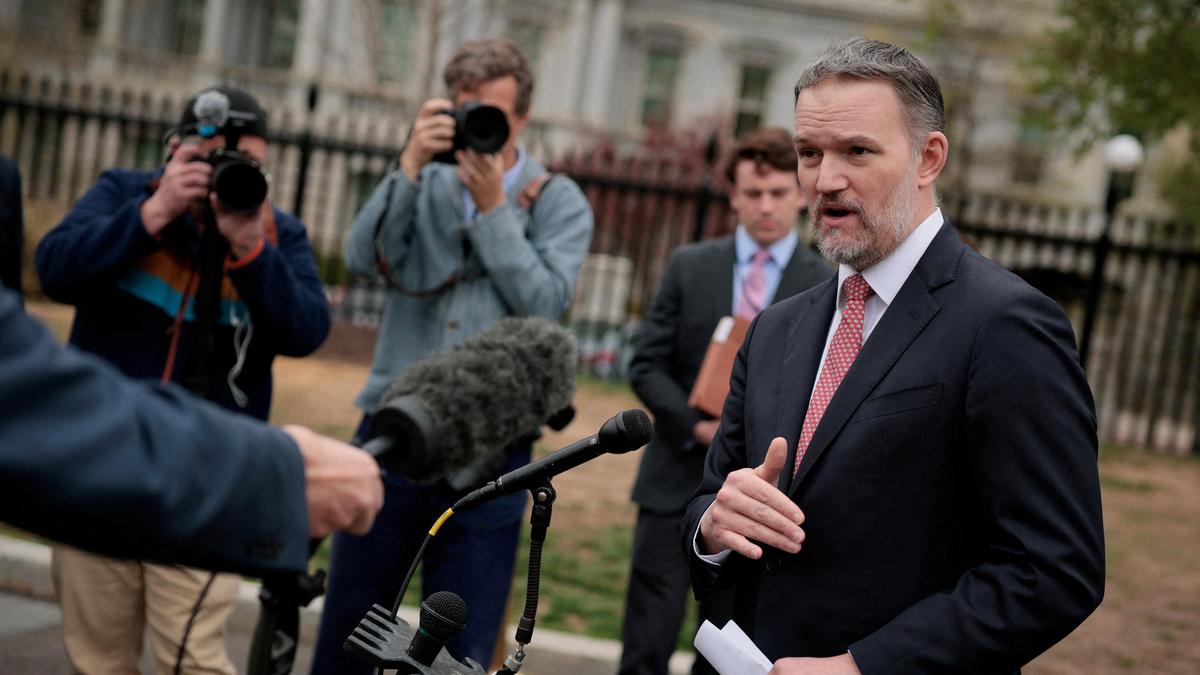
The strategic outcome of the recent Beijing summit does not hinge on direct military co-belligerence in the Persian Gulf, but rather on the cold application of bilateral economic leverage. When U.S. Trade Representative Jamieson Greer confirmed that President Donald Trump secured a commitment from Chinese President Xi Jinping to withhold "material support" from Iran, he outlined a foundational shift in how transpacific trade policy is deployed as a tool of geopolitical containment.
The transaction isolates Iran by neutralizing its most critical economic partner, yet it explicitly avoids demanding Chinese participation in active maritime security operations like clearing the Strait of Hormuz. Instead, the United States utilized a calculated framework of market access, structured state purchasing, and institutionalized negotiation channels to alter Beijing's strategic calculus. Deconstructing this diplomatic maneuver requires evaluating the explicit cost functions, trade-offs, and institutional mechanisms that underpin this uneasy macroeconomic truce.
The Equilibrium of Non-Intervention: Defining "Material Support"
The diplomatic baseline established in Beijing relies on a clear distinction between passive economic consumption and active strategic enablement. Washington did not seek Chinese military intervention to guarantee freedom of navigation in the Middle East, despite Beijing's heavy reliance on the Persian Gulf for crude oil imports. The strategic architecture operates on an asymmetric trade-off structured around two core principles:
- The Principle of Asymmetric Enforcement: The United States assumes the operational risks and capital expenditures required to stabilize the Strait of Hormuz. In return, China agrees to a status of strict non-interference, committing to abstain from transferring dual-use technology, supplying defense materiel, or extending sovereign credit facilities that could alleviate the primary economic pressure currently facing Tehran.
- The Scope of Material Containment: By defining the restriction around "material support," the U.S. draws a hard line between standard mercantile trade—such as the purchasing of heavily discounted Iranian crude via independent "teacup" refineries—and formal state-backed capitalization or military assistance.
This framework creates a stabilizing boundary. China maintains its energy security runway without directly underwriting Iran's external conflicts, while the United States successfully limits the strategic depth of its primary Middle Eastern adversary without triggering a direct naval confrontation with Chinese assets in the Gulf.
The Economics of Transpacific Leverage: The Summit Ledger
The commitment to withhold material support from Iran was not granted in isolation; it was extracted via a highly structured transactional ledger that rebalances specific sectors of the bilateral trade relationship. Rather than resolving the overarching tariff architecture at the leader level, the summit produced a distinct, itemized exchange designed to satisfy domestic political and commercial imperatives on both sides.
The Agriculture and Biotechnology Resumption
Beijing agreed to remove specific non-tariff barriers that had previously throttled American agricultural outputs. This includes the resumption of processing licenses for several U.S. meat-exporting facilities and a formal commitment to review pending approvals for agricultural biotechnology trades. These adjustments run parallel to a baseline enforcement mechanism: the continuation of China’s commitment to purchase 25 million metric tons of U.S. soybeans annually.
The Capital Goods Injection
The most capital-dense component of the agreement is China's commitment to purchase 200 Boeing commercial aircraft. This transaction represents the first major Chinese civil aviation order in nearly a decade, serving a dual economic purpose. For the United States, it provides an immediate capital injection into a critical industrial manufacturing anchor. For China, it secures essential access to Western aerospace supply chains, including auto and aircraft spare parts required to maintain the operational integrity of its existing commercial fleets.
[U.S. Market Access & Tariff Truce] ──> Resumption of Meat Exports & Biotech Reviews
                                    ──> Procurement of 200 Boeing Civil Aircraft
                                      │
                                      ▼
[Chinese Strategic Concession]   ──> Formal Commitment: No Material Support to Iran
This ledger illustrates that the issue of tariffs was deliberately sidelined by both heads of state. By leaving existing levies intact but granting targeted commercial concessions, both nations established a temporary equilibrium that stabilizes supply chains without requiring either side to retreat from their broader protectionist stances.
The Formalization of Economic Conflict: The Board of Trade
The structural centerpiece emerging from these negotiations is the proposed establishment of a bilateral "Board of Trade" and a parallel "Board of Investment." This represents a profound shift away from the ad hoc, crisis-driven trade diplomacy that characterized the past decade, moving instead toward an institutionalized conflict-management framework.
The mechanism bifurcates the bilateral economic relationship into two distinct operational spheres:
1. The Commercial Sphere (Non-Sensitive Goods)
The Board of Trade is explicitly designed to govern trade in non-sensitive commodities. This includes agricultural products, energy goods, civil aviation, and medical devices. By creating a formalized desk to negotiate trading terms, quotas, and non-tariff barriers for these specific categories, both governments seek to maximize mutually beneficial commerce where national security risks are negligible.
2. The Restrictive Sphere (Sensitive Goods)
Crucially, high-technology sectors, dual-use equipment, semiconductor supply chains, and advanced computing are entirely excluded from the Board of Trade's purview. These are categorized strictly as national security imperatives, managed through unilateral export controls, investment screenings, and sanctions frameworks.
This structural separation ensures that ongoing geopolitical friction in high-tech domains does not inadvertently collapse foundational agricultural or consumer trade channels. It provides a formal release valve, allowing both superpowers to manage economic interdependence while simultaneously prosecuting a targeted tech decoupling.
Systemic Risks and the Threshold of Tariff Escalation
The strategic stability heralded by Greer remains highly contingent on strict compliance with the terms of the agreement. The structural fragility of this deal lies in the explicit enforcement mechanisms retained by the United States.
The baseline tariff structure currently governing U.S.-China trade is tethered to a pre-arranged escalation trigger. Should U.S. oversight mechanisms identify systemic Chinese circumvention—either via the provision of illicit material support to Tehran through front companies or via the continuation of industrial overcapacity dumping in Western markets—Washington retains the unilateral right to elevate tariffs by approximately 10 percentage points. This would effectively return duties to the peak levels established during the Busan agreement.
The primary limitation of this strategy is the verification bottleneck. Tracking the movement of dual-use technologies, dark-fleet oil transactions, and illicit financial flows through secondary and tertiary banks across Eurasia represents an immense intelligence challenge. The agreement relies on the assumption that China values its access to Western commercial aircraft, agricultural inputs, and global supply chain stability more than the geopolitical upside of deeply capitalizing the Iranian state.
The Strategic Playbook for Global Supply Chains
Corporate decision-makers, logistics planners, and macro investors must look past the diplomatic rhetoric and prepare for the operational realities created by this conditional stabilization. The framework established in Beijing mandates three clear strategic responses:
- Bifurcate Supply Chain Compliance Architecture: Firms operating at the intersection of dual-use technology and global logistics must structurally isolate their commercial operations. Given that the U.S. Board of Trade will only facilitate non-sensitive commerce, any product line with potential military, aerospace, or advanced computing applications must be built on supply chains that completely bypass Chinese manufacturing inputs and Iranian transshipment routes.
- Execute Capital Expenditure Realignment in Aerospace and Agriculture: The lock-in of 200 Boeing aircraft and the reopening of agricultural facilities signal guaranteed bilateral liquidity in these specific corridors for the medium term. Capital allocation should lean into these stabilized channels, maximizing throughput while the temporary trade truce holds.
- Establish Tariff Contingency Buffers: Because the U.S. retains a unilateral 10 percentage point tariff escalation trigger tied to Chinese compliance regarding Iran and industrial capacity, supply chain models must not assume stable pricing. Procurement teams should stress-test their margins against a sudden return to peak tariff rates, ensuring that alternative sourcing contracts in Southeast Asia or Latin America can be activated within a 30-day window if the geopolitical equilibrium fractures.