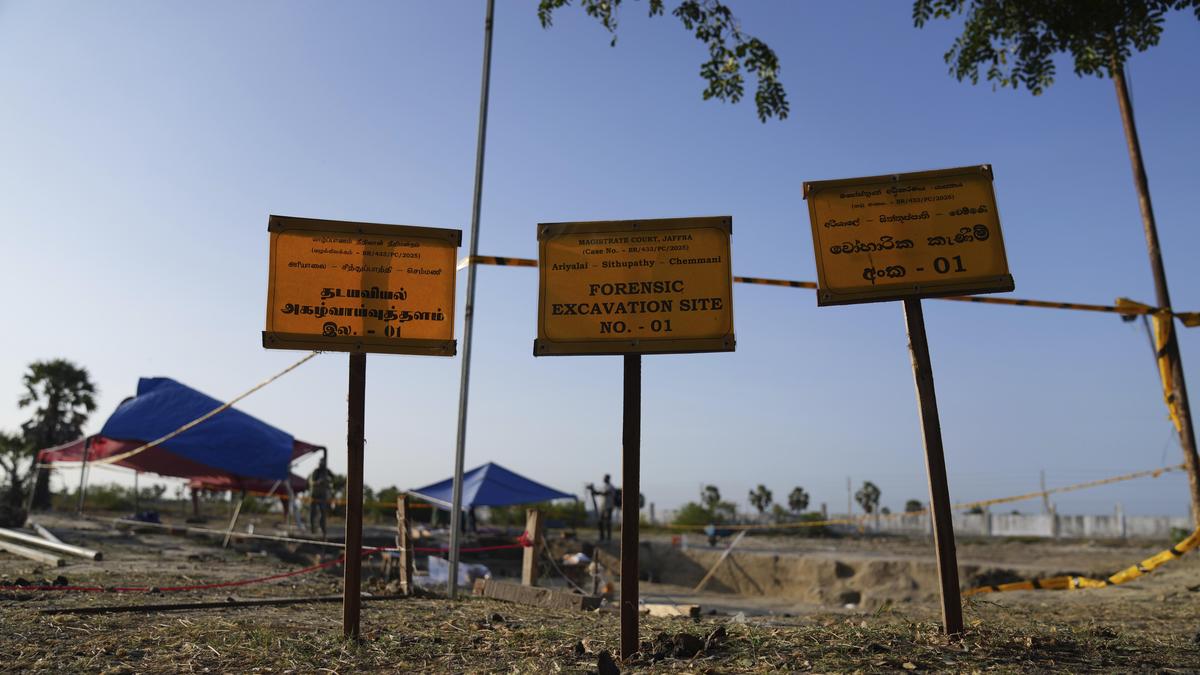
The resumption of excavations at the Chemmani mass grave site in Jaffna represents more than a localized forensic event; it is a critical test of the Sri Lankan state’s institutional integrity under heightened international diplomatic scrutiny. The primary objective of this re-excavation is to reconcile historical allegations of extrajudicial executions with verifiable biological evidence. To achieve this, the process must navigate a complex tri-nodal constraint system: forensic methodology, political sovereignty, and the evidentiary requirements of international human rights law. Success is measured not merely by the recovery of remains, but by the chain of custody and the scientific rigor applied to skeletal identification.
The Three Pillars of Forensic Legitimacy
The Chemmani site operates as a microcosm of Sri Lanka's post-conflict accountability framework. For the findings to hold weight in a judicial or historical capacity, three specific pillars must remain intact:
- Diplomatic Oversight as a Verification Layer: The presence of foreign diplomats and international observers serves as a non-technical audit of the proceedings. This presence is designed to mitigate risks of evidence tampering or procedural shortcuts that have historically plagued domestic inquiries.
- Multidisciplinary Expert Integration: A credible excavation requires the intersection of forensic archaeology, anthropology, and pathology. The challenge lies in the age of the site—dating back to the late 1990s—which necessitates advanced taphonomic analysis to distinguish between natural decomposition and trauma-induced skeletal damage.
- Judicial Continuity: The excavation is bound by the mandates of the Jaffna Magistrate’s Court. This creates a legal bottleneck where scientific progress must align with the pace of a specific domestic legal system, often leading to friction between technical requirements and administrative timelines.
The Cost Function of Delayed Identification
Time is the primary antagonist in forensic recovery. In the context of Chemmani, the delay between the initial allegations and the 2024–2026 excavation cycle introduces several degradation variables.
The chemical composition of the soil in the Jaffna peninsula, characterized by high salinity and specific alkaline levels, significantly impacts the preservation of mitochondrial DNA (mtDNA). As bone mineral density decreases over decades, the "cost" of extraction increases—both in financial terms and in the probability of obtaining a viable profile.
Skeletal remains subjected to tropical weather cycles undergo significant weathering. This physical degradation limits the ability of forensic pathologists to identify "perimortem" trauma—injuries sustained at or near the time of death—versus "postmortem" damage caused by the excavation process itself. The inability to distinguish these two states invalidates the primary evidence required to prove criminal intent or systemic execution patterns.
Mechanisms of Institutional Resistance
The re-excavation is not occurring in a vacuum; it is a reaction to external pressures, specifically from the United Nations Human Rights Council (UNHRC) and the Office on Missing Persons (OMP). However, the "Will-to-Expose" is often countered by internal bureaucratic friction.
- Funding Attrition: Forensic projects of this scale require specialized equipment and long-term storage facilities. By decentralizing the budget or delaying the release of funds to the archaeological teams, the state can effectively stall the process without an overt cessation of activities.
- Expertise Scarcity: Sri Lanka possesses a limited pool of forensic anthropologists. Overburdening these individuals with multiple active sites—such as those in Mannar or Mullaitivu—creates a throughput bottleneck.
- The Chain of Custody Risk: If the transition from the excavation site to the laboratory is not secured by a third-party monitor, the "reasonable doubt" threshold in any future prosecution remains high.
Logical Framework for Victim Identification
The identification process follows a binary logic gate. First, the remains must be confirmed as human. Second, they must be checked for biological profiles (age, sex, stature) that match the database of reported missing persons from the 1996–1998 period.
If the skeletal remains exhibit signs of ligature marks, blindfolds, or gunshot wounds to the cranium, the classification shifts from "unidentified remains" to "evidence of a crime scene." The missing link in the current Sri Lankan strategy is a centralized, accessible DNA database. Without a reference point provided by the surviving kin, the physical evidence remains "silent," providing no legal closure to the families or the international community.
The involvement of the International Committee of the Red Cross (ICRC) or similar bodies is required to bridge the trust gap. Local populations are often hesitant to provide DNA samples to state-controlled entities due to fears of surveillance or future retribution. This creates a data vacuum that renders even the most successful excavation inconclusive.
Geopolitical Leverage and the Accountability Loop
The Chemmani excavation is a strategic signaling mechanism used by the Sri Lankan government to demonstrate compliance with international norms while maintaining domestic control. This creates a "stabilization loop":
- International Signal: By allowing diplomatic presence, the state lowers the temperature of international sanctions and critical UN resolutions.
- Domestic Management: By keeping the process within the domestic judicial framework, the state retains the power to classify findings or limit the scope of the inquiry.
- Outcome: A prolonged, inconclusive investigation that satisfies the procedural requirements of the international community without delivering the disruptive truths that could destabilize domestic political coalitions.
The bottleneck here is the "finality" of the report. Historically, many Sri Lankan commissions and excavations have ended in interim reports that are never fully realized or translated into indictments.
Technical Requirements for a Successful Outcome
To transcend the limitations of previous attempts, the current excavation must adopt a protocol that prioritizes transparency over speed.
- 3D Site Mapping: Utilizing LiDAR or high-resolution photogrammetry to create a digital twin of the mass grave. This preserves the spatial relationship of the remains before they are disturbed, which is vital for reconstructing the events of the burial.
- Isotope Analysis: Given the potential for remains to have been moved, oxygen and strontium isotope analysis can determine the geographic origin of the victims, confirming whether they were locals or individuals brought from other regions.
- Independent Laboratory Verification: Sending a subset of samples to international laboratories (such as the ICMP in The Hague) to cross-verify the results of domestic testing.
The presence of diplomats is a visual deterrent against overt interference, but it does not substitute for these technical safeguards. The diplomat’s role is political; the forensic scientist’s role is evidentiary. Confusing the two leads to a "performative excavation" where the appearance of justice is maintained without the substance of accountability.
Strategic Forecast for Post-Excavation Dynamics
The most likely trajectory for the Chemmani re-excavation involves a high volume of recovered skeletal material but a low rate of positive identification. This outcome is a result of the decades-long gap in evidence collection and the lack of a comprehensive ante-mortem database.
Strategic actors should expect a prolonged legal battle over the "cause of death" findings. State-aligned experts may argue for environmental or natural causes, while independent observers will likely point to clear indicators of trauma. This divergence will keep the Chemmani site on the UNHRC agenda for the foreseeable future.
The immediate requirement for those advocating for justice is the formalization of an independent witness protection program. Without the testimony of those who lived through the 1990s in Jaffna to complement the forensic data, the bones recovered at Chemmani will remain an incomplete record. The state’s willingness to protect these witnesses will be the true indicator of whether the excavation is a genuine search for truth or a sophisticated exercise in diplomatic optics.
The focus must now shift from the act of digging to the methodology of analysis. The forensic report produced from this site will either serve as a blueprint for future mass grave investigations in Sri Lanka or as a final confirmation of the limitations of domestic accountability. The technical integrity of the next six months of laboratory work will dictate the next decade of Sri Lanka's international relations.