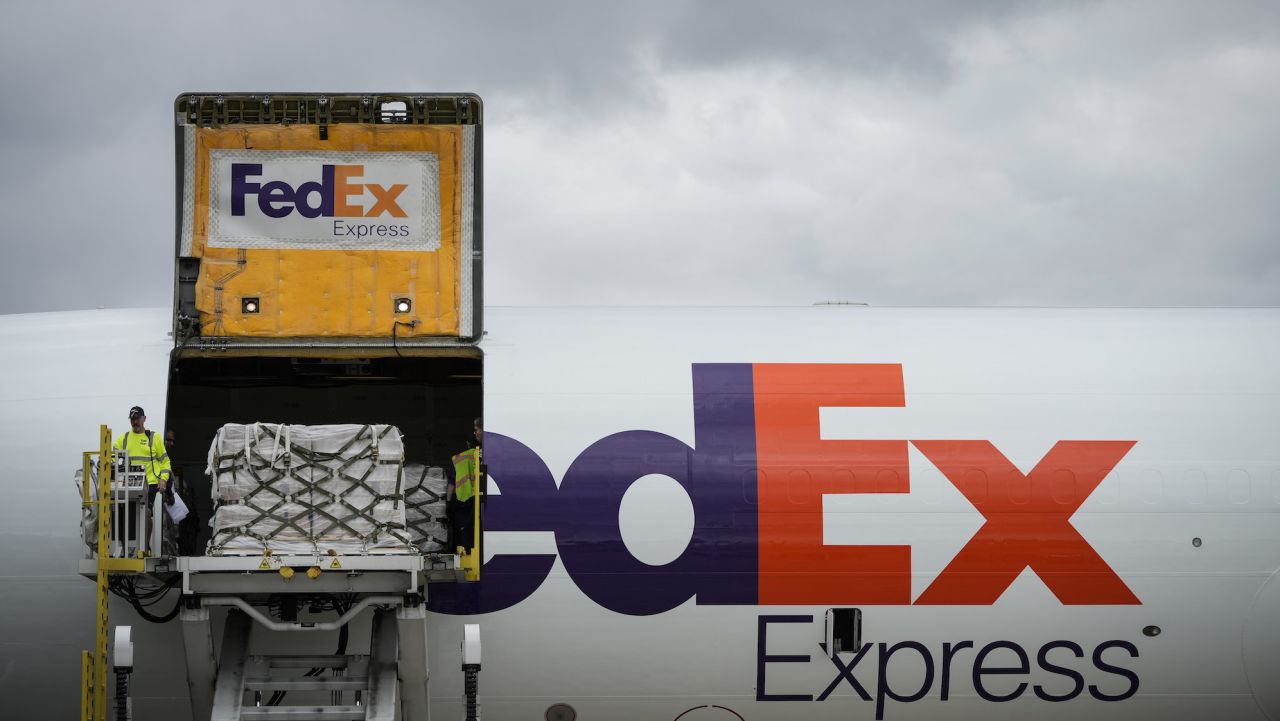
Raj Subramaniam is whistling past the graveyard. When the FedEx CEO brushed off Amazon’s expansion into third-party logistics as a "non-threat" because of "density," he wasn't just being confident. He was being delusional. The market reacted by wiping billions off FedEx’s valuation for a reason. Investors aren't stupid; they see the structural decay of the legacy hub-and-spoke model when it goes up against a data-driven mesh network.
The "lazy consensus" in logistics circles is that FedEx and UPS own the "complex" middle mile and the global infrastructure that Amazon can’t touch. The argument goes that Amazon is great at delivering its own toothpaste and chargers, but it lacks the sophistication to handle the world’s enterprise shipping.
That is a fundamental misunderstanding of how platforms eat industries.
The Density Myth and the Death of the Hub
Subramaniam’s favorite defense is density. He argues that FedEx has the established routes and the volume to make every stop profitable in a way a newcomer can’t match. This is the same logic used by taxi companies before Uber and by bookstores before, well, Amazon.
Density isn't a moat; it’s a temporary mathematical advantage.
FedEx operates on a rigid, hierarchical system. Your package goes from a local station to a regional hub, potentially to the "SuperHub" in Memphis, and then back down the chain. It is a 20th-century solution to a 21st-century problem. It relies on massive fixed assets—planes, sorting facilities, and specialized trucks—that are incredibly expensive to maintain.
Amazon doesn't build hubs; it builds a decentralized web. By the time Amazon Supply Chain was offered to outside merchants, the company had already spent a decade perfecting the art of moving goods based on predictive AI rather than static schedules. Amazon knows what you want before you buy it and positions it five miles from your house. FedEx is still waiting for you to drop a box at a retail counter so they can fly it halfway across the country.
The Software-Defined Logistics Revolution
We need to stop viewing FedEx as a logistics company and start viewing it as a massive, flying real estate portfolio. They are trapped by their assets. Every plane they own is a liability in a world where software can optimize third-party fleets more efficiently than a CEO can manage a private air force.
Amazon Supply Chain isn't just a delivery service; it's an API for the physical world.
When a merchant uses Amazon, they aren't just buying a shipping label. They are plugging into a system that handles inventory management, warehousing, and multi-channel fulfillment. FedEx offers a tracking number. Amazon offers a business operating system.
I’ve seen legacy giants spend nine figures trying to "digitize" their operations. It almost always fails because they try to bolt software onto old hardware. You cannot turn a 1970s freight company into a 2020s tech platform by hiring a few consultants and building a slicker mobile app. The rot is in the infrastructure.
Why the "Specialized Shipping" Defense is a Trap
The last bastion for FedEx defenders is the idea of specialized cargo. "Amazon won't ship cold-chain biologics or heavy industrial machinery," they claim.
Maybe not today. But look at the trajectory.
Every platform starts at the low end of the market—the "easy" packages—and moves up the value chain. By capturing the high-volume, low-complexity consumer goods, Amazon starves the legacy players of the cash flow they need to subsidize their expensive specialized networks.
If FedEx is left only with the "hard" packages—the weirdly shaped, temperature-sensitive, or hazardous materials—their margins will collapse. You cannot maintain a global airline on the back of specialized medical equipment alone. You need the millions of boxes of sneakers and electronics to pay for the fuel.
The False Security of "Partner" Relationships
FedEx famously cut ties with Amazon years ago, claiming they didn't want to help a competitor. It was a bold move that looked smart on a spreadsheet for exactly one quarter. In reality, it accelerated Amazon’s need to build its own fleet.
Now, Amazon is turning that fleet outward.
The industry likes to pretend that retailers hate Amazon and will never trust them with their logistics. This ignores the brutal reality of the bottom line. If Amazon can ship a product 20% cheaper and two days faster than FedEx because their software is better at predicting route efficiency, the "trust" argument evaporates. Merchants will choose the option that keeps them in business.
The Innovation Tax
FedEx is paying an innovation tax. Because they own their planes and trucks, they are locked into current technology. Transitioning to an autonomous or electric fleet is a multi-decade, multi-billion-dollar headache.
Amazon, conversely, can iterate at the speed of software. They can pilot new delivery methods in specific markets without needing to overhaul a global legacy system. They are modular; FedEx is monolithic.
The Brutal Reality of Pricing Power
In a commodity business like shipping, the player with the lowest cost-to-serve wins.
- Amazon’s Cost Basis: Built on top of a retail empire that subsidizes the infrastructure. Delivery is a feature, not the only product.
- FedEx’s Cost Basis: Every dollar of revenue must cover the massive overhead of planes, pilots, and union-adjacent labor pressures.
When Amazon decides to undercut FedEx on third-party shipping, they aren't just competing on price. They are engaging in predatory efficiency. They can afford to break even on shipping because it locks merchants into the broader Amazon ecosystem (AWS, Advertising, Marketplace). FedEx has no "ecosystem." They have a box.
Stop Asking if Amazon Can Compete
The question isn't whether Amazon can compete with FedEx. The question is whether FedEx can survive the "Amazonification" of the entire global supply chain.
People ask: "Will Amazon buy FedEx?"
The answer: "Why would they want the debt and the old planes?"
Amazon is building the future of logistics from the cloud down. FedEx is trying to save the past from the ground up. If you are an investor or a business owner relying on the "stability" of legacy carriers, you are betting against the most successful disruption engine in history.
The "density" Subramaniam talks about is actually a gravity well. It's pulling the company down, making it too heavy to pivot, while the competition flies circles around them with code.
Don't wait for the quarterly earnings report to tell you what the stock market already knows. The era of the pure-play logistics giant is over. You either become a platform or you become a footnote.
Sell the planes. Fire the consultants. Build a time machine. Or get out of the way.