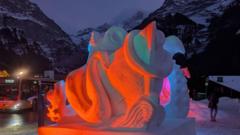
The victory of British stonemasons at the World Snow Festival in Grindelwald, Switzerland, is not a narrative of artistic inspiration, but a successful transfer of specialized industrial competencies from high-density mineral substrates to low-density crystalline structures. While casual observers view snow sculpting as a seasonal aesthetic pursuit, the 2024 performance by the UK team demonstrates a sophisticated understanding of structural load-bearing limits and the thermal dynamics of sintered snow. The transition from carving Portland stone to manipulating compressed snow blocks requires an immediate recalibration of tool-pressure ratios and a deep technical grasp of the material’s shear strength.
The Material Transition Matrix
To understand why professional stonemasons outperformed traditional sculptors, one must analyze the physical properties of the medium. The "snow" used in these competitions is rarely natural precipitation. It is usually machine-produced, high-density snow packed into wooden forms to undergo "sintering"—a process where individual ice crystals bond together under pressure and time.
The resulting medium possesses distinct mechanical properties:
- Compressive Strength: Sintered snow can support significant weight but remains brittle under tension.
- Thermal Sensitivity: The material undergoes constant phase changes. Sublimation (direct transition from solid to gas) and surface melting alter the structural integrity of fine details over the five-day competition window.
- Anisotropy: Depending on how the snow was packed into the 3x3x3 meter blocks, the material may exhibit different strengths in different directions, similar to the grain in timber or the bedding planes in sedimentary rock.
Stonemasons are trained to identify internal flaws and "read" the grain of a substrate. In Grindelwald, this allowed the British team to execute aggressive sub-cuts and cantilevered elements that would have collapsed under the hands of an artist unfamiliar with the physics of weight distribution.
The Three Pillars of Technical Dominance
The success of the British team—comprising carvers who typically work on heritage restoration projects like Westminster Abbey—rests on three specific technical pillars:
1. Geometrical Transferability
The team utilized a "The Beast" design, which required an understanding of anatomical proportions translated into a 3D grid. Unlike clay modeling, which is additive, snow sculpting is purely subtractive. There is no margin for error. Stonemasons utilize a "point-to-point" carving system. By establishing fixed reference points on the exterior of the 27-cubic-meter block, they can maintain symmetry and depth control with mathematical precision. This reduces the cognitive load during the carving process and minimizes the risk of over-carving critical support structures.
2. Specialized Tool Adaptation
While many competitors use generic shovels or wood saws, the British team applied masonry-specific tools—modified to account for the lower density of ice.
- Rifflers and Rasps: Used for fine surface tension management.
- Ductile Iron Saws: For rapid bulk removal without inducing micro-fractures in the core of the block.
- Thermodynamic Buffing: Utilizing the heat from friction to create a "glaze" on the surface, which acts as a protective skin against wind erosion.
3. Structural Integrity and The Center of Gravity
The primary failure point in large-scale snow sculpture is the "Collapse Threshold," where the weight of the upper mass exceeds the compressive strength of the base. The British team’s design distributed the load through a broader footprint while thinning the upper extremities. This demonstrates an intuitive grasp of the Slenderness Ratio, a calculation typically used in masonry column design to prevent buckling. By keeping the center of mass low and centered, they could afford to take "aesthetic risks" with protruding limbs that appeared to defy gravity.
Environmental Variables and Risk Mitigation
The Grindelwald environment introduces a chaotic variable: ambient temperature fluctuations. During the 2024 event, temperatures reached 12°C, a catastrophic level for snow stability.
The strategy shifts from "carving for beauty" to "carving for survival" under these conditions. The British team’s background in outdoor masonry restoration provided a distinct advantage here. They are accustomed to working with materials that expand and contract. They employed a "Shade-Side Prioritization" workflow, finishing the south-facing (sun-exposed) surfaces first and leaving more mass on the northern side to provide a thermal heat sink, slowing the overall melt rate of the sculpture’s core.
The Economic and Cultural Capital of Craft
The victory highlights a significant trend in the global "creator economy": the premium on specialized trade skills. The "stonemason" is no longer just a construction worker but a high-value consultant in ephemeral design.
There is a clear cause-and-effect relationship between the decline of traditional apprenticeship programs and the rising "novelty value" of these skills in competitive arenas. The UK’s victory acts as a proof-of-concept for the versatility of vocational training. If a technician can master the most difficult substrate (stone), they can dominate any subordinate medium (snow, ice, sand, or wood) through the application of the same first-principles physics.
Limitations of the Medium
Despite the technical mastery displayed, snow remains a fundamentally flawed medium for long-term artistic expression. The "Victory of Grindelwald" lasted only as long as the weather permitted. This creates a bottleneck for the commercialization of such art. Unlike the stone cathedrals these masons usually repair, which have a lifecycle of 500+ years, a snow sculpture has a lifecycle of approximately 120 hours.
The value proposition of the competition is therefore not the end product, but the demonstration of process-perfection. The judges in Switzerland—many of whom are architects and engineers—award points based on technical difficulty, which is a proxy for the team's ability to manage the physics of the block.
Strategic Deployment of Vocational Skills
Organizations looking to replicate this success in other high-stakes environments should focus on the "transversal application" of core competencies. The British team did not win because they were better artists; they won because they were better engineers of their medium.
To achieve similar results in any technical field:
- Isolate the core physical constraints of the task (weight, temperature, time).
- Apply the tools of a "harder" discipline to a "softer" problem.
- Prioritize structural stability over aesthetic flourish until the final 10% of the project timeline.
The Grindelwald victory is a data point confirming that when specialized industrial skill sets intersect with creative competitions, the technician will almost always out-produce the pure artist by minimizing the margin for structural failure.
Identify the "hardest" material constraints in your current project and apply the rigorous subtraction logic used by the British masons. Map out your fixed reference points before the first cut is made.
Would you like me to analyze the specific tool-set modifications used by the team to handle high-moisture snow conditions?