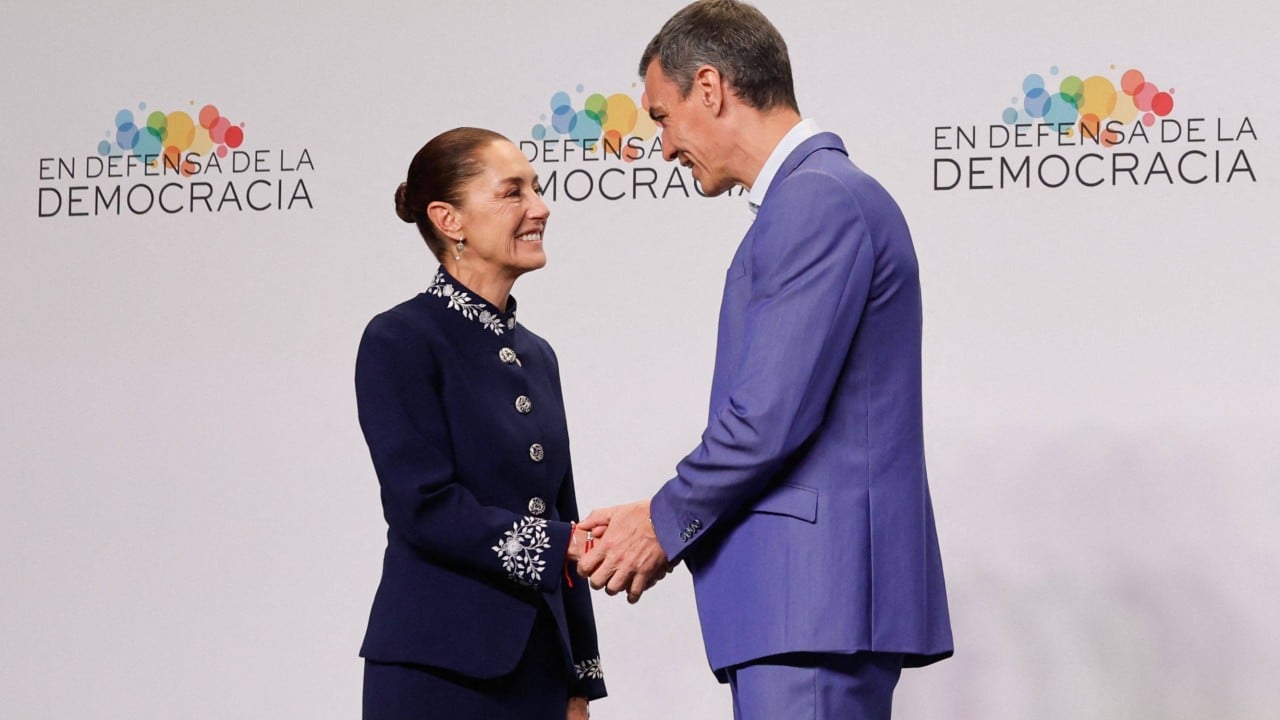
Diplomacy usually moves at a snail's pace, but sometimes it just takes a handshake and a few blunt words to end a seven-year freeze. Mexican President Claudia Sheinbaum just landed in Barcelona, marking the first time a Mexican head of state has set foot on Spanish soil in eight years. If you've followed the drama since 2019, you know this isn't just a standard state visit. It’s a massive tonal shift for a relationship that was, frankly, stuck in a repetitive loop of historical grievances and hurt feelings.
The "pause" in relations is officially over. Sheinbaum met with Spanish Prime Minister Pedro Sánchez at the "In Defense of Democracy" summit, and the vibe was a far cry from the ice-cold standoff of the last several years. "There is no diplomatic crisis; there never has been one," Sheinbaum told reporters. It’s a bold claim considering her predecessor, Andrés Manuel López Obrador (AMLO), basically ghosted the Spanish monarchy for years because they wouldn't apologize for the colonial conquest. But in the world of high-stakes politics, yesterday's "unacceptable" snub is today's "minor misunderstanding."
Why the Thaw is Happening Now
Let’s be real: Mexico can’t afford to stay mad at Spain forever. While the rhetoric about colonial-era abuses makes for great domestic politics in Mexico, the economic reality is much more sobering. Spain is Mexico’s second-largest European trading partner. We’re talking about over $116 billion in cumulative bilateral investment.
Spanish banks like BBVA and Santander practically run the Mexican financial sector. On the flip side, Mexican giants like Grupo Bimbo and Alsea are aggressively expanding across the Iberian Peninsula. When you have that much money flowing back and forth, keeping a "diplomatic pause" isn't just inconvenient—it's bad for business.
The shift also comes because the Spanish side finally blinked. In March 2026, King Felipe VI did something his advisors probably told him never to do: he publicly acknowledged that the conquest of the Americas involved "abuse" of native peoples. It wasn't the full-blown, televised apology AMLO wanted, but it was enough of a concession for Sheinbaum to claim a win and move on.
The Trump Factor
You can't talk about Mexican foreign policy in 2026 without mentioning the elephant in the room: the United States. With Donald Trump back in the White House and ratcheting up pressure on the border and trade tariffs, Mexico needs friends. Fast.
It’s a classic geopolitical hedge. If your neighbor to the north is threatening to tear up trade deals or close the border, you start looking across the Atlantic. Spain isn't just a historical relative; it’s Mexico’s gateway to the European Union. By mending this fence, Sheinbaum is ensuring that Mexico isn't totally isolated if things get ugly with Washington.
Moving Past the Apology Narrative
For years, the conversation between Mexico City and Madrid was stuck on 1521. AMLO’s 2019 letter demanding an apology was treated as a joke in Spain and a rallying cry in Mexico. It reached a low point in late 2024 when Sheinbaum didn't even invite King Felipe VI to her inauguration. Spain responded by boycotting the ceremony entirely.
But look at the change in just two years:
- March 2026: King Felipe acknowledges colonial "excesses."
- April 2026: Sheinbaum visits Barcelona and meets Sánchez.
- June 2026: The King is expected to attend a World Cup match in Mexico as an official guest.
This isn't to say the historical hurt is gone. Sheinbaum was quick to remind Sánchez that recognizing the violence of the conquest still matters. But she’s doing it while sitting at the table, not from across an ocean. It’s a pragmatic evolution. She’s keeping the ideological stance of the Morena party but stripping away the "pause" that was hurting Mexican interests.
What’s Actually on the Table
While the headlines are about the handshake, the real work is happening in the backrooms. The two leaders aren't just talking about the past; they're looking at:
- Energy Transition: Spain has massive experience in renewables (Iberdrola, anyone?), and Mexico needs to modernize its grid without relying entirely on fossil fuels.
- Infrastructure: Spanish firms are eyeing contracts for the next phase of Mexico’s massive rail and transit projects.
- The EU-Mexico Global Agreement: They’re pushing to finalize the modernization of this trade deal, which has been languishing in bureaucratic limbo for years.
The Reality of the Rapprochement
Don't expect everything to be sunshine and roses. There’s still a deep-seated suspicion among some in the Spanish right-wing who think Mexico is being "disrespectful" to Spanish heritage. Similarly, the hardline base of Sheinbaum’s party might see this visit as a "sell-out" to the former colonizers.
But honestly? Most people in both countries don't care about a 500-year-old war as much as they care about the price of gas or the stability of their bank accounts. The "rapprochement" is a recognition that the world is too volatile to let pride stand in the way of profit.
If you’re a business owner or an investor, this is the green light you’ve been waiting for. The legal uncertainty that hovered over Spanish companies in Mexico during the AMLO era is evaporating. Sheinbaum is signaling that she’s a "progressive leader" who still knows how to play ball with global capital.
Watch the World Cup invitations. If King Felipe shows up in Mexico City this June and gets a warm reception, the "cold war" isn't just thawing—it’s over. For now, the focus shifts to the 2027 "In Defense of Democracy" summit, which Sheinbaum has already invited Sánchez to host in Mexico. It looks like the two countries are finally ready to stop arguing about the 16th century and start dealing with the 21st.
If you're dealing with cross-border trade between these two, now's the time to audit your regulatory compliance. The "pause" is dead, and the floodgates for new bilateral contracts are creaking open. Don't wait for the official press release to start making moves.