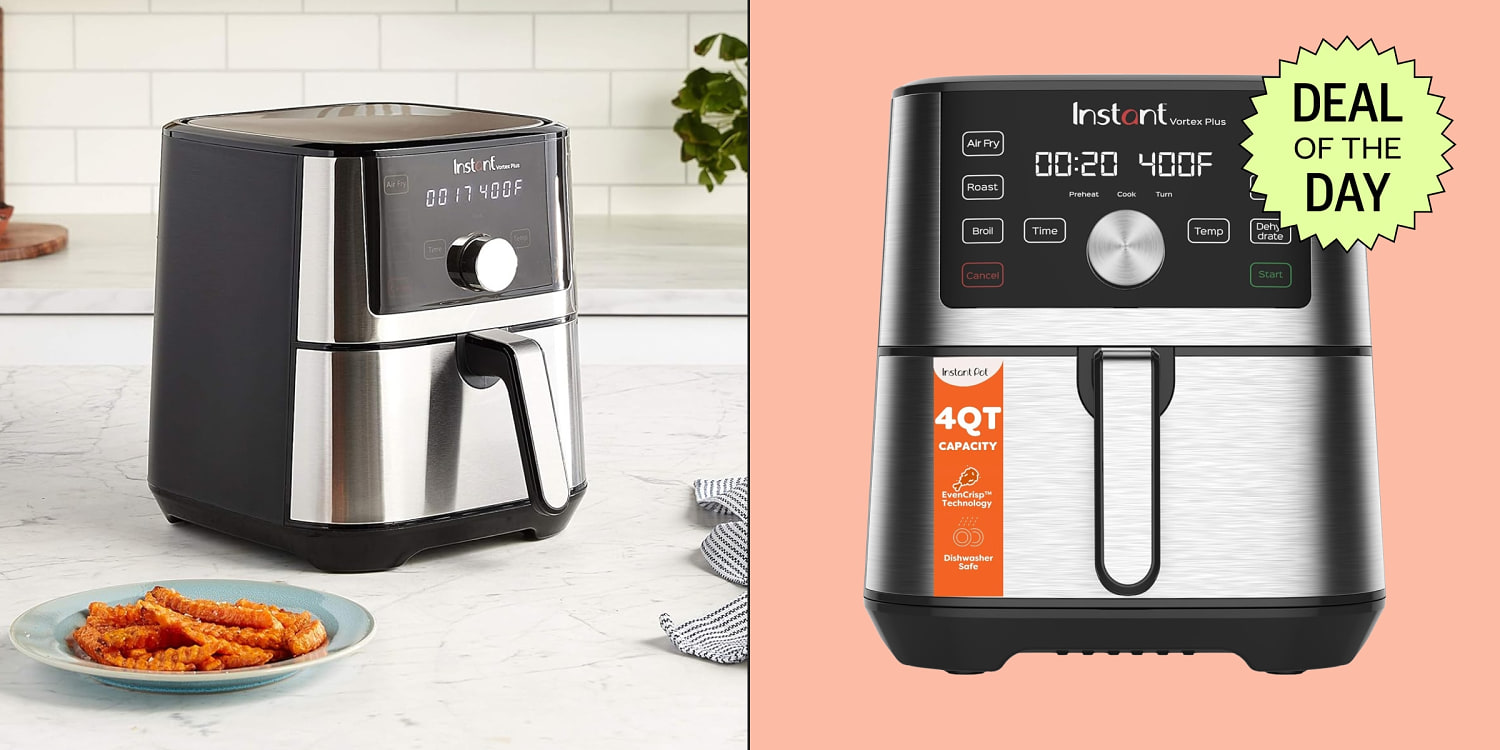
The "46% off" tag is the oldest trick in the retail playbook. It triggers a lizard-brain response: I’m winning. But you aren't winning. You are paying for the privilege of cluttering your kitchen with a device that does ten things mediocrely instead of one thing exceptionally.
Retailers want you to believe the Instant Pot Duo Crisp is a miracle of miniaturization—an oven that fits in a breadbox. That is a lie. It is not "practically your oven." It is a pressurized bucket with a hair dryer strapped to the lid.
If you want to cook better food, stop chasing discounts on multi-function gadgets and start understanding the physics of heat.
The Convection Lie
The marketing hook for these units relies on the "air fryer" craze. Let’s kill that term first. An air fryer is just a small, intense convection oven. It uses a high-velocity fan to circulate hot air around food, speeding up the Maillard reaction.
The Instant Pot version is fundamentally flawed because of its geometry.
Standard ovens work because they have surface area. When you roast a chicken or bake a tray of fries, you spread them out. In the narrow, deep cylinder of an Instant Pot, you are forced to stack your food.
Physics doesn't care about your convenience.
Crowding is the enemy of crispiness. When you pile frozen wings into a deep basket, the air cannot circulate. You don't get "fried" food; you get steamed mush with scorched tips. To get anything resembling a decent crunch, you have to open the lid, shake the basket, and restart the cycle every five minutes.
At that point, you haven't saved time. You've just turned yourself into a manual labor component for a poorly designed machine.
The Versatility Trap
"It replaces 11 appliances!"
This is the siren song for people living in tiny apartments or those obsessed with minimalism. But "all-in-one" is usually code for "master of none."
I have spent a decade testing kitchen gear, and I have never seen a multi-cooker that performs a slow-cook function as well as a $30 ceramic Crock-Pot. Why? Because the heating elements in an Instant Pot are concentrated at the bottom to facilitate pressure cooking. A dedicated slow cooker heats from the sides, providing the gentle, even soak that tough cuts of meat require.
When you use the Duo Crisp as a slow cooker, you often end up with a "hot spot" at the base that scorches your sauce while the top remains undercooked.
Then there is the pressure cooking itself. Yes, it’s fast. Yes, it makes great beans and stocks. But do you need a specialized air-frying lid—which is bulky, heavy, and requires its own storage space—to achieve that? No.
By buying the hybrid, you are paying a premium for a "lid-swapping" workflow that is clunky and counter-intuitive. You pressure cook the chicken, then you have to find a place to put a scalding hot, pressurized lid, grab the other massive air fryer lid, and lock it on. It’s a kitchen dance that feels like a choreographed disaster.
The Real Cost of 46% Off
Let’s talk about the "deal."
Manufacturers inflate the MSRP (Manufacturer’s Suggested Retail Price) specifically so they can "slash" it during Prime Day or Black Friday. That $200 unit was never meant to sell at $200. Its true market value is exactly what you see during the sale.
When you buy based on a discount percentage, you are letting the marketing department dictate your needs.
Why Your Oven Is Actually Better
The article you read claims this device is "practically your oven but a fraction of the size." This is mathematically and culinarily false.
- Volume vs. Surface Area: A standard oven rack gives you roughly 300 to 400 square inches of space. An Instant Pot basket gives you maybe 50.
- Thermal Mass: Your oven, once preheated, holds a massive amount of energy in its walls. When you slide food in, the temperature stays stable. A small plastic-and-metal pod loses its heat the second you crack the lid to check your fries.
- Moisture Control: Pressure cookers are designed to trap moisture. Air fryers are designed to remove it. Putting an air fryer lid on a pressure cooker base is a conflict of interest. The deep well of the pot holds onto steam, which is exactly what you don't want when trying to crisp skin.
The Counter-Intuitive Alternative
If you actually want to save space and cook like a professional, do this instead:
- Buy a dedicated Pressure Cooker: Get a standard 6-quart model. Use it for what it’s good at—braising, grains, and stocks.
- Invest in a Quarter-Sheet Pan and a Wire Rack: Put this in your "real" oven. Set it to 425°F. The wire rack allows air to circulate under the food. You now have an air fryer with four times the capacity and zero extra counter footprint.
- Stop Buying Plastic: Most of these "air fryer" lids are encased in cheap plastic that off-gasses during the first twenty uses. Your oven is made of steel and porcelain.
People Also Ask (And They Are Wrong)
"Can I bake a cake in it?"
You can, but why would you? You’ll get a dense, steamed sponge because the moisture has nowhere to go. Use a tin in the oven.
"Is it easier to clean?"
Absolutely not. Scrubbing the grease off the heating coil inside an air fryer lid is a nightmare that requires a toothbrush and a lot of patience. A sheet pan goes in the dishwasher.
"Does it save energy?"
Marginally. But if you have to run three "batches" of wings to feed a family of four because the basket is too small, you've used more electricity than the oven would have consumed in one go.
The Industry Secret
The reason influencers and "deals" sites push these hybrids so hard isn't because they use them. It’s because the affiliate commissions are higher on high-ticket "all-in-one" units. They aren't selling you a better dinner; they are selling you the idea of a simplified life.
Real simplicity isn't a gadget that does eleven things. It’s a few high-quality tools that you actually know how to use.
The Duo Crisp is a monument to the "Just In Case" school of cooking. I’ll buy it just in case I want to dehydrate kale. You won’t. You’ll use it for frozen fries twice, realize it’s a pain to clean, and then it will sit in the back of your pantry, a $120 paperweight.
The 46% you think you’re saving is money leaving your pocket for a problem you didn't have.
Throw the circular out. Turn on your oven. Stop letting the lid-swapping circus dictate your kitchen layout.