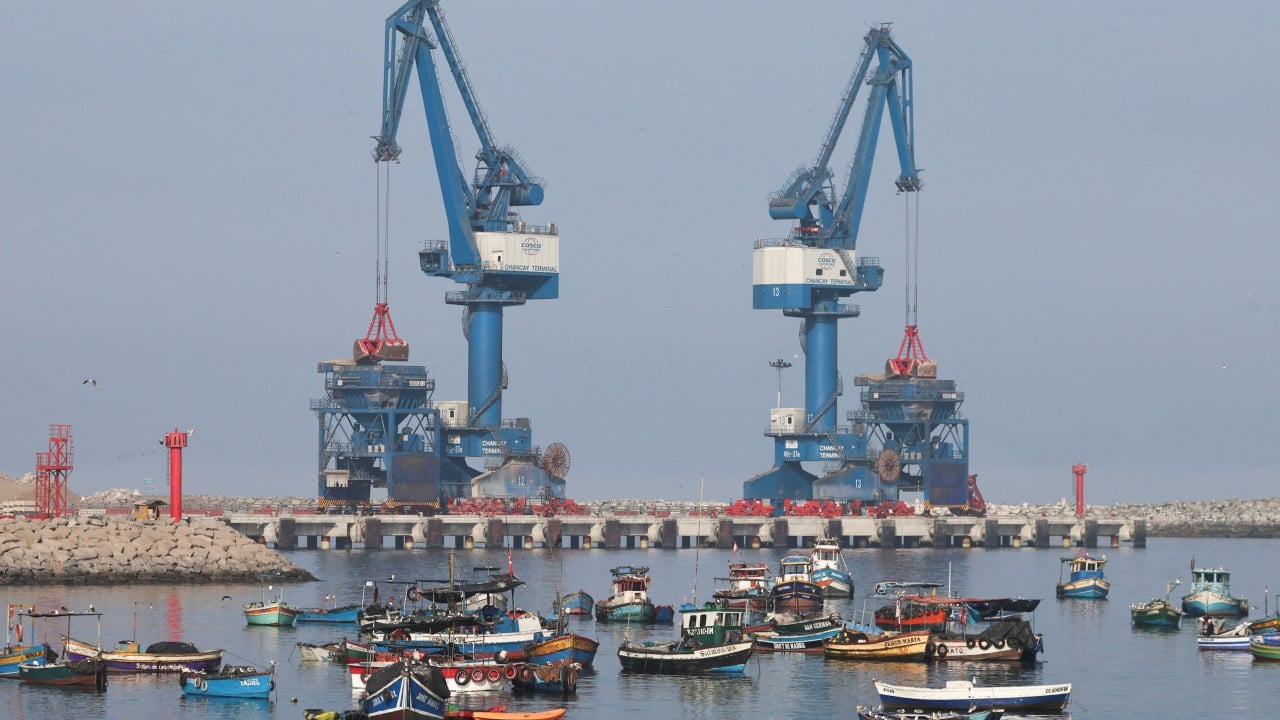
The United States has finally noticed the massive, automated crane towers rising over the Peruvian coastline, but Washington is decades late to the construction site. Recent declarations from the U.S. House Foreign Affairs Committee suggesting that the U.S. will help Peru "take back" the Port of Chancay from Chinese control represent a shift in rhetoric, yet they mask a desperate lack of practical alternatives. While American officials frame the $3.5 billion deep-water port as a security threat, the reality on the ground is driven by a cold, hard economic vacuum that the U.S. private sector has ignored for nearly half a century.
Chancay is not merely a shipping terminal. It is a tectonic shift in global logistics. Controlled by Cosco Shipping, a Chinese state-owned giant, the port is designed to bypass the traditional, aging hubs of the American West Coast and the Panama Canal. For the first time, South American soy, copper, and lithium will have a direct "maritime expressway" to Shanghai, cutting transit times by as much as two weeks. The U.S. now faces a scenario where its own "backyard" is physically and digitally integrated into the Belt and Road Initiative, leaving Washington to scramble for a strategy that involves more than just stern warnings.
The Illusion of Taking It Back
The suggestion that Peru can simply "take back" a project of this scale ignores the ironclad nature of international maritime law and sovereign contracts. Cosco Shipping holds a 60% stake in the project. The Peruvian government, despite internal friction regarding the exclusivity of services at the port, is tethered to the capital. To "take back" the port would require an act of nationalization or a legal maneuver so aggressive it would likely trigger a massive flight of foreign investment from Lima.
Washington’s leverage is thin. The U.S. cannot force a private Peruvian entity to break a contract with a Chinese firm without offering a financial package that matches or exceeds the Chinese investment. Currently, no such package exists. The Development Finance Corporation (DFC) and the "Americas Partnership for Economic Prosperity" are often cited as tools for this pushback, but their budgets are rounding errors compared to the deep pockets of China’s state-backed lenders. You cannot beat a mountain of concrete with a stack of white papers.
Beyond the Security Scare
The Pentagon and U.S. Southern Command have sounded the alarm over "dual-use" capabilities. They argue that any port deep enough for a massive container ship is deep enough for a Chinese People’s Liberation Army Navy destroyer. While technically true, focusing solely on the specter of Chinese warships misses the more immediate threat: data and influence.
Chancay will be an automated port. The software running the logistics, the 5G networks managing the autonomous vehicles, and the scanning equipment checking every crate are likely to be Chinese-made. This gives Beijing a granular view of every scrap of raw material leaving South America and every finished good entering it. It is an intelligence goldmine that allows China to map the economic nervous system of the Western Hemisphere in real-time.
The Panama Canal Problem
For over a century, the Panama Canal was the choke point that ensured U.S. dominance over regional trade. Climate change and fluctuating water levels have made the canal increasingly unreliable, leading to massive backlogs and increased transit fees. Chancay offers a way out. By creating a hub that can handle the "Ultra Large Container Vessels" that struggle with the canal’s constraints, China is effectively building a bypass around American-influenced geography.
The Cost of American Absence
If the U.S. wants to regain its footing in Peru, it has to answer why it wasn't there when the first shovel hit the dirt. For decades, American investment in South America has shifted toward services, finance, and software, leaving the "dirty" work of infrastructure—roads, bridges, and ports—to whoever was willing to pay. China was willing.
Local leaders in Peru are not necessarily pro-China; they are pro-development. If a mayor in a coastal town sees his community transformed from a fishing village to a global logistics hub, he will take the money regardless of where the passport of the investor comes from. The U.S. has spent years lecturing Latin American nations on the dangers of "debt-trap diplomacy" while offering very little in the way of "opportunity diplomacy."
Infrastructure as Sovereignty
To the Peruvian government, Chancay represents a bid for regional relevance. They envision Peru becoming the "Singapore of South America." This ambition is a powerful motivator that Washington’s security-centric rhetoric fails to address. When U.S. officials talk about "taking back" the port, it sounds to many in Lima like a return to the Monroe Doctrine—the idea that the U.S. has a right to dictate the internal economic affairs of its neighbors.
The Critical Minerals Factor
The battle for Chancay is inextricably linked to the global energy transition. The "Lithium Triangle" of Chile, Argentina, and Bolivia sits just across the border. Massive copper deposits in the Peruvian Andes are the lifeblood of the electric vehicle industry. By controlling the primary exit point for these minerals, China secures its supply chain for the next century.
If the U.S. succeeds in pressuring Peru to limit Chinese influence at Chancay, it must be prepared to integrate Peru into its own domestic supply chains. This would mean passing trade agreements that have become politically toxic in the U.S. Congress. It is a glaring contradiction: Washington wants to stop Chinese expansion but is unwilling to open its own markets to the very countries it is trying to "save."
Rebuilding the Arsenal of Development
Any serious attempt to counter Chinese influence in Peru must move beyond the floor of the House of Representatives and into the boardrooms of major engineering firms. It requires a fundamental shift in how the U.S. views foreign aid and investment.
- Equity over Debt: Instead of just offering loans, the U.S. needs to encourage private equity and pension funds to take direct stakes in South American infrastructure.
- Technical Standards: By setting the global bar for port automation and data security, the U.S. can make Chinese hardware look like a liability rather than an asset.
- The Middle Road: Instead of demanding a total break with Beijing, the U.S. could work with Peru to ensure "neutrality" at the port, perhaps by installing international monitors or ensuring that the digital infrastructure is multi-vendor.
The Coming Friction
The tension over Chancay is a preview of a new era of "gray zone" competition. It is not a war of missiles, but a war of berthing rights and bandwidth. The Peruvian government is currently caught in the middle, attempting to balance the enormous economic windfall of Chinese cash with the geopolitical necessity of staying on Washington's good side.
Recent legal disputes in Peru over Cosco's exclusive rights suggest that the "take back" might start with legal red tape rather than a grand diplomatic gesture. The Peruvian port authority recently tried to annul the exclusivity clause it had previously granted to Cosco, citing administrative errors. This is where the real fight happens—in the fine print of municipal codes and regulatory filings.
The Limits of Rhetoric
Talking about "taking back" a three-billion-dollar asset is easy. Building a competing vision for the 21st century is difficult. If the U.S. continues to rely on warnings without providing a credible, well-funded alternative, it will find itself a spectator in its own hemisphere. The cranes at Chancay are moving. They do not wait for the results of the next congressional hearing.
The U.S. must decide if it is willing to get its hands dirty in the business of nation-building again, or if it will be content to watch from the sidelines as the map of global trade is redrawn in a language it no longer speaks. The time for warnings has passed. The time for concrete has arrived.
The gravity of global trade is shifting South and West, away from the old Atlantic alliances and toward a Pacific-centric reality where the U.S. is just one of many players.