The silence of a mountain in July is supposed to be heavy with the scent of pine and the hum of dragonflies. But at the summit of a dying glacier in the Alps, the silence is different. It is surgical.
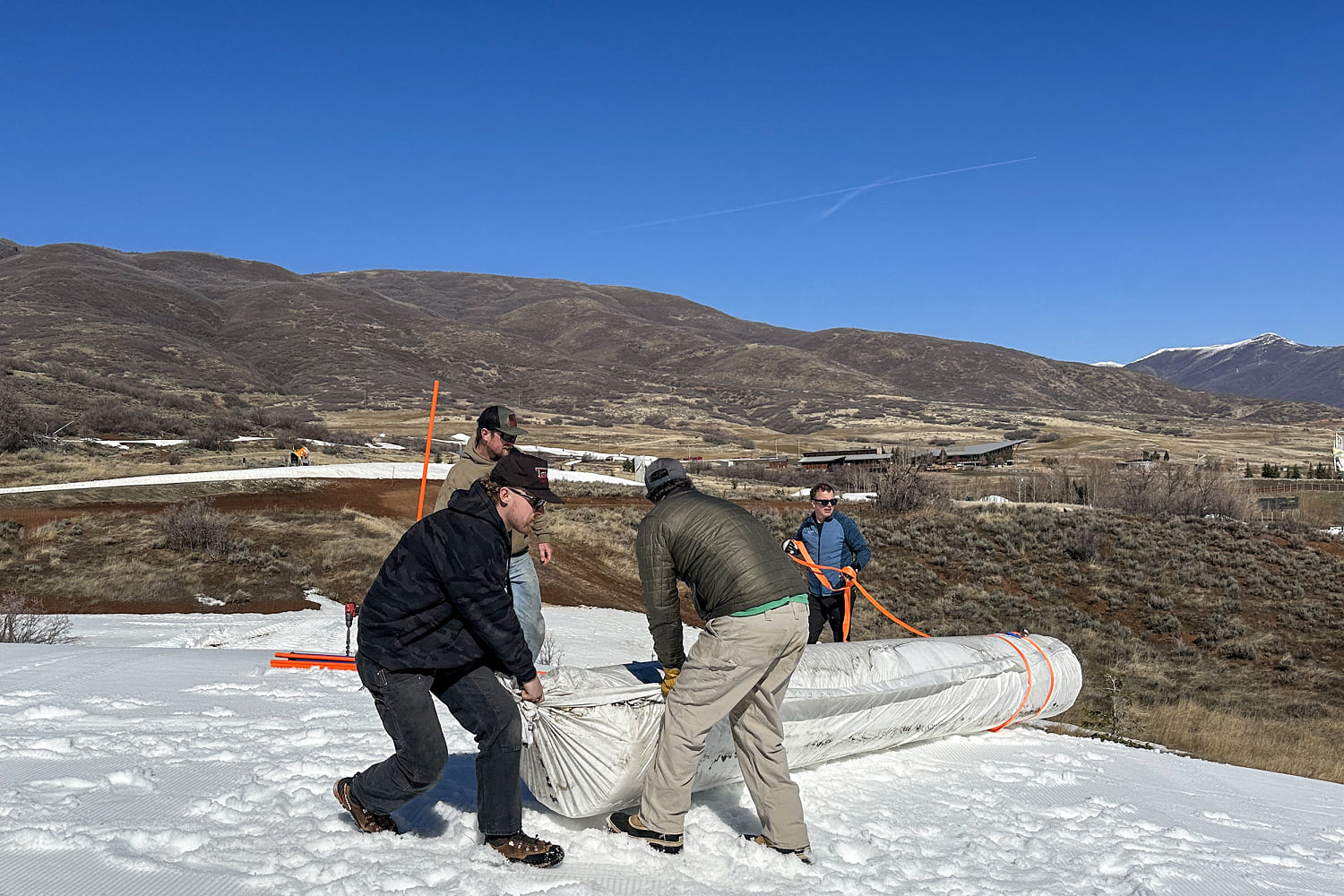
Hans, a third-generation lift operator whose face is a roadmap of frostbite and high-altitude sun, stands over a massive, undulating white shape that looks like a fallen cloud. It isn't a cloud. It is a three-story-high pile of last winter’s snow, swaddled in industrial-grade fleece blankets.
He pats the fabric. It feels like touching the flank of a sleeping beast. Underneath this white shroud lies the economic lifeblood of the valley below. If this snow melts, the hotels go quiet. The rental shops shutter. The village, which has lived off the cold for centuries, begins to evaporate.
This is snow farming. It is a desperate, brilliant, and deeply strange act of preservation. We are no longer just waiting for winter to arrive. We are kidnapping it and holding it hostage through the heat of August.
The Anatomy of a White Gold Mine
To understand why a ski resort would spend hundreds of thousands of dollars to tuck snow into bed for the summer, you have to understand the math of a warming world.
In the old days—twenty, maybe thirty years ago—the cycle was rhythmic. The first dusting arrived in October. The base built in November. By Christmas, the slopes were a sprawling canvas of powder. Now, the sky is fickle. December rains wash away a month’s worth of expensive snowmaking in a single afternoon.
Resorts found themselves in a trap. They could make more artificial snow, but that requires freezing temperatures and staggering amounts of water and electricity. If the temperature stays at 2°C, the most advanced snow cannons in the world are just very expensive garden hoses.
So, they pivoted. Instead of trying to manufacture winter in an increasingly warm autumn, they started hoarding the winter they already had.
The process is deceptively simple but logistically grueling. When April arrives and the last skiers descend, the "farming" begins. PistenBullys—those massive, treaded tractors—crawl across the mountain, scraping every remaining inch of snow into centralized, shadowed hollows. They build a mountain within a mountain.
Then comes the insulation.
Consider the physics of a thermos. A massive pile of snow has a low surface-area-to-volume ratio, meaning the core stays freezing even if the outer layer warms. By covering these mounds with specialized geotextile blankets—usually a mix of polyester and polypropylene—resorts can reflect nearly all incoming solar radiation.
It works. It works shockingly well. On average, a well-managed snow farm can retain 75% to 80% of its volume through a sweltering summer. When the "first" tracks are skied in October, the people carving those turns aren't skiing on fresh flakes. They are skiing on the ghost of last March.
The Cost of Defying the Seasons
There is a hollow, metallic clanging as Hans adjusts the weighted ropes holding the blankets down. The wind at 2,500 meters is a persistent thief, always trying to peel back the covers.
"People think it's just about skiing," Hans says, his voice a gravelly whisper. "They think it’s about rich tourists in neon jackets. But if we don't have snow on November 1st, the baker doesn't hire a helper. The bus driver doesn't get his overtime. The mountain doesn't care about our bank accounts, but the village does."
The financial stakes are staggering. A mid-sized resort might spend $100,000 on the labor and materials to "farm" a significant stash of snow. It sounds like a gamble until you realize that being the only resort open in a dry November can generate millions in early-season revenue.
But the "invisible" cost is what keeps the locals up at night.
To save the snow, we use machines that burn diesel. We use fabrics that, eventually, break down into microplastics. We are using the tools of the Anthropocene to protect ourselves from the climate the Anthropocene created. It is a circular logic that feels like trying to put out a fire with a fan.
A Hypothetical Winter Without a Past
Imagine a town called Obersdorf. In this hypothetical scenario, the town elders decide snow farming is too expensive, too ugly, or too "fake."
October arrives. The air is crisp, but the ground is brown. The "World Cup" race scheduled for late October is canceled. The television crews don't show up. The hotels, booked months in advance, start receiving the "cancel" emails. It’s a slow-motion collapse. By the time the first natural flake falls in mid-January, the local ski school has already lost half its staff to the construction industry or the city.
This isn't just a "what if." It happened in parts of the Pyrenees and the lower Alps. The loss of "reliable" snow is a loss of identity.
When a resort farms snow, they aren't just selling a sport. They are selling certainty. They are telling the world, "The seasons may be breaking, but we will provide the illusion of a functioning planet for just a little longer."
The Science of the Shroud
It isn't just blankets anymore. The technology is evolving into something out of a science fiction novel.
Some resorts in Switzerland are experimenting with wood chips. By burying a snow pile under 40 centimeters of sawdust and bark, they create a natural, breathable insulation layer that is even more effective than the white fleece. The wood chips absorb moisture and provide a thermal buffer that is remarkably efficient.
Others are looking at "vacuum" snowmaking, a process borrowed from the mining industry that allows for the creation of snow at temperatures as high as 20°C.
But the "farm" remains the most honest method. It is the simple act of saving for a rainy day. Or, more accurately, a sunny one.
The technical challenge isn't just keeping the snow frozen; it's managing the meltwater. If water pools at the base of the pile, it acts like a hot stone, eating the snow from the bottom up. Engineers must design "grave" sites for the snow that allow for perfect drainage, ensuring the pile stays dry and cold.
It is a feat of civil engineering dedicated to a substance that disappears the moment you touch it.
The Moral Friction of the Mountain
There is a tension here that no amount of white fabric can hide.
Environmentalists often point to snow farming as a symptom of a deeper sickness. We are, quite literally, bandaging the earth. In places like the Titlis Glacier in Switzerland, the blankets are used not just to save ski runs, but to stop the glacier itself from retreating.
It feels like a funeral rite.
We are wrapping the ice in a shroud, hoping to keep the corpse cold for one more season. And yet, for the people who live there, the choice is nonexistent. You either farm the snow, or you watch your heritage melt into the creek.
There is a profound vulnerability in Hans's eyes when he talks about his grandkids. He knows he is part of a bridge generation. He is the one who remembers when the blankets weren't necessary. His grandkids will grow up thinking that mountains are naturally covered in white plastic during the summer.
To them, the "farm" will be the mountain.
Beyond the Slopes
The implications of this technology reach far beyond the tourism industry.
As we get better at "saving" cold, the techniques of snow farming are being looked at for water preservation in arid regions. If we can keep a pile of frozen water alive through a desert summer, we can change the way we manage reservoirs and irrigation.
But that is a cold comfort for a skier.
Skiing is, at its heart, an act of surrender to nature. You go where the wind blows the powder. You follow the terrain the earth gave you. Snow farming turns that surrender into a management project. It turns the wild mountain into a warehouse.
The First Run of the Year
Late October. The temperature finally dips.
The crews arrive at the farm. They peel back the blankets, revealing a dense, blue-tinted core of ice and compressed crystals. It isn't the light, fluffy stuff of dreams. It is hard. It is "man-made" by pressure and time.
The PistenBullys return, spreading this saved treasure across the thin strips of the main runs. From a distance, it looks like white ribbons draped over a brown, sleeping giant.
The first skiers arrive. They have traveled from cities, hungry for the feel of an edge biting into the surface. They click into their bindings, their breath blooming in the cold air. They push off.
They don't think about the fleece. They don't think about the diesel or the microplastics or the desperate Hans standing on the ridge. They only feel the wind and the slide.
For a few minutes, the illusion holds. The world is cold. The snow is there. The ghost has been brought back to life.
But down in the valley, the baker is already checking the long-range forecast for next year. He knows the blankets can only hold back the sun for so long. Eventually, the farm will run out of seeds.
Until then, we scrape. We pile. We cover. We wait.
Would you like me to create a detailed map of the major "snow farming" sites across the Alps and North America?