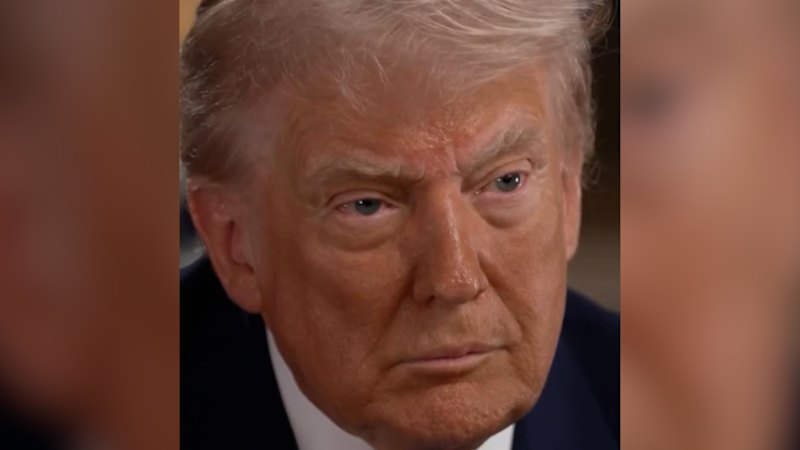
The air in the room didn’t just sit there; it pressed. Under the heavy, golden glow of the White House chandeliers, the silence between sentences felt like a physical weight. Lesley Stahl sat across from Donald Trump, her notes a thin shield against the sheer velocity of the man. This wasn’t a standard exchange of ideas or a civil debate on policy. It was a high-speed collision between two irreconcilable versions of reality.
When the cameras rolled for that 60 Minutes sit-down, the world didn’t just see an interview. It saw the breaking point of American discourse.
The tension started long before the first question was finished. You could see it in the set of the jaw, the way the President leaned forward, not to listen, but to intercept. To Stahl, the goal was accountability—the old-school journalistic belief that if you point at a fact long enough, the truth will emerge. To Trump, the interview was an ambush, a rigged game played by a "fake" referee.
"You’re horrible people," he told them.
He didn't whisper it. He didn't say it with a wink. It was a blunt-force trauma of a sentence. In that moment, the presidency wasn't a policy engine; it was a raw nerve.
The Invisible Wall of Perception
We often think of political interviews as a quest for information. We tune in to hear about healthcare, foreign trade, or the economy. But that is a polite fiction. In reality, these encounters are about the struggle for the narrative—the right to define what is real.
Imagine standing on a bridge. On one side, you have the traditional guardrails of institutional media. They rely on "the record," on previous statements, on non-partisan data. On the other side, you have a populist movement that views those very guardrails as the bars of a cage. When Trump lashed out at Stahl, he wasn't just attacking a reporter. He was attacking the idea that she had the right to frame his story.
The friction is where the heat comes from.
Stahl pressed on the nuances of healthcare. She asked about the timing of a plan that had been promised for years. In a traditional setting, a politician might pivot, offer a vague timeline, or deflect to a different success. Trump did something different. He challenged the premise. He challenged the person asking. He transformed the "dry facts" of policy into a personal battle of wills.
This is the "human element" that data points miss. It is the feeling of being gaslit—or the feeling of being finally defended—depending on which side of the television screen you inhabit. For a Trump supporter, that "horrible people" comment wasn't an insult; it was a shield. It was the President saying what they felt every time they turned on the evening news. For the critic, it was a terrifying breakdown of the respect due to the free press.
The Mechanics of the Meltdown
Rhythm is the heartbeat of a crisis. The interview moved in jagged pulses. Stahl would ask a question with a sharp, upward inflection. Trump would counter with a flat, declarative denial.
"Look at the way you're asking me," he said.
The focus shifted from the "what" to the "how." By focusing on the tone of the interview, the President effectively neutralized the content. It’s a brilliant, if exhausting, tactical maneuver. If you can convince the audience that the process is corrupt, the results of that process no longer matter.
Consider the hypothetical voter sitting in a diner in Scranton or a tech hub in Austin. They aren't looking at the footnotes of a healthcare bill. They are looking at the screen and seeing two people who cannot agree on what color the sky is. That disconnect creates a profound sense of vertigo. When the leader of the free world tells a veteran journalist that she is "horrible," the stakes aren't just about a single election. They are about whether or not we can still share a common language.
The interview didn't end with a handshake. It ended with a walkout.
Trump didn't just stop talking; he removed himself from the frame. It was a cinematic move, a rejection of the medium itself. He posted his own footage of the encounter before CBS could air their edited version. He wanted to own the light, the sound, and the sequence. He wanted to ensure that the "truth" wasn't something curated by a producer in New York, but something delivered raw from his own digital pulpit.
The Cost of the Shouting
There is a hollow ache that follows these kinds of spectacles. It’s the exhaustion of a culture that has replaced debate with theater.
We are no longer looking for "The Truth" with a capital T. We are looking for "Our Truth." The 60 Minutes incident was a perfect microcosm of this shift. Stahl represented the old world—the world of the three-network evening news, where Walter Cronkite told us "that's the way it is." Trump represented the new world—the world of the fractured feed, where "the way it is" depends entirely on who you follow.
The human cost is the loss of the middle ground.
When a President lashes out with such personal vitriol, it gives permission for everyone else to do the same. It turns the dinner table into a minefield. It turns the comment section into a war zone. We stop seeing the "other side" as people with different ideas and start seeing them as "horrible people."
That is the invisible stake. It’s not just about who wins the White House. It’s about what’s left of our ability to live next door to one another once the cameras are turned off.
The Blue Room is supposed to be a place of history, a place where the gravity of the office humbles the person holding it. But during those forty-five minutes, it was a pressure cooker. The steam had to go somewhere. It went into the microphones, into the living rooms of millions, and into the very fabric of the American psyche.
The Last Word That Wasn’t
Long after the lights were dimmed and the crew packed up their gear, the echoes of that confrontation remained.
Journalism is often called the "first rough draft of history." But in the modern era, there are two drafts being written simultaneously, in different languages, on different continents of the mind. Stahl’s draft will say the President was erratic and evasive. Trump’s draft will say he stood up to a biased elite that hates his voters.
Neither side is looking for a correction.
The real tragedy isn't that a President was rude to a reporter. The tragedy is that we have become a nation that watches a car crash and argues about who manufactured the asphalt instead of checking for a pulse. We are so busy cheering for our "driver" that we forget we are all in the same vehicle.
As the President walked away from the table, leaving Lesley Stahl with her unanswered questions and her silent microphone, he wasn't just leaving an interview. He was signaling the end of an era where a shared reality was even a possibility.
The door closed.
The screen went black.
And we were left in the dark, wondering if we would ever find our way back to a room where we could simply speak to one another without drawing blood.