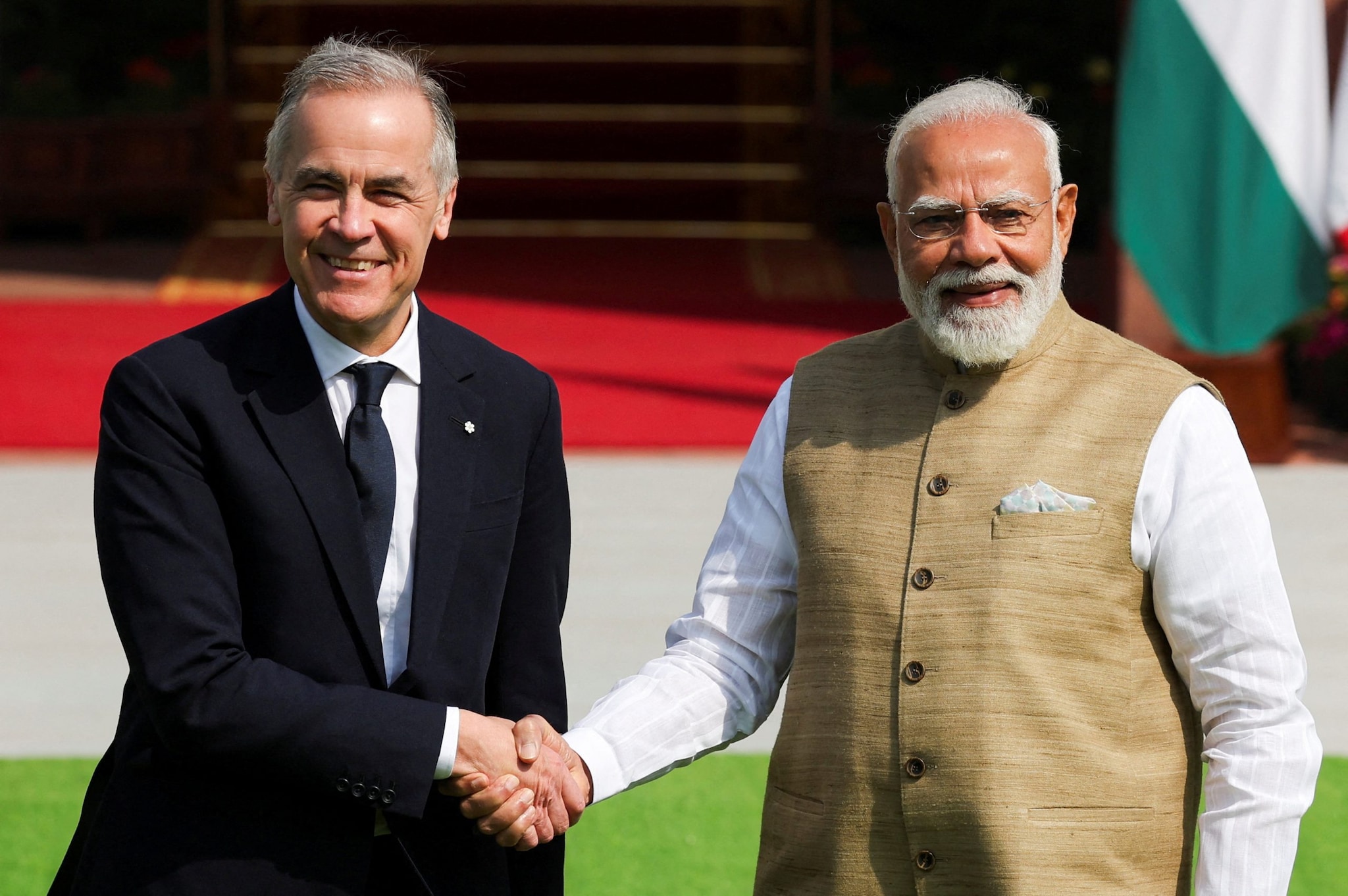
The proposed escalation of bilateral trade between India and Canada to $50 billion by 2030 represents a 400% increase from current baseline figures, a trajectory that requires more than incremental growth; it demands a fundamental restructuring of the existing supply chain architecture. Reaching this target is not a matter of diplomatic sentiment but a function of three specific economic variables: the synchronization of carbon-transition technologies, the liberalization of professional services mobility, and the resolution of non-tariff barriers in the agri-food sector.
The Asymmetric Trade Matrix
Current trade dynamics are defined by a complementary imbalance. Canada functions primarily as a high-latitude resource base—exporting potash, pulses, and energy—while India serves as a high-growth consumption engine and a hub for specialized ICT (Information and Communication Technology) services.
- Resource Security and Volatility: Canada provides approximately 30% of India’s potash requirements, a critical input for India’s food security.
- Service Export Dominance: Indian IT services and professional labor account for a significant portion of the "invisible" trade, which is often undercounted in standard customs valuations.
- Capital Flows: Canadian pension funds (CPPIB, CDPQ) have deployed over $60 billion into Indian infrastructure and renewable energy, creating a paradoxical situation where investment volume far outpaces direct trade volume.
The gap between current trade ($8-10 billion in goods) and the $50 billion target reveals that the "low-hanging fruit" has already been harvested. To bridge the remaining $40 billion, the trade relationship must shift from a commodity-exchange model to an integrated value-chain model.
The Pulse-Potash Pivot and Food Security
Agricultural trade is the most volatile component of the bilateral relationship, dictated by monsoon cycles in India and regulatory shifts in Canada. The path to $50 billion requires stabilizing this sector through long-term institutional contracts rather than spot-market transactions.
India’s dependence on Canadian yellow peas and lentils is structural. However, frequent shifts in Minimum Support Prices (MSP) and sudden import duty impositions create a high-risk environment for Canadian farmers. A stabilized trade framework would involve:
- Quantitative Predictability: Moving toward multi-year procurement quotas to de-risk Canadian planting cycles.
- Phytosanitary Standardization: Resolving the long-standing dispute over fumigation requirements. Canada’s cold climate naturally mitigates certain pests, but Indian regulations often demand methyl bromide treatment, which is being phased out globally. A mutual recognition agreement (MRA) on pest-control protocols would immediately reduce landed costs by 5-8%.
Energy Transition as a Trade Multiplier
The $50 billion target is mathematically impossible without a massive expansion in energy exports. Canada’s Liquefied Natural Gas (LNG) and uranium sectors are the only categories with the unit value high enough to shift the needle significantly.
- The Uranium Component: As India expands its nuclear fleet to meet net-zero commitments, the 2015 Civil Nuclear Cooperation Agreement must be scaled. Canadian uranium is a high-value, low-volume commodity that offers significant "trade density"—meaning it adds high dollar value to trade statistics with minimal logistics friction.
- Critical Minerals and the EV Supply Chain: India’s FAME-II scheme and Production Linked Incentive (PLI) programs for battery manufacturing require lithium, cobalt, and nickel. Canada’s Critical Minerals Strategy aligns with India’s manufacturing ambitions. Establishing a "mine-to-factory" corridor would bypass third-party processing hubs, capturing more value within the bilateral loop.
The EPTA Framework: A Necessary Intermediate Step
Negotiations for a Comprehensive Economic Partnership Agreement (CEPA) have been complex, leading to the pursuit of an Early Progress Trade Agreement (EPTA). This staged approach is a tactical necessity designed to build momentum while bypassing the most sensitive sectors like dairy in Canada or retail in India.
An effective EPTA must address the "Rules of Origin" (RoO) bottleneck. If the RoO are too stringent, the administrative cost of compliance exceeds the tariff savings, rendering the agreement moot. Conversely, if they are too lax, Canada becomes a "backdoor" for third-party goods into the North American market, or vice versa for India in South Asia.
Mobility and the Service-Led Growth Engine
The most significant friction point in the bilateral relationship is the movement of natural persons (GATS Mode 4). India’s primary export interest is the ease of visas for its professionals.
The economic logic is clear: Indian talent drives the Canadian tech ecosystem, which in turn exports services globally. However, the lack of professional qualification recognition remains a structural barrier. An engineer or architect licensed in Delhi often finds their credentials unrecognized in Ontario. Solving this through Mutual Recognition Agreements (MRAs) would unlock a "Services Multiplier."
When a Canadian firm hires an Indian service provider, it often leads to secondary trade in hardware, software licenses, and maintenance contracts. This "pull-through" effect is a critical, albeit often ignored, component of the $50 billion roadmap.
Constraints and Systemic Risks
The path to $50 billion is hindered by two primary risks: geopolitical volatility and infrastructure deficits.
- Geopolitical Friction: Diplomatic tensions can lead to "non-tariff harassment," where customs inspections become more frequent or visa processing slows down. Trade targets are rarely achieved in an environment of political unpredictability.
- Logistics Costs: The maritime distance between Mumbai and Vancouver is significant. High freight rates can erase the competitive advantage of Canadian commodities. Without investment in "Port-to-Port" efficiency and direct shipping lanes, the cost function remains unfavorable compared to India's trade with closer partners in the Middle East or ASEAN.
Quantification of the $40 Billion Gap
To reach the $50 billion threshold, the growth must be distributed across these specific tranches:
- Traditional Commodities (Pulses, Potash): Expansion from $3B to $7B through volume increases and price stabilization.
- Energy (LNG, Uranium, Coal): Expansion from $2B to $15B, contingent on Canadian export terminal completion.
- High-Tech and Aerospace: Expansion from $1B to $8B, leveraging Canada’s aerospace cluster (Bombardier, CAE) and India’s aviation boom.
- Critical Minerals and Industrial Inputs: Expansion to $10B as India’s EV and semiconductor sectors mature.
- Consumer Goods and Specialized Manufacturing: The remaining $10B through diversified SME trade.
Strategic Execution Path
The immediate priority for stakeholders is the decoupling of trade policy from short-term diplomatic cycles. Corporations must lead the integration by establishing Joint Ventures (JVs) that create "vested interests" on both sides.
Specifically, Canadian firms should look toward the PLI (Production Linked Incentive) schemes in India to set up manufacturing bases that serve the broader Indo-Pacific region, while Indian firms should utilize Canada as a strategic entry point for the US market under the USMCA framework. This "Triangular Trade Strategy" leverages Canada’s unique trade access to North America as a value-add for Indian exporters.
The $50 billion target will not be met by selling more of the same; it will be met by changing how the two nations trade. Transitioning from a buyer-seller relationship to a co-investment and co-production model is the only viable mechanism for achieving the 2030 objective.